







Question: NEED SOLUTIONS TO PART A AND PART C. Installment options are such that the option premium is paid in installments and at each installment date
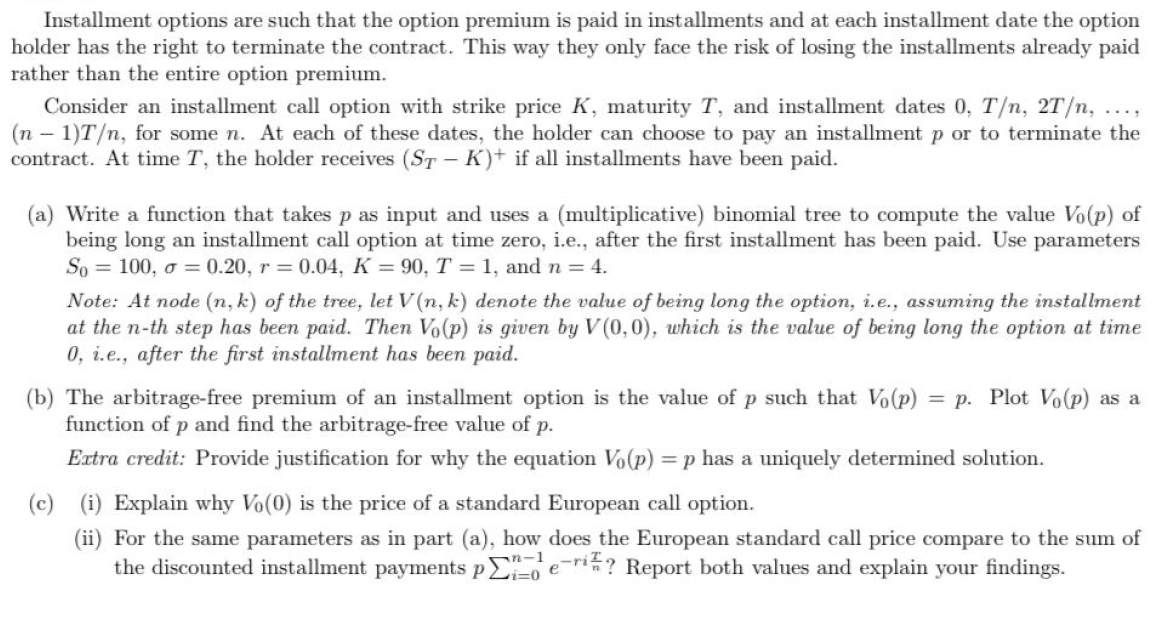 NEED SOLUTIONS TO PART A AND PART C.
Installment options are such that the option premium is paid in installments and at each installment date the option holder has the right to terminate the contract. This way they only face the risk of losing the installments already paid rather than the entire option premium. Consider an installment call option with strike price K, maturity T, and installment dates 0,T,2T,, (n1)T, for some n. At each of these dates, the holder can choose to pay an installment p or to terminate the contract. At time T, the holder receives (STK)+if all installments have been paid. (a) Write a function that takes p as input and uses a (multiplicative) binomial tree to compute the value V0(p) of being long an installment call option at time zero, i.e., after the first installment has been paid. Use parameters S0=100,=0.20,r=0.04,K=90,T=1, and n=4. Note: At node (n,k) of the tree, let V(n,k) denote the value of being long the option, i.e., assuming the installment at the n-th step has been paid. Then V0(p) is given by V(0,0), which is the value of being long the option at time 0, i.e., after the first installment has been paid. (b) The arbitrage-free premium of an installment option is the value of p such that V0(p)=p. Plot V0(p) as a function of p and find the arbitrage-free value of p. Extra credit: Provide justification for why the equation V0(p)=p has a uniquely determined solution. (c) (i) Explain why V0(0) is the price of a standard European call option. (ii) For the same parameters as in part (a), how does the European standard call price compare to the sum of the discounted installment payments pi=0n1erinT ? Report both values and explain your findings. Installment options are such that the option premium is paid in installments and at each installment date the option holder has the right to terminate the contract. This way they only face the risk of losing the installments already paid rather than the entire option premium. Consider an installment call option with strike price K, maturity T, and installment dates 0,T,2T,, (n1)T, for some n. At each of these dates, the holder can choose to pay an installment p or to terminate the contract. At time T, the holder receives (STK)+if all installments have been paid. (a) Write a function that takes p as input and uses a (multiplicative) binomial tree to compute the value V0(p) of being long an installment call option at time zero, i.e., after the first installment has been paid. Use parameters S0=100,=0.20,r=0.04,K=90,T=1, and n=4. Note: At node (n,k) of the tree, let V(n,k) denote the value of being long the option, i.e., assuming the installment at the n-th step has been paid. Then V0(p) is given by V(0,0), which is the value of being long the option at time 0, i.e., after the first installment has been paid. (b) The arbitrage-free premium of an installment option is the value of p such that V0(p)=p. Plot V0(p) as a function of p and find the arbitrage-free value of p. Extra credit: Provide justification for why the equation V0(p)=p has a uniquely determined solution. (c) (i) Explain why V0(0) is the price of a standard European call option. (ii) For the same parameters as in part (a), how does the European standard call price compare to the sum of the discounted installment payments pi=0n1erinT ? Report both values and explain your findings
Step by Step Solution
There are 3 Steps involved in it

Get step-by-step solutions from verified subject matter experts
 Study Help