







Question: need solutions with work shown asap please, thanks Suppose that initially the economy is in equilibrium (at potential) and the trade balance is zero. a)
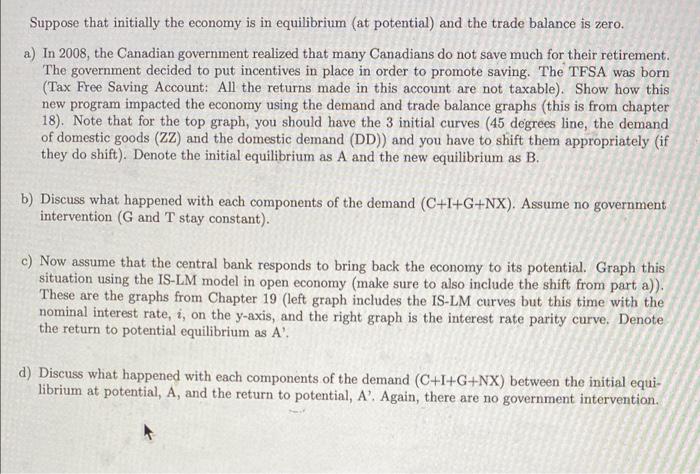
Suppose that initially the economy is in equilibrium (at potential) and the trade balance is zero. a) In 2008, the Canadian government realized that many Canadians do not save much for their retirement. The government decided to put incentives in place in order to promote saving. The TFSA was born (Tax Free Saving Account: All the returns made in this account are not taxable). Show how this new program impacted the economy using the demand and trade balance graphs (this is from chapter 18). Note that for the top graph, you should have the 3 initial curves (45 degrees line, the demand of domestic goods (ZZ) and the domestic demand (DD)) and you have to shift them appropriately (if they do shift). Denote the initial equilibrium as A and the new equilibrium as B. b) Discuss what happened with each components of the demand (C+I+G+NX). Assume no government intervention (G and T stay constant). c) Now assume that the central bank responds to bring back the economy to its potential. Graph this situation using the IS-LM model in open economy (make sure to also include the shift from part a)). These are the graphs from Chapter 19 (left graph includes the IS-LM curves but this time with the nominal interest rate, i, on the y-axis, and the right graph is the interest rate parity curve. Denote the return to potential equilibrium as A'. d) Discuss what happened with each components of the demand (C+I+G+NX) between the initial equi- librium at potential, A, and the return to potential, A'. Again, there are no government intervention. Suppose that initially the economy is in equilibrium (at potential) and the trade balance is zero. a) In 2008, the Canadian government realized that many Canadians do not save much for their retirement. The government decided to put incentives in place in order to promote saving. The TFSA was born (Tax Free Saving Account: All the returns made in this account are not taxable). Show how this new program impacted the economy using the demand and trade balance graphs (this is from chapter 18). Note that for the top graph, you should have the 3 initial curves (45 degrees line, the demand of domestic goods (ZZ) and the domestic demand (DD)) and you have to shift them appropriately (if they do shift). Denote the initial equilibrium as A and the new equilibrium as B. b) Discuss what happened with each components of the demand (C+I+G+NX). Assume no government intervention (G and T stay constant). c) Now assume that the central bank responds to bring back the economy to its potential. Graph this situation using the IS-LM model in open economy (make sure to also include the shift from part a)). These are the graphs from Chapter 19 (left graph includes the IS-LM curves but this time with the nominal interest rate, i, on the y-axis, and the right graph is the interest rate parity curve. Denote the return to potential equilibrium as A'. d) Discuss what happened with each components of the demand (C+I+G+NX) between the initial equi- librium at potential, A, and the return to potential, A'. Again, there are no government intervention
Step by Step Solution
There are 3 Steps involved in it

Get step-by-step solutions from verified subject matter experts
 Study Help