Question: need some help about how to go about doing this 11 B IV A - A. 3b. Design the Database (E-R Diagram): John took an
need some help about how to go about doing this
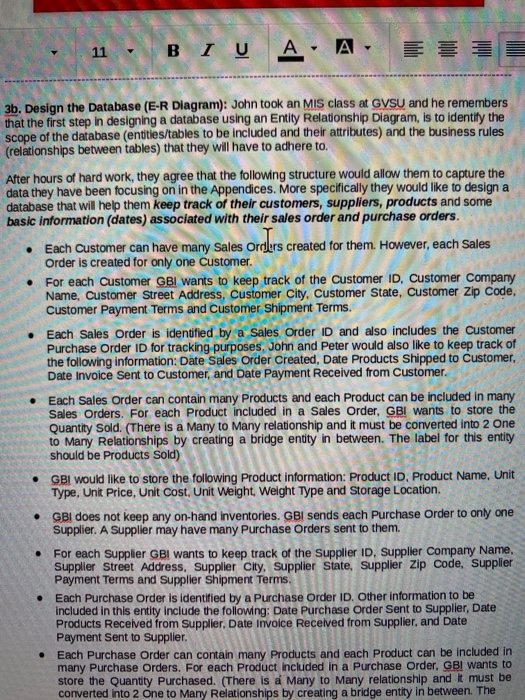
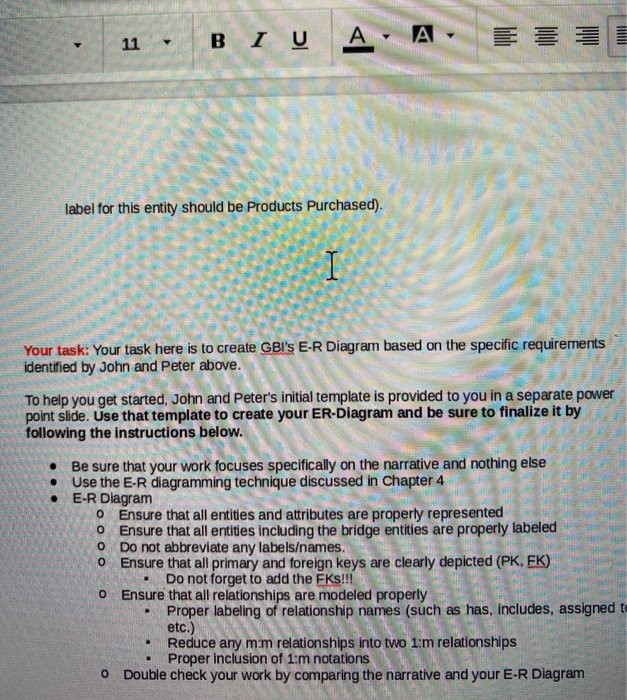
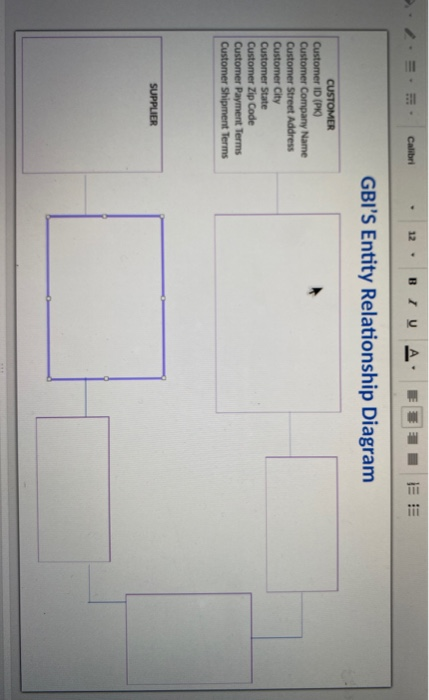
11 B IV A - A. 3b. Design the Database (E-R Diagram): John took an MIS class at GVSU and he remembers that the first step in designing a database using an Entity Relationship Diagram, is to identify the scope of the database (entitles/tables to be included and their attributes) and the business rules (relationships between tables) that they will have to adhere to. After hours of hard work, they agree that the following structure would allow them to capture the data they have been focusing on in the Appendices. More specifically they would like to design a database that will help them keep track of their customers, suppliers, products and some basic information (dates) associated with their sales order and purchase orders. Each Customer can have many Sales Orders created for them. However, each Sales Order is created for only one Customer. For each customer GBI wants to keep track of the Customer ID, Customer Company Name, Customer Street Address, Customer City, Customer State, Customer Zip Code, Customer Payment Terms and Customer Shipment Terms. Each Sales Order is identified by a Sales Order ID and also includes the Customer Purchase Order ID for tracking purposes, John and Peter would also like to keep track of the following information: Date Sales Order Created, Date Products Shipped to Customer, Date Invoice Sent to Customer, and Date Payment Received from Customer. Each Sales Order can contain many Products and each Product can be included in many Sales Orders. For each Product included in a Sales Order, GBI wants to store the Quantity Sold. (There is a Many to Many relationship and it must be converted into 2 One to Many Relationships by creating a bridge entity in between. The label for this entity should be Products Sold) GBI would like to store the following Product information: Product ID, Product Name, Unit Type, Unit Price, Unit Cost, Unit Weight Weight Type and Storage Location. GBI does not keep any on-hand inventories. GBI sends each Purchase order to only one Supplier. A Supplier may have many Purchase Orders sent to them. For each Supplier GBI wants to keep track of the Supplier ID, Supplier Company Name, Supplier Street Address, Supplier City, Supplier State, Supplier Zip Code, Supplier Payment Terms and Supplier Shipment Terms. Each Purchase Order is identified by a Purchase Order ID. Other information to be included in this entity include the following: Date Purchase Order Sent to Supplier, Date Products Received from Supplier, Date Invoice Received from Supplier, and Date Payment Sent to Supplier. Each Purchase Order can contain many Products and each Product can be included in many Purchase Orders. For each Product included in a Purchase Order, GBI wants to store the Quantity Purchased. (There is a Many to Many relationship and it must be converted into 2 One to Many Relationships by creating a bridge entity in between. The . M 11 BI U A label for this entity should be Products Purchased). I Your task: Your task here is to create GBI's E-R Diagram based on the specific requirements identified by John and Peter above. To help you get started, John and Peter's initial template is provided to you in a separate power point slide. Use that template to create your ER-Diagram and be sure to finalize it by following the instructions below. Be sure that your work focuses specifically on the narrative and nothing else Use the E-R diagramming technique discussed in Chapter 4 E-R Diagram o Ensure that all entities and attributes are property represented Ensure that all entities including the bridge entities are properly labeled Do not abbreviate any labelsames. Ensure that all primary and foreign keys are clearly depicted (PK, EK) Do not forget to add the FKs!!! Ensure that all relationships are modeled properly Proper labeling of relationship names (such as has, includes, assigned to etc.) Reduce any mim relationships into two 1:m relations hips Proper inclusion of 1:m notations o Double check your work by comparing the narrative and your E-R Diagram o o O . TI 311 Calibri 12 B I U . GBI'S Entity Relationship Diagram CUSTOMER Customer ID (PK) Customer Company Name Customer Street Address Customer City Customer State Customer Zip Code Customer Payment Terms Customer Shipment Terms SUPPLIER









 Study Help