







Question: Need some help on this assignment, I've got code written for most of it but the answers im getting do not seem right. Population Number
Need some help on this assignment, I've got code written for most of it but the answers im getting do not seem right.
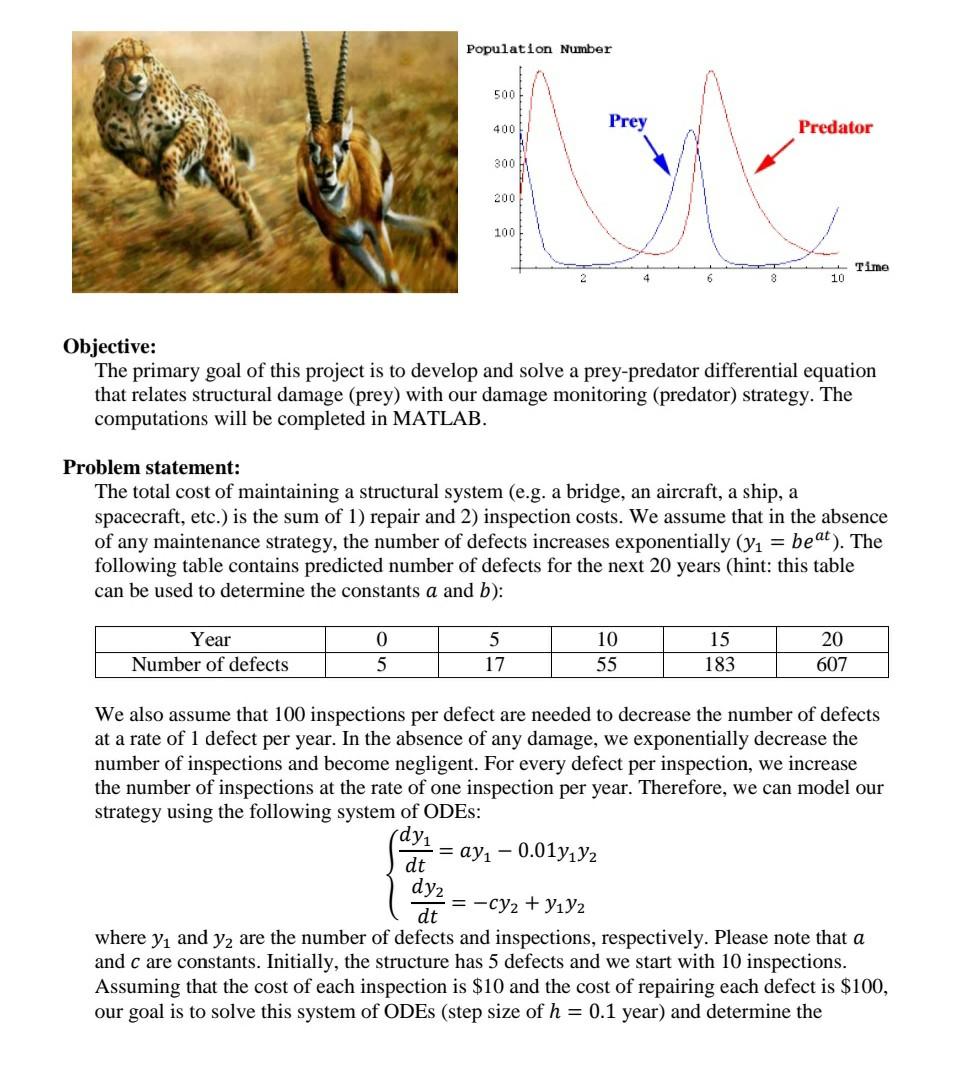
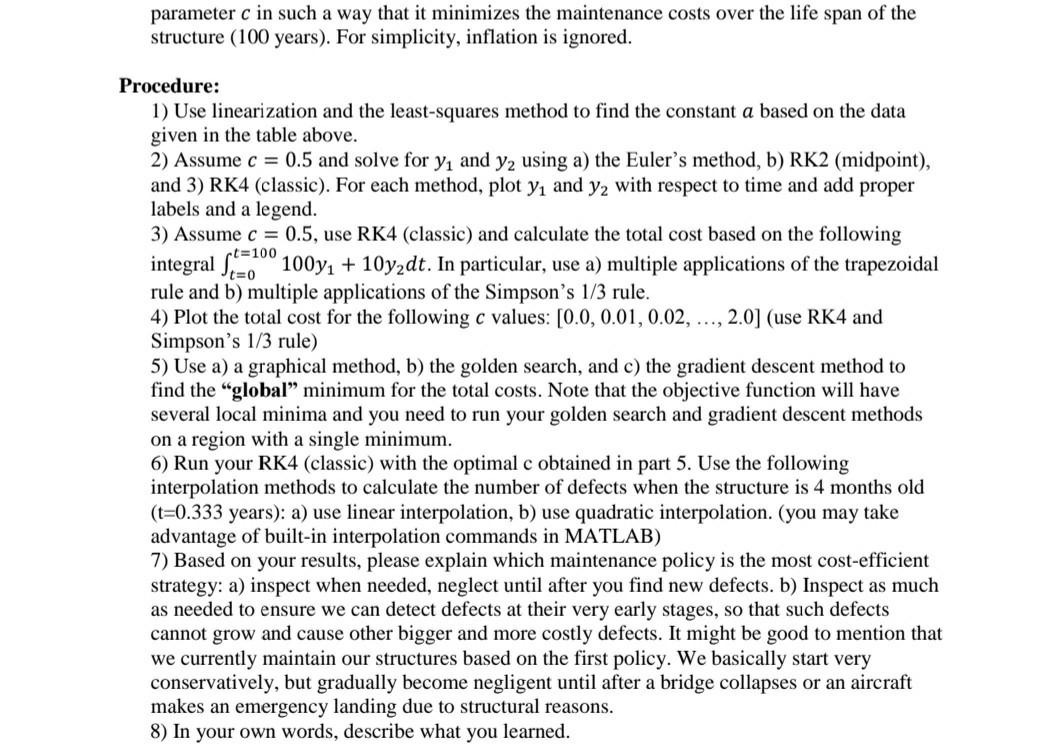
Population Number 500! 400 Prey Predator 300 200 100 Time 10 Objective: The primary goal of this project is to develop and solve a prey-predator differential equation that relates structural damage (prey) with our damage monitoring (predator) strategy. The computations will be completed in MATLAB. Problem statement: The total cost of maintaining a structural system (e.g. a bridge, an aircraft, a ship, a spacecraft, etc.) is the sum of 1) repair and 2) inspection costs. We assume that in the absence of any maintenance strategy, the number of defects increases exponentially (y1 = beat). The following table contains predicted number of defects for the next 20 years (hint: this table can be used to determine the constants a and b): 0 Year Number of defects 5 17 10 55 15 183 20 607 5 We also assume that 100 inspections per defect are needed to decrease the number of defects at a rate of 1 defect per year. In the absence of any damage, we exponentially decrease the number of inspections and become negligent. For every defect per inspection, we increase the number of inspections at the rate of one inspection per year. Therefore, we can model our strategy using the following system of ODES: dy = ay -0.01y1y2 dt dy2 = -cy2 + 91Y2 dt where y and y2 are the number of defects and inspections, respectively. Please note that a and c are constants. Initially, the structure has 5 defects and we start with 10 inspections. Assuming that the cost of each inspection is $10 and the cost of repairing each defect is $100, our goal is to solve this system of ODEs (step size of h = 0.1 year) and determine the parameter c in such a way that it minimizes the maintenance costs over the life span of the structure (100 years). For simplicity, inflation is ignored. Procedure: 1) Use linearization and the least-squares method to find the constant a based on the data given in the table above. 2) Assume c = 0.5 and solve for y, and y2 using a) the Euler's method, b) RK2 (midpoint), and 3) RK4 (classic). For each method, plot y, and y2 with respect to time and add proper labels and a legend. 3) Assume c = 0.5, use RK4 (classic) and calculate the total cost based on the following integral Se-20 100y + 10yzdt. In particular, use a) multiple applications of the trapezoidal rule and b) multiple applications of the Simpson's 1/3 rule. 4) Plot the total cost for the following c values: (0.0, 0.01, 0.02, ..., 2.0) (use RK4 and Simpson's 1/3 rule) 5) Use a) a graphical method, b) the golden search, and c) the gradient descent method to find the "global minimum for the total costs. Note that the objective function will have several local minima and you need to run your golden search and gradient descent methods on a region with a single minimum. 6) Run your RK4 (classic) the optimal c obtained in part 5. Use the following interpolation methods to calculate the number of defects when the structure is 4 months old (t=0.333 years): a) use linear interpolation, b) use quadratic interpolation. (you may take advantage of built-in interpolation commands in MATLAB) 7) Based on your results, please explain which maintenance policy is the most cost-efficient strategy: a) inspect when needed, neglect until after you find new defects. b) Inspect as much as needed to ensure we can detect defects at their very early stages, so that such defects cannot grow and cause other bigger and more costly defects. It might be good to mention that we currently maintain our structures based on the first policy. We basically start very conservatively, but gradually become negligent until after a bridge collapses or an aircraft makes an emergency landing due to structural reasons. 8) In your own words, describe what you learned. Population Number 500! 400 Prey Predator 300 200 100 Time 10 Objective: The primary goal of this project is to develop and solve a prey-predator differential equation that relates structural damage (prey) with our damage monitoring (predator) strategy. The computations will be completed in MATLAB. Problem statement: The total cost of maintaining a structural system (e.g. a bridge, an aircraft, a ship, a spacecraft, etc.) is the sum of 1) repair and 2) inspection costs. We assume that in the absence of any maintenance strategy, the number of defects increases exponentially (y1 = beat). The following table contains predicted number of defects for the next 20 years (hint: this table can be used to determine the constants a and b): 0 Year Number of defects 5 17 10 55 15 183 20 607 5 We also assume that 100 inspections per defect are needed to decrease the number of defects at a rate of 1 defect per year. In the absence of any damage, we exponentially decrease the number of inspections and become negligent. For every defect per inspection, we increase the number of inspections at the rate of one inspection per year. Therefore, we can model our strategy using the following system of ODES: dy = ay -0.01y1y2 dt dy2 = -cy2 + 91Y2 dt where y and y2 are the number of defects and inspections, respectively. Please note that a and c are constants. Initially, the structure has 5 defects and we start with 10 inspections. Assuming that the cost of each inspection is $10 and the cost of repairing each defect is $100, our goal is to solve this system of ODEs (step size of h = 0.1 year) and determine the parameter c in such a way that it minimizes the maintenance costs over the life span of the structure (100 years). For simplicity, inflation is ignored. Procedure: 1) Use linearization and the least-squares method to find the constant a based on the data given in the table above. 2) Assume c = 0.5 and solve for y, and y2 using a) the Euler's method, b) RK2 (midpoint), and 3) RK4 (classic). For each method, plot y, and y2 with respect to time and add proper labels and a legend. 3) Assume c = 0.5, use RK4 (classic) and calculate the total cost based on the following integral Se-20 100y + 10yzdt. In particular, use a) multiple applications of the trapezoidal rule and b) multiple applications of the Simpson's 1/3 rule. 4) Plot the total cost for the following c values: (0.0, 0.01, 0.02, ..., 2.0) (use RK4 and Simpson's 1/3 rule) 5) Use a) a graphical method, b) the golden search, and c) the gradient descent method to find the "global minimum for the total costs. Note that the objective function will have several local minima and you need to run your golden search and gradient descent methods on a region with a single minimum. 6) Run your RK4 (classic) the optimal c obtained in part 5. Use the following interpolation methods to calculate the number of defects when the structure is 4 months old (t=0.333 years): a) use linear interpolation, b) use quadratic interpolation. (you may take advantage of built-in interpolation commands in MATLAB) 7) Based on your results, please explain which maintenance policy is the most cost-efficient strategy: a) inspect when needed, neglect until after you find new defects. b) Inspect as much as needed to ensure we can detect defects at their very early stages, so that such defects cannot grow and cause other bigger and more costly defects. It might be good to mention that we currently maintain our structures based on the first policy. We basically start very conservatively, but gradually become negligent until after a bridge collapses or an aircraft makes an emergency landing due to structural reasons. 8) In your own words, describe what you learned
Step by Step Solution
There are 3 Steps involved in it

Get step-by-step solutions from verified subject matter experts
 Study Help