







Question: Need the solution for question 3 to prepare for exam, figured out question 2! Thank you:) 2. (15 points) We have a single processor, and
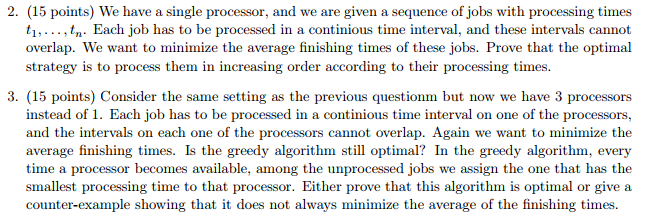
Need the solution for question 3 to prepare for exam, figured out question 2! Thank you:)
2. (15 points) We have a single processor, and we are given a sequence of jobs with processing times t1,... ,tn Each job has to be processed in a continious time interval, and these intervals cannot overlap. We want to minimize the average finishing times of these jobs. Prove that the optimal strategy is to process them in increasing order according to their processing times. 3. (15 points) Consider the same setting as the previous questionm but now we have 3 processors instead of 1. Each job has to be processed in a continious time interval on one of the processors and the intervals on each one of the processors cannot overlap. Again we want to minimize the average finishing times. Is the greedy algorithm still optimal? In the greedy algorithm, every time a processor becomes available, among the unprocessed jobs we assign the one that has the smallest processing time to that processor. Either prove that this algorithm is optimal or give a counter-example showing that it does not always minimize the average of the finishing times
Step by Step Solution
There are 3 Steps involved in it

Get step-by-step solutions from verified subject matter experts
 Study Help