







Question: need this ABCD all the details are needed 37. Two authors published a study in 1992 of the effect of minimum wages on teenage employment
need this ABCD all the details are needed
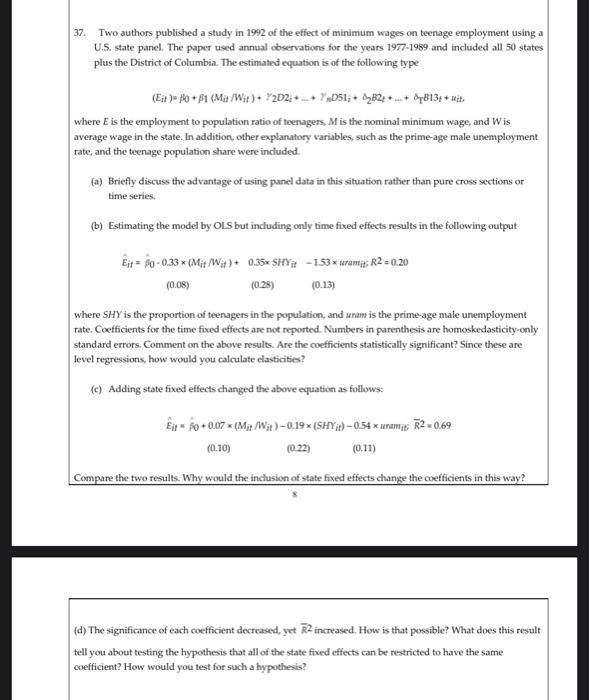
37. Two authors published a study in 1992 of the effect of minimum wages on teenage employment using a U.S. state panel. The paper used annual observations for the years 1977-1989 and included all 50 states plus the District of Columbia. The estimated equation is of the following type (Eit )- 50 + 1 (Mit/Wit)+ 72D2; + - + 7,D51; + 8%B2+ + ... + 58134 + uit where E is the employment to population ratio of teenagers, Mis the nominal minimum wage, and Wis average wage in the state. In addition, other explanatory variables, such as the prime-age male unemployment rate, and the teenage population share were included. (a) Briefly discuss the advantage of using panel data in this situation rather than pure cross sections or time series. (b) Estimating the model by OLS but including only time fixed effects results in the following output Eit = $o- 0.33 * (Mit/Wit)+ 0.354 SHY:t - 1.53 x uramie: R2 = 0.20 (0.08) (0:28) (0.13) where SHY is the proportion of teenagers in the population, and uram is the prime age male unemployment rate. Coefficients for the time fixed effects are not reported. Numbers in parenthesis are homoskedasticity-only standard errors. Comment on the above results. Are the coefficients statistically significant? Since these are level regressions, how would you calculate elasticities? (c) Adding state fixed effects changed the above equation as follows: it = $o +0.07% (Mit /Wit ) - 0.19 x (SHY?!) - 0.54 x uramie: R2 -0.69 (0.10) (0:22) (0.11) Compare the two results. Why would the inclusion of state fixed effects change the coefficients in this way? (a) The significance of each coefficient decreased, yet R2 increased. How is that possible? What does this result tell you about testing the hypothesis that all of the state fixed effects can be restricted to have the same coefficient? How would you test for such a such a hypothesis? 37. Two authors published a study in 1992 of the effect of minimum wages on teenage employment using a U.S. state panel. The paper used annual observations for the years 1977-1989 and included all 50 states plus the District of Columbia. The estimated equation is of the following type (Eit )- 50 + 1 (Mit/Wit)+ 72D2; + - + 7,D51; + 8%B2+ + ... + 58134 + uit where E is the employment to population ratio of teenagers, Mis the nominal minimum wage, and Wis average wage in the state. In addition, other explanatory variables, such as the prime-age male unemployment rate, and the teenage population share were included. (a) Briefly discuss the advantage of using panel data in this situation rather than pure cross sections or time series. (b) Estimating the model by OLS but including only time fixed effects results in the following output Eit = $o- 0.33 * (Mit/Wit)+ 0.354 SHY:t - 1.53 x uramie: R2 = 0.20 (0.08) (0:28) (0.13) where SHY is the proportion of teenagers in the population, and uram is the prime age male unemployment rate. Coefficients for the time fixed effects are not reported. Numbers in parenthesis are homoskedasticity-only standard errors. Comment on the above results. Are the coefficients statistically significant? Since these are level regressions, how would you calculate elasticities? (c) Adding state fixed effects changed the above equation as follows: it = $o +0.07% (Mit /Wit ) - 0.19 x (SHY?!) - 0.54 x uramie: R2 -0.69 (0.10) (0:22) (0.11) Compare the two results. Why would the inclusion of state fixed effects change the coefficients in this way? (a) The significance of each coefficient decreased, yet R2 increased. How is that possible? What does this result tell you about testing the hypothesis that all of the state fixed effects can be restricted to have the same coefficient? How would you test for such a such a hypothesis
Step by Step Solution
There are 3 Steps involved in it
1 Expert Approved Answer
Step: 1 Unlock

Question Has Been Solved by an Expert!
Get step-by-step solutions from verified subject matter experts
Step: 2 Unlock
Step: 3 Unlock
 Study Help