







Question: Need this in C++ program please Introduction: Sorting routines are among the most widely used and studied algorithms. Every student should know how to implement
Need this in C++ program please
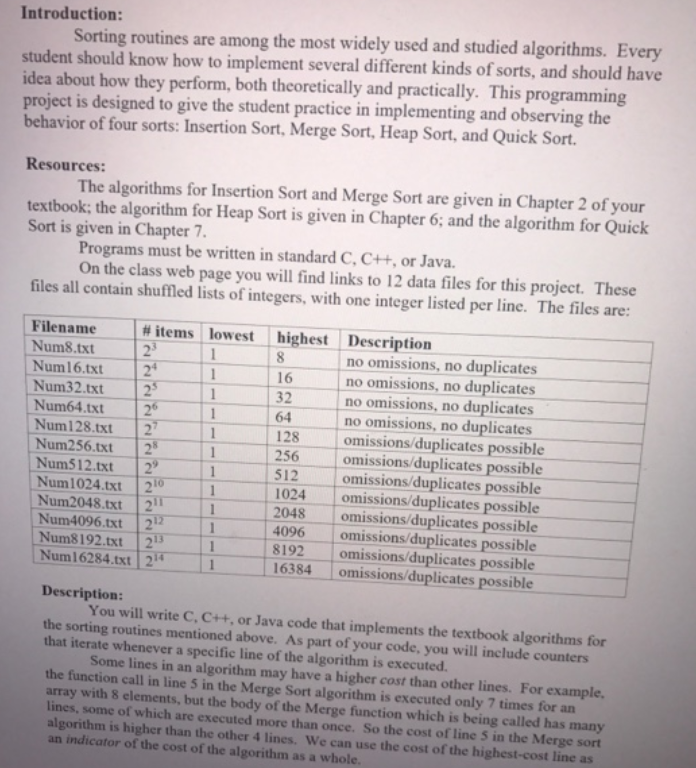
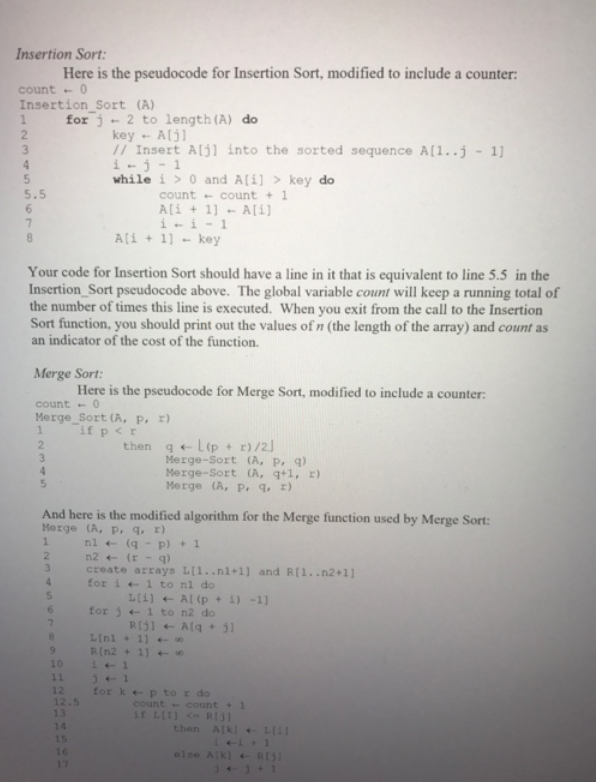
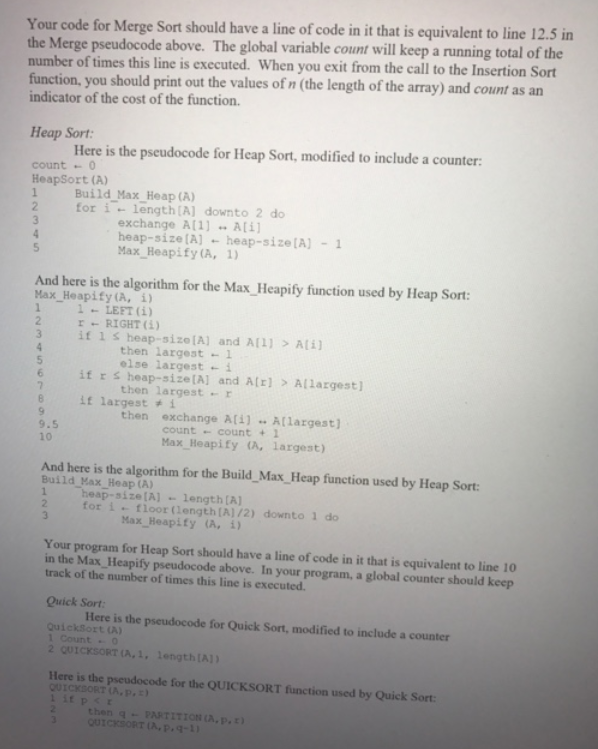
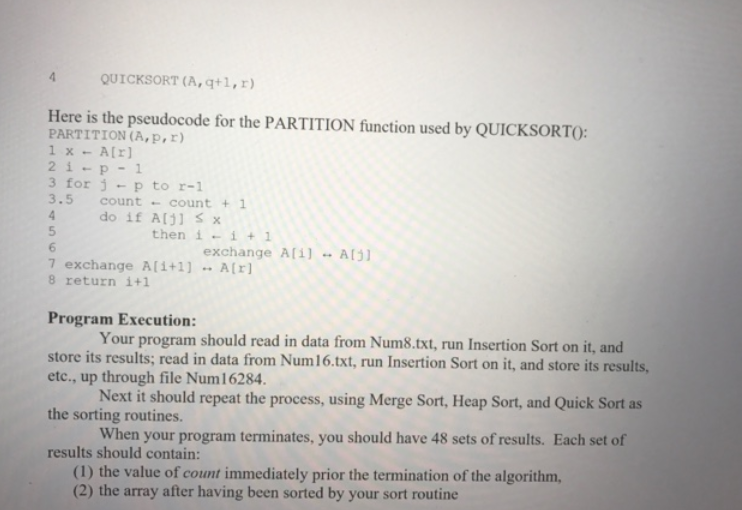
Introduction: Sorting routines are among the most widely used and studied algorithms. Every student should know how to implement several different kinds of sorts, and should have idea about how they perform, both theoretically and practically. This programming project is designed to give the student practice in implementing and observing the behavior of four sorts: Insertion Sort, Merge Sort, Heap Sort, and Quick Sort. Resources: The algorithms for Insertion Sort and Merge Sort are given in Chapter 2 of your textbook; the algorithm for Heap Sort is given in Chapter 6; and the algorithm for Quick Sort is given in Chapter 7. Programs must be written in standard C, C++, or Java. On the class web page you will find links to 12 data files for this project. These files all contain shuffled lists of integers, with one integer listed per line. The files are: Filename #items lowest highest Description Num8.txt 23 1 8 no omissions, no duplicates Num16.txt 24 1 16 no omissions, no duplicates Num32.txt 23 1 32 no omissions, no duplicates Num64.txt 2 1 64 no omissions, no duplicates Num 128.txt 27 1 128 omissions/duplicates possible Num256.txt 28 1 256 omissions/duplicates possible Num512.txt 29 1 512 omissions/duplicates possible Num 1024.txt 1 1024 omissions/duplicates possible Num2048.txt 1 2048 omissions/duplicates possible Num4096.txt 4096 omissions/duplicates possible Num8192.txt 213 1 8192 omissions/duplicates possible Num16284.txt 214 16384 omissions/duplicates possible Description: You will write C, C++, or Java code that implements the textbook algorithms for the sorting routines mentioned above. As part of your code, you will include counters that iterate whenever a specific line of the algorithm is executed. Some lines in an algorithm may have a higher cost than other lines. For example, the function call in line 5 in the Merge Sort algorithm is executed only 7 times for an array with 8 elements, but the body of the Merge function which is being called has many lines, some of which are executed more than once. So the cost of line 5 in the Merge sort algorithm is higher than the other 4 lines. We can use the cost of the highest-cost line as an indicator of the cost of the algorithm as a whole. 210 211 212 Insertion Sort: Here is the pseudocode for Insertion Sort, modified to include a counter: count - 0 Insertion_Sort (A) 1 for j - 2 to length(A) do 2 key - Alil 3 // Insert All into the sorted sequence A[1.. j - 1] 4 i-j-1 5 while i > 0 and A[i] > key do 5.5 count count - 1 6 A[i+1] - A[i] 2 i-i-1 Ali + 1] - key 8 Your code for Insertion Sort should have a line in it that is equivalent to line 5.5 in the Insertion_Sort pseudocode above. The global variable count will keep a running total of the number of times this line is executed. When you exit from the call to the Insertion Sort function, you should print out the values of n (the length of the array) and count as an indicator of the cost of the function. Merge Sort: Here is the pseudocode for Merge Sort, modified to include a counter: count - 0 Merge_Sort (A, P. r) itpar L(P + 2)/2] Merge-Sort (A, P, 9) Merge-Sort (A, 9+1, r) Merge (A, p, q, r) then 1 2 3 4 5 And here is the modified algorithm for the Merge function used by Merge Sort: Merge (A, P. 9. r) 1 nl (9 - p) + 1 2 n2 - 9 3 create arrays L[1..n1+1) and R[1..n2+1] 4 for i 1 to nl do 5 L11 Alp + 1) -1) 6 for 1 to n2 do 7 R01 AG - 31 Lint - 11 - Rin2 + 11 10 11 12 for keto I do 12.5 count-count 13 then AKLI Aikl B1 Your code for Merge Sort should have a line of code in it that is equivalent to line 12.5 in the Merge pseudocode above. The global variable count will keep a running total of the number of times this line is executed. When you exit from the call to the Insertion Sort function, you should print out the values of n (the length of the array) and count as an indicator of the cost of the function. Heap Sort: Here is the pseudocode for Heap Sort, modified to include a counter: count - 0 HeapSort (A) Build_Max_Heap (A) for i - length(A) downto 2 do exchange A[1] -- A[i] heap-size(A) heap-size(A) - 1 Max_Heapify (A, 1) 1 2 3 5 And here is the algorithm for the Max_Heapify function used by Heap Sort: Max_Heapify (A, i) 1 1- LEFT (i) 2 - RIGHT (1) 3 if is heap-size[A] and All > A[i] 4 then largest olse largest 6 it r s heap-size[A] and All > Al largest) 17 then largest - B it largest i then exchange A[i] - Allargest) 9.5 count count + 1 10 Max_leapify (a, largest) 5 9 And here is the algorithm for the Build_Max_Heap function used by Heap Sort: Build Max_Heap (A) 1 heap-sizeIA) - length(A) 2 for i-floor length [A]/2) downto 1 do 3 Max_Heapity (A, 1) Your program for Heap Sort should have a line of code in it that is equivalent to line 10 in the Max_Heapify pseudocode above. In your program, a global counter should keep track of the number of times this line is executed. Quick Sort: Here is the pseudocode for Quick Sort, modified to include a counter Quicksort 2 QUICKSORT (A, 1. length Here is the pseudocode for the QUICKSORT function used by Quick Sort: QUICKBORT.P.) I itp then 4 - PARTITION (.p.) QUICKORTI. P.4-11 QUICKSORT (A, 9+1,r) Here is the pseudocode for the PARTITION function used by QUICKSORT(): PARTITION (A,P,r) 1 X - A[r] 2 i- p - 1 3 for j - p to r-1 3.5 - count + 1 4 do if Al 3x then ii + 1 6 exchange A[i] A[ 7 exchange A[i+1] - A[r] 8 return i+1 count 5 Program Execution: Your program should read in data from Num8.txt, run Insertion Sort on it, and store its results; read in data from Num 16.txt, run Insertion Sort on it, and store its results, etc., up through file Num16284. Next it should repeat the process, using Merge Sort, Heap Sort, and Quick Sort as the sorting routines. When your program terminates, you should have 48 sets of results. Each set of results should contain: (1) the value of count immediately prior the termination of the algorithm, (2) the array after having been sorted by your sort routine
Step by Step Solution
There are 3 Steps involved in it

Get step-by-step solutions from verified subject matter experts
 Study Help