







Question: Need to use Coq functional programming language to solve below question: (g) Define the multiplication function mult: Nat -> Nat -> Nat. (3 points) (h)
Need to use Coq functional programming language to solve below question:
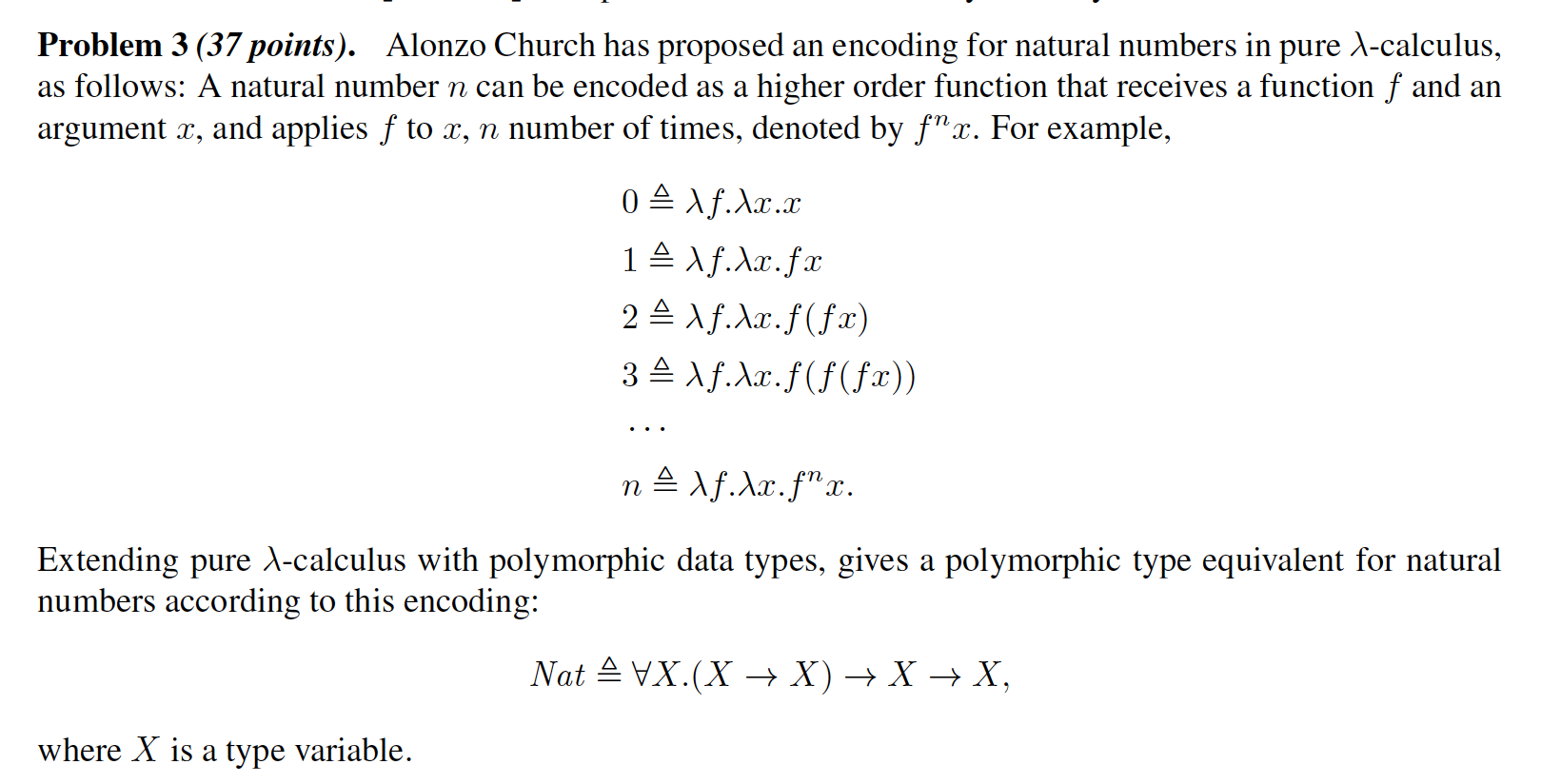
(g) Define the multiplication function mult: Nat -> Nat -> Nat. (3 points)
(h) As unit tests, check the following. (3 points)
(i) mult one one = one
(ii) mult zero (plus three three) = zero
(iii) mult two three = plus three three
Problem 3 (37 points). Alonzo Church has proposed an encoding for natural numbers in pure \-calculus, as follows: A natural number n can be encoded as a higher order function that receives a function f and an argument x, and applies f to x, n number of times, denoted by fx. For example, 04 If.lx.x 14 If..x.fx 24 f. dr.f (f) 34 f.dr.ff (fr)) n A X.X.r.f"c. Extending pure l-calculus with polymorphic data types, gives a polymorphic type equivalent for natural numbers according to this encoding: Nat 4 VX(X + X) + X X, where X is a type variable. Problem 3 (37 points). Alonzo Church has proposed an encoding for natural numbers in pure \-calculus, as follows: A natural number n can be encoded as a higher order function that receives a function f and an argument x, and applies f to x, n number of times, denoted by fx. For example, 04 If.lx.x 14 If..x.fx 24 f. dr.f (f) 34 f.dr.ff (fr)) n A X.X.r.f"c. Extending pure l-calculus with polymorphic data types, gives a polymorphic type equivalent for natural numbers according to this encoding: Nat 4 VX(X + X) + X X, where X is a type variable
Step by Step Solution
There are 3 Steps involved in it

Get step-by-step solutions from verified subject matter experts
 Study Help