



Question: NEED TO WRITE 1000 WORDS for presentation no copy and paste How can RFID technology simplify basic library processes like the lending and returns of
NEED TO WRITE 1000 WORDS for presentation
no copy and paste
How can RFID technology simplify basic library processes like the lending and returns of books?
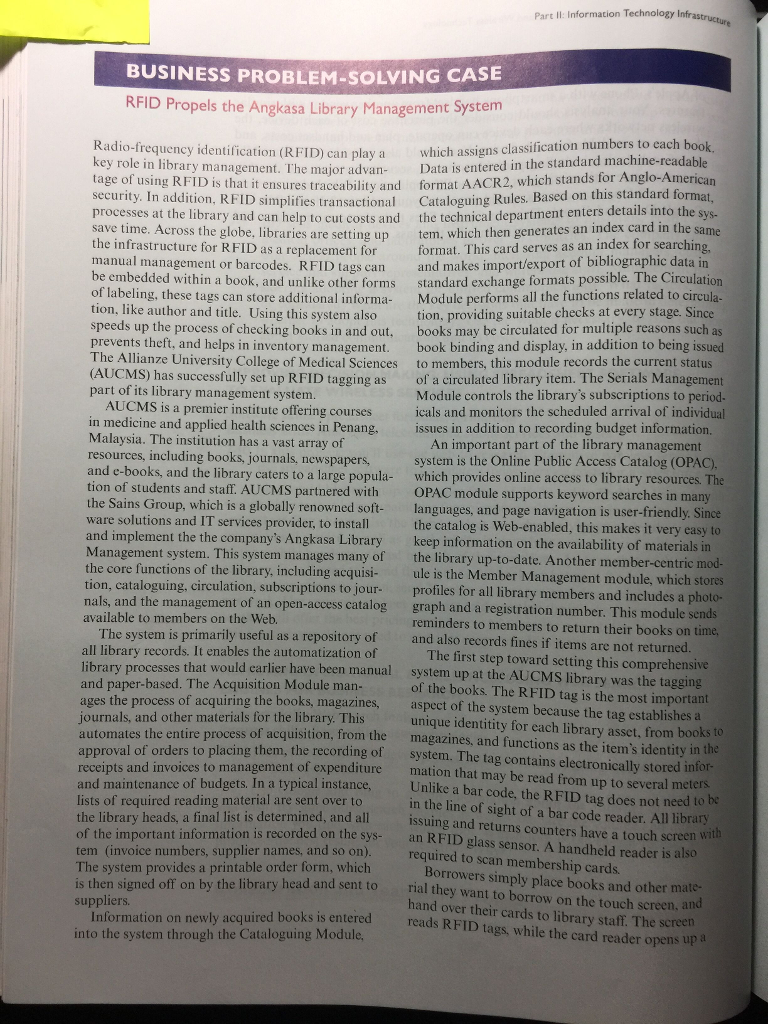
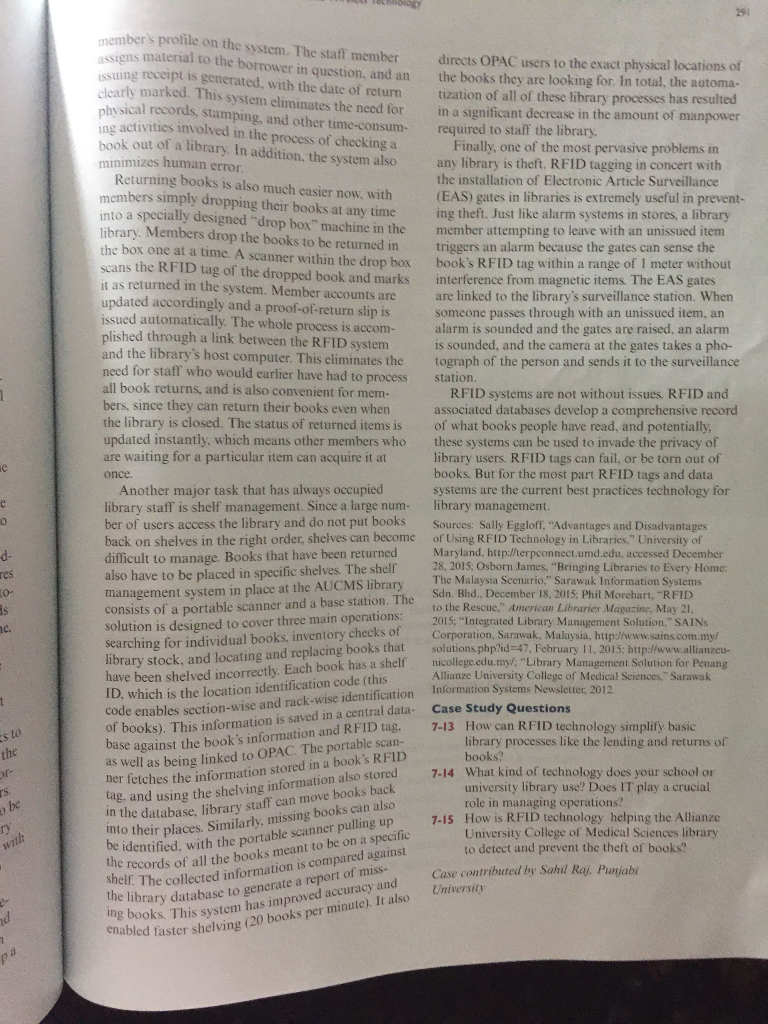
Part II: Information Technology Infrastructure security RFID tagging as BUSINESS PROBLEM-SOLVING CASE RFID Propels the Angkasa Library Management System Radio-frequency identification (RFID) can play a which assigns classification numbers to each book key role in library management. The major advan- Data is entered in the standard machine-readable tage of using RFID is that it ensures traceability and format AACR2, which stands for Anglo-American In addition, RFID simplifies transactional Cataloguing Rules. Based on this standard format. processes at the library and can help to cut costs and the technical department enters details into the sys- save time. Across the globe, libraries are setting up tem, which then generates an index card in the same the infrastructure for RFID as a format. This card serves as an index for searching, manual management or barcodes. RFID tags can and makes import/export of bibliographic data in be embedded within a book, and unlike other forms standard exchange formats possible. The Circulation of labeling, these tags can store additional informa- Module performs all the functions related to circula- tion, like author and Using this system also tion, providing suitable checks at every stage. Since speeds up the process of checking books in and out, books may be circulated for multiple reasons such as prevents theft, and helps in in inventory management. book binding and display, in addition to being issued The Allianze University College of Medical Sciences to members, this module records the current status ( CMS) has successfully set up of a circulated library item. The Serials Management part of its library management system. Module controls the library's subscriptions to period- AUCMS is a premier institute offering courses icals and monitors the scheduled arrival of individual in medicine and applied health sciences in Penang, issues in addition to recording budget information Malaysia. The institution has a vast array of An important part of the library management resources, including books, journals, newspapers, system is the Online Public Access Catalog (OPAC). and e-books, and the library caters to a large popula- which provides online access to library resources. The tion of students and staff. AUCMS partnered with OPAC module supports keyword searches in many ware solutions and IT services provider, to s Group, which is a globally renowned soft- languages, and page navigation is user-friendly. Since the catalog is Web-enabled, this makes it and implement the the company's Angkasa Library easy to keep information on the availability of materials in very Management system. This system manages the library up-to-date. Another member-centric mod- the core functions of the library, including acquisi- ule is the Member Management module, which stores tion, subscriptions to jour- profiles for all library members and includes a photo- nals, and the management of an open-access catalog graph and a registration number. This module sends available to members on the Web. reminders to members to return their books on time, The system is primarily useful as a seful as a repository of and also records fines if items are not returned. all library records. It enables the automatization of The first step toward setting this comprehensive library processes that would earlier have been manual system up at the AUCMS library was the tagging and paper-based. The Acquisition Module man- of the books. The RFID tag is the most important ages the process of acquiring the books, magazines, aspect of the system because the tag establishes a journals, and other materials for the library. This unique identitity for each library asset, from books to automates the entire process of acquisition, from the magazines, and functions as the item's identity in the an 1 of orders to placing them, the recording of system. The tag contains electronically stored infor- receipts and invoices to management of expenditure mation that may be read from up to several meters and maintenance of budgets. In a typical instance, Unlike a bar code, the RFID tag does not need to be lists of required reading material are sent over to in the line of sight of a bar code reader. All library the library heads, a final list is determined, and all issuing and returns counters have a touch screen with of the important information is recorded on the sys- an RFID glass sensor. A handheld reader is also tem (invoice numbers, supplier names, and so on). The system provides a printable order form, which Borrowers simply place books and other mate is then signed off on by the library head and sent to rial they want to borrow on the touch screen and suppliers. Information on newly acquired books is entered into the system through the Cataloguing Module, many of tion, cataloguing. approval required to scan membership cards. hand over their cards to library staff. The screen reads RFID tags, while the card reader opens up a enabled faster shelving (20 books per minute). It also 29 in prevent- in the database, library staff can move bu be identified, with the portable scanner pulling up the records of all the books meant to be on a specific shelf. The collected information is compared against the library database to generate a report of miss. ing books. This system has improved accuracy and member's profile on the system. The staff member assigns material to the borrower in question, and an directs OPAC users to the exact physical locations of issuing receipt is generated, with the date of return the books they are looking for. In total, the automa- clearly marked. This system eliminates the need for tization of all of these library processes has resulted physical records, stamping, and other time-consum- in a significant decrease in the amount of manpower ing activities involved in the process of checking a required to staff the library book out of a library. In addition, the system also Finally, one of the most pervasive problems in minimizes human error any library is theft. RFID tagging in concert with Returning books is also much easier now, with the installation of Electronic Article Surveillance members simply dropping their books at any time (EAS) gates in libraries is extremely useful in into a specially designed "drop box" machine in the ing theft. Just like alarm systems in stores, a library library Members drop the books to be returned in member attempting to leave with an unissued item the box one at a time. A scanner within the drop box triggers an alarm because the gates can sense the scans the RFID tag of the dropped book and marks book's RFID tag within a range of 1 meter without it as returned in the system. Member accounts are interference from magnetic items. The EAS gates updated accordingly and a proof-of-return slip is are linked to the library's surveillance station. When issued automatically. The whole process is accom- someone passes through with an unissued item, an plished through a link between the RFID system alarm is sounded and the gates are raised an alarm is sounded, and the camera at the gates takes a pho- and the library's host computer. This eliminates the tograph of the person and sends it to the surveillance need for staff who would earlier have had to process station all book returns, and is also convenient for mem- RFID systems are not without issues. RFID and bers, since they can return their books even when associated databases develop a comprehensive record the library is closed. The status of returned items is of what books people have read, and potentially, updated instantly, which means other members who these systems can be used to invade the privacy of are waiting for a particular item can acquire it at library users. RFID tags can fail, or be torn out of once. books. But for the most part RFID tags and data Another major task that has always occupied systems are the current best practices technology for e library staff is shelf management. Since a large num- library management 0 ber of users access the library and do not put books Sources: Sally Eggloff, "Advantages and Disadvantages back on shelves in the right order, shelves can become of Using RFID Technology in Libraries." University of Maryland, http://erpconnect.umd.edu, accessed December difficult to manage. Books that have been returned 28. 2015: Osborn James, "Bringing Libraries to Every Home: also have to be placed in specific shelves. The shelf The Malaysia Scenario." Sarawak Information Systems Sdn. Bhd., December 18, 2015: Phil Morehart, "RFID As consists of a portable scanner and a base station. The to the Rescue." American Libraries Magazine, May 21, ne. solution is designed to cover three e main operations 2015: "Integrated Library Management Solution." SAINS Corporation, Sarawak, Malaysia, http://www.sains.com.my/ searching for individual books, inventory checks of solutions.php'lid:47. February 11, 2015: http://www.allianzeu- library stock, and locating and replacing books that nicollege.edu.myl: "Library Management Solution for Penang have been shelved incorrectly . Each book has a shelf Allianze University College of Medical Sciences." Sarawak 1 Information Systems Newsletter, 2012 ID, which is the location identification code (this in a central data Case Study Questions of books). This information is saved 7-13 How can RFID technology simplify basic library processes like the lending and returns of books? 7-14 What kind of technology does your school or university library use? Does IT play a crucial role in managing operations? 7-15 How is RFID technology helping the Allianze University College of Medical Sciences library to detect and prevent the theft of books? Case contributed by Sahil Raj Punjabi University d- res 10- is to the code enables section-wise and rack-wise identification base against the book's information and RFID tag, as well as being linked to OPAC. The portable scan- her fetches the information stored in a book's RFID lag, and using the shelving information also stored books back hato their places. Similarly , missing books can also TS be d 7 po
Step by Step Solution
There are 3 Steps involved in it
1 Expert Approved Answer
Step: 1 Unlock

Question Has Been Solved by an Expert!
Get step-by-step solutions from verified subject matter experts
Step: 2 Unlock
Step: 3 Unlock