







Question: Need urgent answer . Explain Why consumption is not constant across time, under the per- manent income hypothesis with uncertainty. What happens instead? 3 points
Need urgent answer
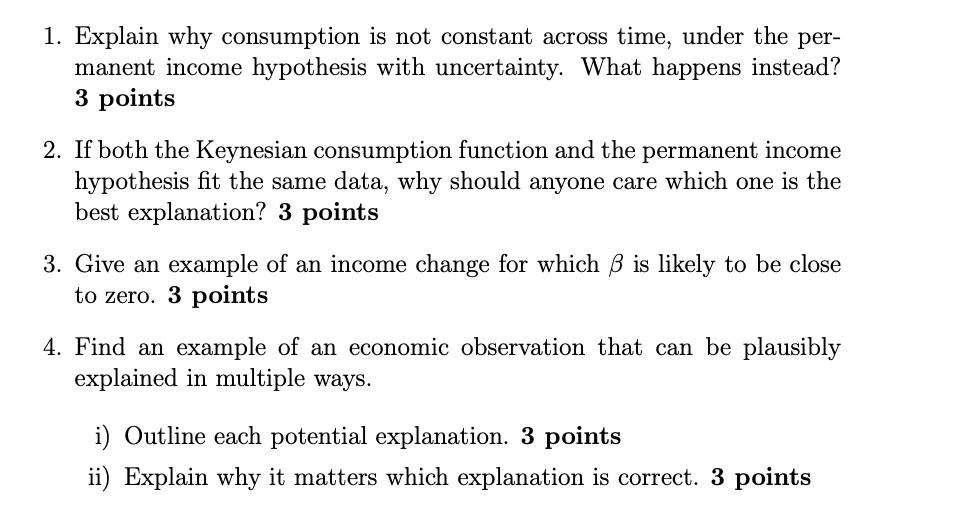
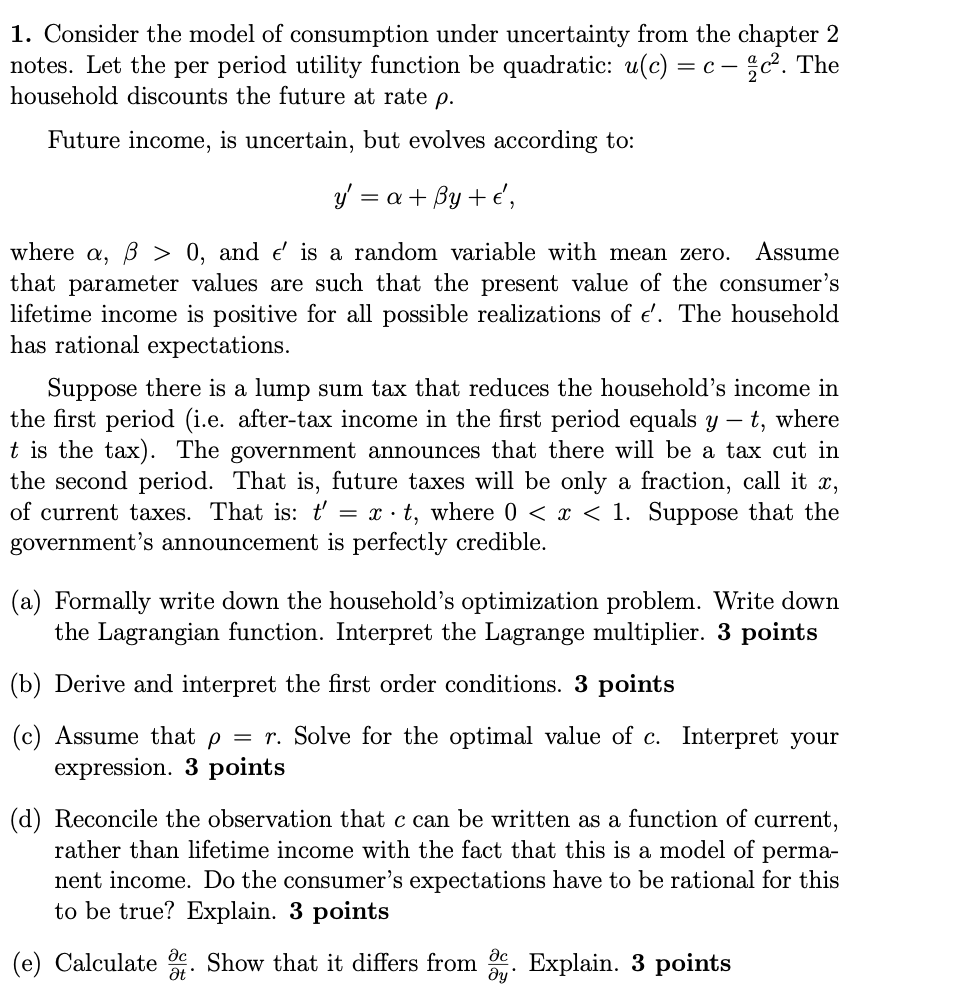
. Explain Why consumption is not constant across time, under the per- manent income hypothesis with uncertainty. What happens instead? 3 points . If both the Keynesian consumption function and the permanent income hypothesis t the same data, why should anyone care which one is the best explanation? 3 points . Give an example of an income change for which 18 is likely to be close to zero. 3 points . Find an example of an economic observation that can be plausibly explained in multiple ways. i) Outline each potential explanation. 3 points ii) Explain why it matters which explanation is correct. 3 points 1. Consider the model of consumption under uncertainty from the chapter 2 notes. Let the per period utility function be quadratic: u(c) = c g8. The household discounts the future at rate ,0. Future income, is uncertain, but evolves according to: y' = a + I33; + 6', where or, ,8 > 0, and e' is a random variable with mean zero. Assume that parameter values are such that the present value of the consumer's lifetime income is positive for all possible realizations of c'. The household has rational expectations. Suppose there is a lump sum tax that reduces the household's income in the rst period (i.e. after-tax income in the rst period equals 3; t, where t is the tax). The government announces that there will be a tax cut in the second period. That is, future taxes will be only a fraction, call it x, of current taxes. That is: t' = a: - t, where 0
Step by Step Solution
There are 3 Steps involved in it

Get step-by-step solutions from verified subject matter experts
 Study Help