







Question: Need within 1 hr, we upvote from multiple accounts Consider a problem of chromatographic separation of a mixture of two compounds A and B. Both
Need within 1 hr, we upvote from multiple accounts
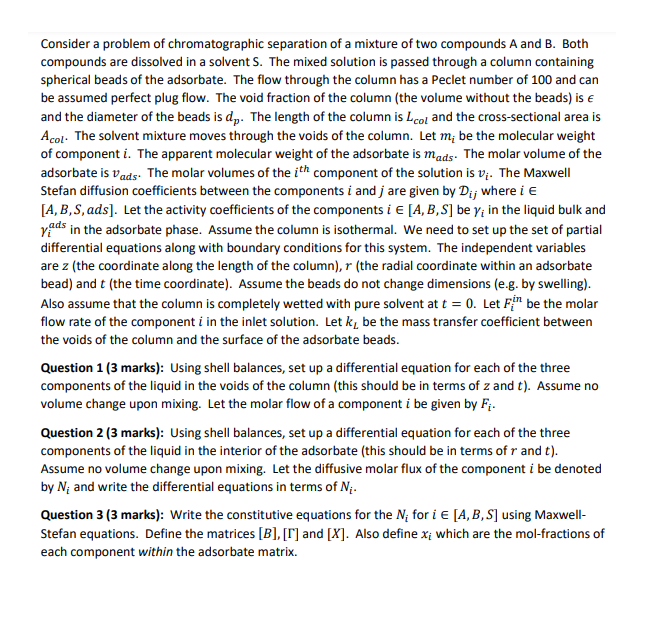
Consider a problem of chromatographic separation of a mixture of two compounds A and B. Both compounds are dissolved in a solvent S. The mixed solution is passed through a column containing spherical beads of the adsorbate. The flow through the column has a Peclet number of 100 and can be assumed perfect plug flow. The void fraction of the column (the volume without the beads) is e and the diameter of the beads is dy. The length of the column is Lcol and the cross-sectional area is Acol. The solvent mixture moves through the voids of the column. Let m; be the molecular weight of component i. The apparent molecular weight of the adsorbate is mads. The molar volume of the adsorbate is vads. The molar volumes of the ith component of the solution is vi. The Maxwell Stefan diffusion coefficients between the components i and j are given by Dij where i e [A, B,S, ads]. Let the activity coefficients of the components i E [A, B,S] be y; in the liquid bulk and vads in the adsorbate phase. Assume the column is isothermal. We need to set up the set of partial differential equations along with boundary conditions for this system. The independent variables are z (the coordinate along the length of the column), r (the radial coordinate within an adsorbate bead) and t (the time coordinate). Assume the beads do not change dimensions (e.g. by swelling). Also assume that the column is completely wetted with pure solvent at t = 0. Let Fill be the molar flow rate of the component i in the inlet solution. Let k be the mass transfer coefficient between the voids of the column and the surface of the adsorbate beads. Question 1(3 marks): Using shell balances, set up a differential equation for each of the three components of the liquid in the voids of the column (this should be in terms of z and t). Assume no volume change upon mixing. Let the molar flow of a component i be given by Fi. Question 2 (3 marks): Using shell balances, set up a differential equation for each of the three components of the liquid in the interior of the adsorbate (this should be in terms of r and t). Assume no volume change upon mixing. Let the diffusive molar flux of the component i be denoted by N; and write the differential equations in terms of Ni. Question 3 (3 marks): Write the constitutive equations for the N; for i E [A, B, S] using Maxwell- Stefan equations. Define the matrices [B], [T] and [X]. Also define xi which are the mol-fractions of each component within the adsorbate matrix. Consider a problem of chromatographic separation of a mixture of two compounds A and B. Both compounds are dissolved in a solvent S. The mixed solution is passed through a column containing spherical beads of the adsorbate. The flow through the column has a Peclet number of 100 and can be assumed perfect plug flow. The void fraction of the column (the volume without the beads) is e and the diameter of the beads is dy. The length of the column is Lcol and the cross-sectional area is Acol. The solvent mixture moves through the voids of the column. Let m; be the molecular weight of component i. The apparent molecular weight of the adsorbate is mads. The molar volume of the adsorbate is vads. The molar volumes of the ith component of the solution is vi. The Maxwell Stefan diffusion coefficients between the components i and j are given by Dij where i e [A, B,S, ads]. Let the activity coefficients of the components i E [A, B,S] be y; in the liquid bulk and vads in the adsorbate phase. Assume the column is isothermal. We need to set up the set of partial differential equations along with boundary conditions for this system. The independent variables are z (the coordinate along the length of the column), r (the radial coordinate within an adsorbate bead) and t (the time coordinate). Assume the beads do not change dimensions (e.g. by swelling). Also assume that the column is completely wetted with pure solvent at t = 0. Let Fill be the molar flow rate of the component i in the inlet solution. Let k be the mass transfer coefficient between the voids of the column and the surface of the adsorbate beads. Question 1(3 marks): Using shell balances, set up a differential equation for each of the three components of the liquid in the voids of the column (this should be in terms of z and t). Assume no volume change upon mixing. Let the molar flow of a component i be given by Fi. Question 2 (3 marks): Using shell balances, set up a differential equation for each of the three components of the liquid in the interior of the adsorbate (this should be in terms of r and t). Assume no volume change upon mixing. Let the diffusive molar flux of the component i be denoted by N; and write the differential equations in terms of Ni. Question 3 (3 marks): Write the constitutive equations for the N; for i E [A, B, S] using Maxwell- Stefan equations. Define the matrices [B], [T] and [X]. Also define xi which are the mol-fractions of each component within the adsorbate matrix
Step by Step Solution
There are 3 Steps involved in it

Get step-by-step solutions from verified subject matter experts
 Study Help