







Question: needjng help with case study T was midnight on a Friday night in the middle of April 2008, and Mount Allison University campus was alive.
needjng help with case study 
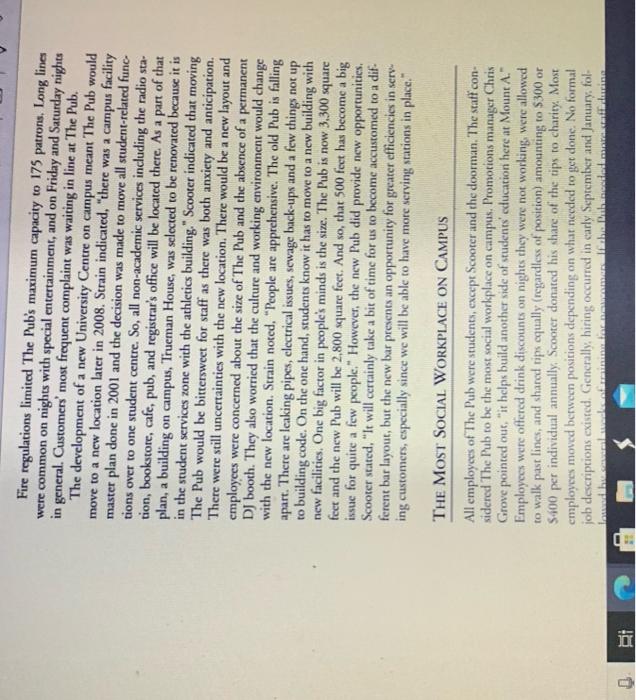
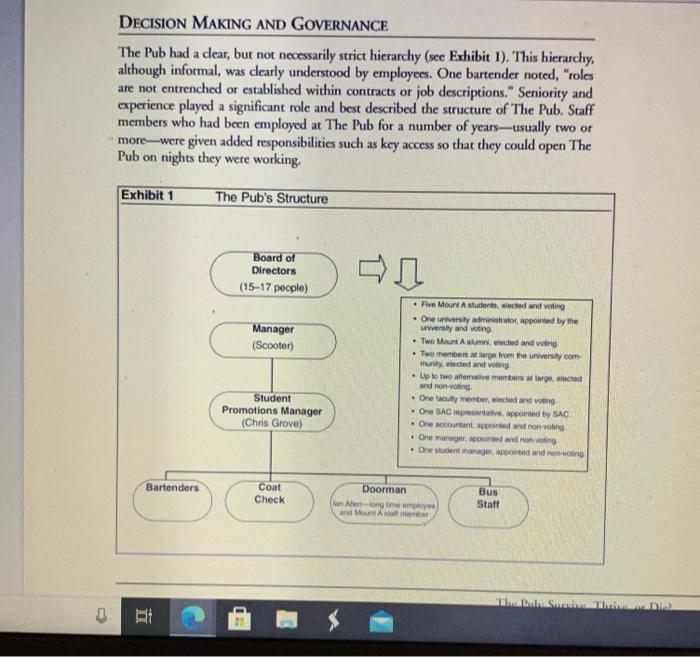
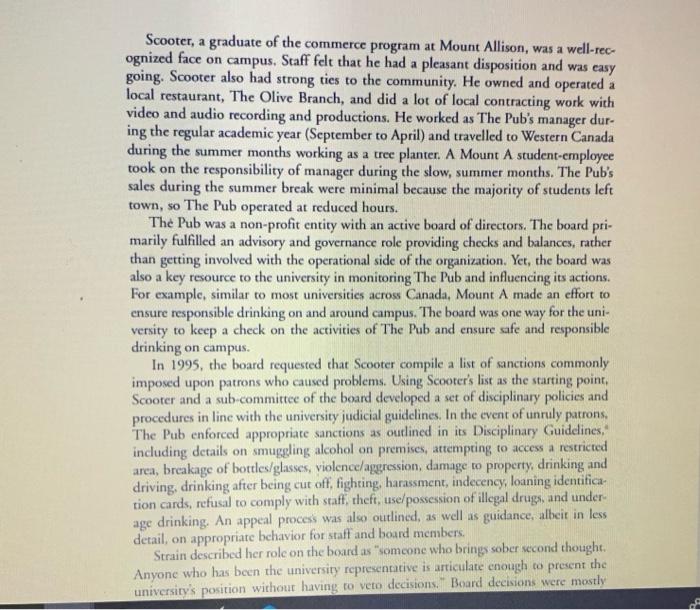
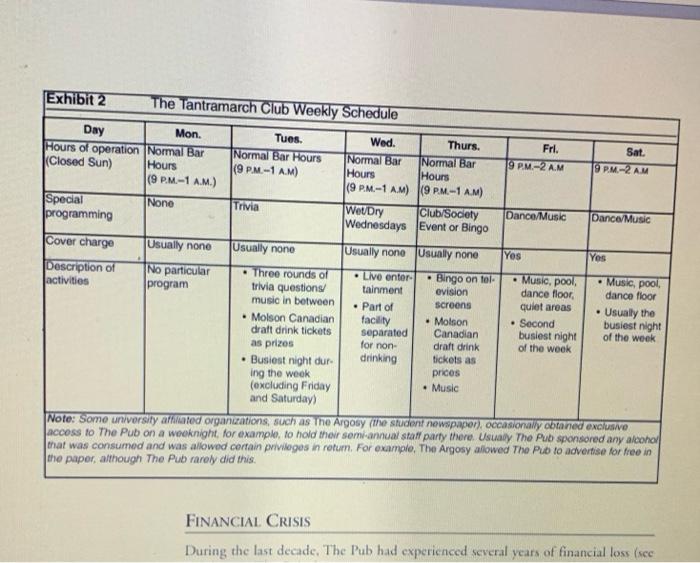

T was midnight on a Friday night in the middle of April 2008, and Mount Allison University campus was alive. The Pub was filling up. Patrons waited in line for twenty minutes, had their identification cards thoroughly checked, and entered into the basement-level facility. The music was pumping, the strobe lights were moving, and the dance floor was crammed. It was going to be another entertaining night at The Pub. Behind the bar was a familiar face-Jonathan Clark-known to everyone in town as Scooter. Scooter had been The Pub's regular manager since 1993. Students and alumni would remember him long after they had forgotten their grade point average. On that particular night, Scooter's thoughts were elsewhere. He was thinking about the board meeting held earlier that week. The board talked at length about The Pub's financial situation and the need to change how it did business. The Pub had experienced financial difficulties for several years, although the current year had been financially sound. The likelihood of The Pub remaining profitable in the future was unclear. Competition among bars had increased as alcohol consumption patterns in Canada changed. The Pub had a special connection with the student base as their campus pub, but studenes were fickle and quick to move on to a different bar if it offered something more appealing. The Pub was set to move to a new location on campus in August 2008, and the board and Scooter needed to determine the most appropriate business model to ensure ies survival. Scooter needed a plan to bring back to the board at the end of the summer. Officially known as The Tantramarsh Club, The Pub was formed in 1974 at Mount Allison University (Mount A) in Sackville, New Brunswick, Canada. The town of Sackville was located in southeastern New Brunswick, in the middle of the Maritime provinces of Canada. The town bordered the province of Nova Scotia. Sackville's economy was driven by tourism and the staff, students, and visitors of Mount A. Sackville's Copyright 2010 by the Case Research Joumal and by G. Grandy, M.P. Gunther, A. Couturier, B. Goldberg. I. Macleod and T. Steeves. The authors would like to acknowledge the help of Tupper Cawscy and three reviewers. An earlier version of this case was presented at the Atlantic Schools of Business Conference held in St. Johr's, Newfoundland, Canada in 2008. The Pub: Survive, Thrive, or Die? 1 This document is authorized for use only in Intemational Strategic Management 2014 by Dr loannis Thanos at University of Giasgow from September 2014 to March population was comprised of approximately 5,000 residents and a university student base of an additional 2,000 people. Mount A was a public university and cmployed approximarely 180 faculty (30 part-time and 150 full-time) and 340 staff (50 part-time and 290 full-time) . The university's target enrollment level was 2,275 students. The university administration deliberately controlled enrollment at this target number to ensure studens benefited from the close-knit nature of relationships with students, staft, and faculty. The universiry experienced a decline in enrollmens in 20012005 that took four years to work through the svstem. Enrollment levels were approximately 2.200 in 20072008. through the system. Enrollment levels were approximately 2,200 in 2007-2008. National trends indicated that between 2001 and 2011, undergraduate enrollment would increase by 34 percent. Data showed that 85 percent of all full-time students were enrolled in undergraduate programs. These rising participation rates were attributed to (1) an increasing number of university-educated parents influencing their children to attend university, and (2) students' perceptions that a university degree would result in a higher paying and more rewarding career. 2 National trends also indicated that males represented 42 percent of total enrollment at universities.' This national pattern was also evident at Mount A where female enrollment made up 61 to 64 percent of total enrollment in any given year. Mount A was primarily an undergraduate university with more than forty distinct programs. The university offered bachelor's degrees in arts, science, commerce, fine arts, and music, as well as master of science (biology and chemistry) and a certificate in bilingualism. Mount A ranked as the number one undergraduate university in 2007 by Maclean's magazine. The university achieved this number one position twelve times over a seventeen-year period. Founded in 1839, the university was known for excellence in liberal arts education. There were more than 140 clubs and societies (e.g., Bio-Med Sociery, Commerce Society, Coalition for Social Justice, Garnet and Gold Musical Theatre Society, Judo Club), a campus theatre, a visiting performing arts series, and numerous concerts (often performed by students and faculty of the music department). University constituents were also actively involved in community-based activities in Sackville. The university had a strong alumni base and there were more than thirty chapter locations across the world. The university held two significant on-campus events annually: the reunion weekend in May and the homecoming weekend in September. TRACING THE PUB's ROOTS The university established regulations in 1968 that permitted students to consume alcohol on campus. Mount A's governing body approved the formation of a campus pub in 1973 but it would operate as a separate entity from the university. The Pub's financial year did coincide with the university's financial reporting year (May 1 through to April 30). The Constitution, originally approved on November 2, 1973, outlined the purpose of The Pub as: fostering and promoting, artistic, literary, educational, social, fecreational, and sponing activities for the advancement of the intersets of its memben and others providing a other upgrades to reflect the university's intended image to potential students, visitors, and the public at large. The Pub's lease could be terminated if its management did not comply with the requirements set by Mount A's administrators and board of regents. Within a year of opening, the directors of The Pub employed a full-time manager to handle all operational issues. The manager's duties induded, staffing, inventory control, cash reconciliations, bank deposits, liquor purchasing and pickup, security, maintenance, deaning and equipment maintenance, payroll, accounting assistance, recordkeeping, public relations, promotions and advertising, musiclentertainment control, and regular operational maintenance of the third-party ATM machine. The manager acted in a similar fashion as an owner/operator would in such a small organization of approximately twenty-two employees, twenty of whom were part-time student employees. A WORN BUT ADORED PLACE The Pub was located in the basement of the University Centre on the north side of campus. Access via a treacherous staircase meant that students with disabilities had difficulty entering The Pub. No signage appeared on the exterior of the building, but most individuals on campus knew exactly where to find it. The Pub symbolized tradition and for former and current students it was a nostalgic place. A vibrant overhead mural on the entrance staircase corresponded with the interior dcor. Walls were also painted with colorful murals depicting political and social scenes. Small round tables, painted like the rest of the facility, dotted the premises in no real order or form. A small coat check was at the entrance, covered with pictures of patrons from years gone by. A iong, thin, cramped bar stretched the length of the room, with ciear signs stating, "Order efforts of the employees. A maximum of two bartenders served customers. On some efforts of the employecs. A maximum of two bartenders served customers. On some slow service. A DJ booth overlooked a dance floor to the left as patrons entered the facility: Speakers surrounded the DJ booth and pool tables were located in the back area. The ceiling was exposed, allowing all who entered to notice the piping and ventilation systems. The majority of the floors were covered with old, stained carpet and the rest with bland tile. This was The Pub, and despite its run-down appearance, it had been the adored hangout of Mount A students for decades. Fire regulations limited The Pub's maximum capacity to 175 patrons. Long line were common on nights with special entertainment, and on Friday and Saturday nights in general. Customers' most frequent complaint was waiting in line at The Pub. The development of a new University Centre on campus meant The Pub would move to a new location later in 2008. Strain indicated, "there was a campus facility master plan done in 2001 and the decision was made to move all student-related functions over to one student centre. So, all non-academic services including the radio station, bookstore, cafe, pub, and registrar's office will be located there. As a part of that plan, a building on campus, Trueman House, was selected to be renovated because it is in the student services zone with the athletics building." Scooter indicated that moving The Pub would be bittersweet for staff as there was both anxiety and anticipation. There were still uncertainties with the new location. There would be a new layout and employees were concerned about the size of The Pub and the absence of a permanent DJ booth. They also worried that the culture and working environment would change with the new location. Strain noted, "People are apprehensive. The old Pub is falling apart. There are leaking pipes, electrical issues, sewage back-ups and a few things not up to building code. On the one hand, students know it has to move to a new building with new facilitics. One big factor in peoples minds is the size. The Pub is now 3,300 square issue for quite a few people," However, the new Pub did provide new opportunities. Scooter stated, "It will certainly take a bit of time for us to become accustomed to a different bar layout, but the new bar presenes an opportunity for greater efficiencies in serving customers, especially since we will be able to have more serving stations in place." THE MOST SOCIAL WORKPLACE ON CAMPUS All employees of The Pub were students, except Scooter and the doorman. The staff considered The Pub to be the most social workplace on campus. Promotions manager Chris Grove pointed out, "it helps build another side of students' education here at Mount A." Employees were offered drink discounts on nights they were not working, were allowed to walk past lines, and shared rips equally (regardless of position) amounting to $300 or S400 per individual annually. Scooter donated his share of the tips to charity. Most employees moved berween positions depending on what needed to get done. No formal job descriptions existed. Generally, hiring occurred in early September and January. fol- DECISION MAKING AND GOVERNANCE The Pub had a clear, but not necessarily strict hierarchy (see Exhibit 1). This hierarchy, although informal, was clearly understood by employees. One bartender noted, "roles are not entrenched or established within contracts or job descriptions," Seniority and experience played a significant role and best described the structure of The Pub. Staff members who had been employed at The Pub for a number of years-usually two or more-were given added responsibilities such as key access so that they could open The Pub on nights they were working. Scooter, a graduate of the commerce program at Mount Allison, was a well-recognized face on campus. Staff felt that he had a pleasant disposition and was easy going. Scooter also had strong ties to the community. He owned and operated a local restaurant, The Olive Branch, and did a lot of local contracting work with video and audio recording and productions. He worked as The Pub's manager during the regular academic year (September to April) and travelled to Western Canada during the summer months working as a tree planter. A Mount A student-employee took on the responsibility of manager during the slow, summer months. The Pub's sales during the summer break were minimal because the majority of students left town, so The Pub operated at reduced hours. The Pub was a non-profit entity with an active board of directors. The board primarily fulfilled an advisory and governance role providing checks and balances, rather than getting involved with the operational side of the organization. Yet, the board was also a key resource to the university in monitoring The Pub and influencing its actions. For example, similar to most universitics across Canada, Mount A made an effort to ensure responsible drinking on and around campus. The board was one way for the university to keep a check on the activities of The Pub and ensure safe and responsible drinking on campus. In 1995, the board requested that Scooter compile a list of sanctions commonly imposed upon patrons who caused problems. Using Scooter's list as the starting point, Scooter and a sub-committee of the board developed a set of disciplinary policies and procedures in line with the university judicial guidelines. In the event of unruly patrons. The Pub enforced appropriate sanctions as outlined in its Disciplinary Guidelines," including details on smuggling alcohol on premises, attempting to access a restricted area, breakage of bottes/glasses, violence/aggression, damage to property, drinking and driving, drinking after being cut off, fighting, harassment, indecency, loaning identification cards, refusal to comply with staff, theft, use/possession of illegal drugs, and underage drinking. An appeal process was also outlined, as well as guidance, albeit in less detail, on appropriate behavior for staff and board members. Strain described her role on the board as "someone who brings sober second thought. Anyone who has been the university represennative is articulate enough to present the universiry's position withour having to veto decisions," Board decisions were mostly accoss to the Pub on a wooknight, for example, to hold their semi annua staff party there Usualy The Pub sponsored ane that was consumed and was allowed certain privileges in retum. For example. The Argosy a lisuled The Pub sponsored any alcohor the paper, although The Pub rarely did this. Financial Crisis During the last decade. The Pub had experienced screral years of financial loss (sec a. How did the bargaining power between the bars and the sunpliers mentioned in "The Pub" case change during the case? b. How did the bargaining power between the bars and the buyers mentioned in "The Pub" case change during the case? c. How did the substitutes of the bars mentioned in "The Pub" case thange during the case? d. How did the potential new entrants mentioned in "The Pub" case change during the case? e. How did the intensity of the rivalry among competitors according to "The Pub" case change during the case
Step by Step Solution
There are 3 Steps involved in it
1 Expert Approved Answer
Step: 1 Unlock

Question Has Been Solved by an Expert!
Get step-by-step solutions from verified subject matter experts
Step: 2 Unlock
Step: 3 Unlock
 Study Help