







Question: needs to be 250 words minimum! What Would You Do? Case Assignment Walt Disney Company Burbank, California Over two decades, your predecessor and boss, CEO
needs to be 250 words minimum! 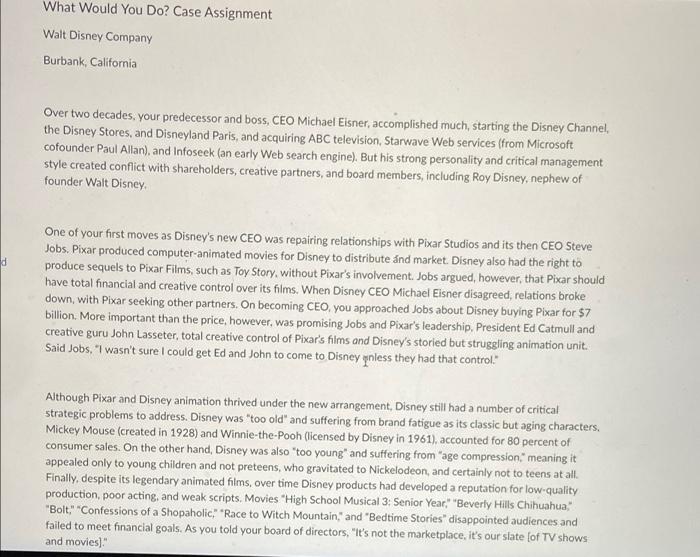
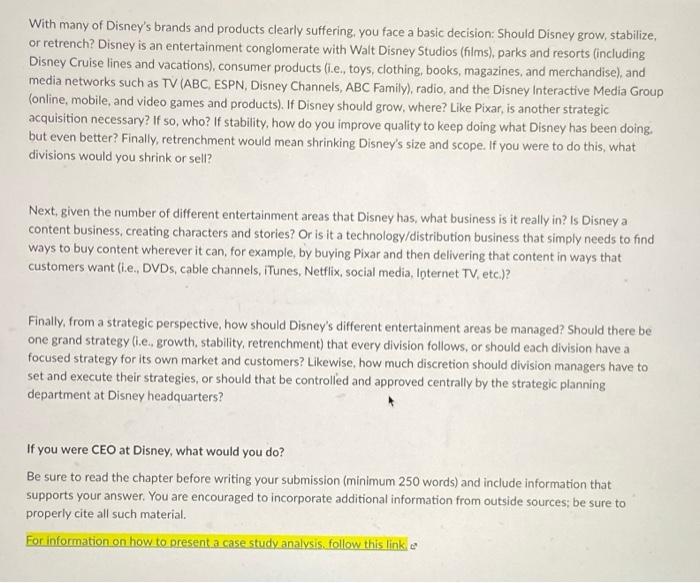
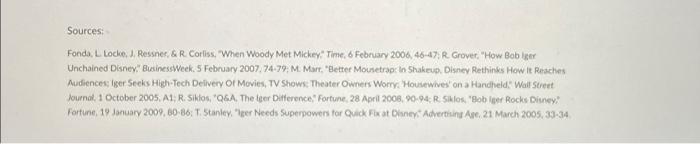
What Would You Do? Case Assignment Walt Disney Company Burbank, California Over two decades, your predecessor and boss, CEO Michael Eisner, accomplished much, starting the Disney Channel, the Disney Stores, and Disneyland Paris, and acquiring ABC television, Starwave Web services (from Microsoft cofounder Paul Allan), and Infoseek (an early Web search engine). But his strong personality and critical management style created conflict with shareholders, creative partners, and board members, including Roy Disney, nephew of founder Walt Disney d One of your first moves as Disney's new CEO was repairing relationships with Pixar Studios and its then CEO Steve Jobs. Pixar produced computer-animated movies for Disney to distribute and market. Disney also had the right to produce sequels to Pixar Films, such as Toy Story, without Pixar's involvement. Jobs argued, however, that Pixar should have total financial and creative control over its films. When Disney CEO Michael Eisner disagreed, relations broke down with Pixar seeking other partners. On becoming CEO, you approached Jobs about Disney buying Pixar for $7 billion. More important than the price, however, was promising Jobs and Pixar's leadership, President Ed Catmull and creative guru John Lasseter, total creative control of Pixar's films and Disney's storied but struggling animation unit. Said Jobs. "I wasn't sure I could get Ed and John to come to Disney ynless they had that control Although Pixar and Disney animation thrived under the new arrangement, Disney still had a number of critical strategic problems to address. Disney was "too old and suffering from brand fatigue as its classic but aging characters, Mickey Mouse (created in 1928) and Winnie-the-Pooh (licensed by Disney in 1961), accounted for 80 percent of consumer sales. On the other hand, Disney was also "too young and suffering from "age compression meaning it appealed only to young children and not preteens, who gravitated to Nickelodeon, and certainly not to teens at all Finally, despite its legendary animated films. over time Disney products had developed a reputation for low quality production, poor acting, and weak scripts, Movies "High School Musical 3: Senior Year," "Beverly Hills Chihuahua "Bolt," "Confessions of a Shopaholic," Race to Witch Mountain," and "Bedtime Stories" disappointed audiences and failed to meet financial goals. As you told your board of directors, "It's not the marketplace, it's our slate of TV shows and movies) With many of Disney's brands and products clearly suffering, you face a basic decision: Should Disney grow, stabilize, or retrench? Disney is an entertainment conglomerate with Walt Disney Studios (films), parks and resorts (including Disney Cruise lines and vacations), consumer products (.e., toys, clothing, books, magazines, and merchandise), and media networks such as TV (ABC, ESPN, Disney Channels, ABC Family), radio, and the Disney Interactive Media Group (online, mobile, and video games and products). If Disney should grow, where? Like Pixar, is another strategic acquisition necessary? If so, who? If stability, how do you improve quality to keep doing what Disney has been doing. but even better? Finally, retrenchment would mean shrinking Disney's size and scope. If you were to do this, what divisions would you shrink or sell? Next, given the number of different entertainment areas that Disney has, what business is it really in? Is Disney a content business, creating characters and stories? Or is it a technology/distribution business that simply needs to find ways to buy content wherever it can, for example, by buying Pixar and then delivering that content in ways that customers want (1.e., DVDs, cable channels, iTunes, Netflix, social media, Internet TV, etc.)? Finally, from a strategic perspective, how should Disney's different entertainment areas be managed? Should there be one grand strategy (ie, growth, stability, retrenchment) that every division follows, or should each division have a focused strategy for its own market and customers? Likewise, how much discretion should division managers have to set and execute their strategies, or should that be controlled and approved centrally by the strategic planning department at Disney headquarters? If you were CEO at Disney, what would you do? Be sure to read the chapter before writing your submission (minimum 250 words) and include information that supports your answer. You are encouraged to incorporate additional information from outside sources: be sure to properly cite all such material. For information on how to present a case study analysis follow this link. Sources: Fonda, L Locke, J. Ressner & R. Corliss. When Woody Met MickeyTime, 6 February 2006, 46-47 R. Grover "How Bobler Unchained Disney. Business Week. 5 February 2007, 74.79; M. Marr, Better Mousetrap In Shakeun. Disney Rethinks How It Reaches Audiences; Iger Seeks High-Tech Delivery of Movies, TV Shows Theater Owners Worry, Housewives on a Handheld Wall Street Journal, 1 October 2005. A1: R. Siklos, 'Q6A. The teer Difference Fortune, 28 April 2008.90-94: R. Siklos Bob loer Rocks Disney! Fortune, 19 January 2009,60 86 T Stanley, per Needs Superpowers for Quick Fixat line Advertising A 21 March 2005,33-34
Step by Step Solution
There are 3 Steps involved in it
1 Expert Approved Answer
Step: 1 Unlock

Question Has Been Solved by an Expert!
Get step-by-step solutions from verified subject matter experts
Step: 2 Unlock
Step: 3 Unlock
 Study Help