







Question: Needs to be in Java By maintaining the invariant that the elements in the priority queue are sorted in non-increasing order (that is, the largest
Needs to be in Java
By maintaining the invariant that the elements in the priority queue are sorted in non-increasing order (that is, the largest item is first, the smallest is last), you can implement both findMin and delete Min in constant time. However, insert is expensive. Do the following: a. Describe the algorithms for insert, find Min, and delete Min. b. What is the Big-Oh running time for insert? c. Write an implementation that uses these algorithms.
I already have the algorithms and the big oh notation i just need help with the implementation. It needs to be written in Java
Please Help
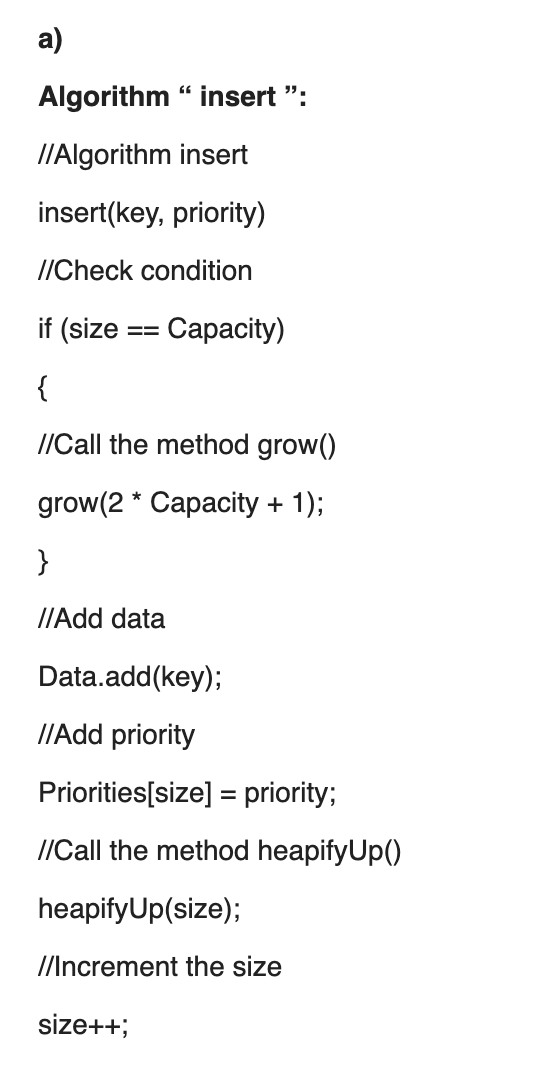
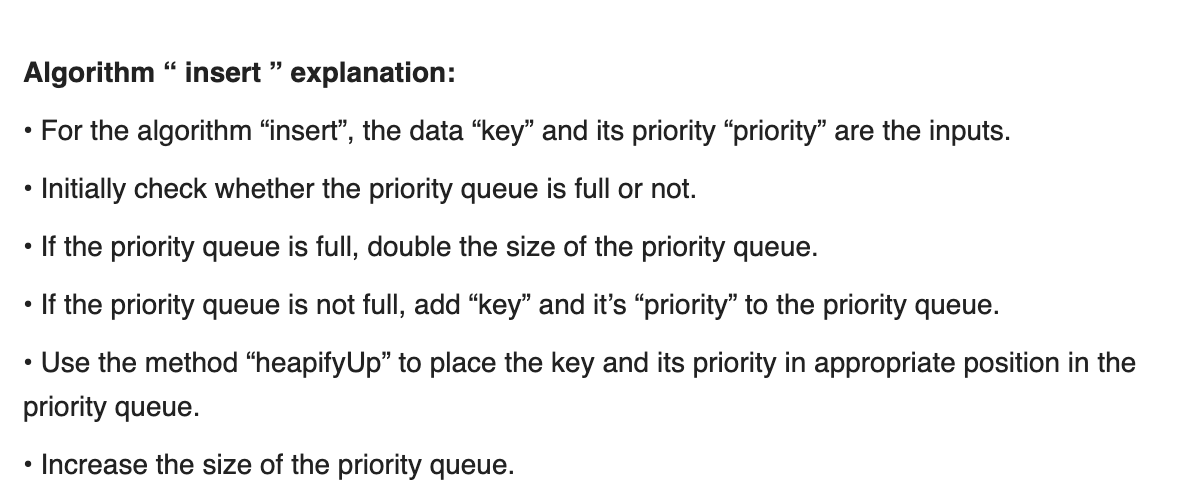
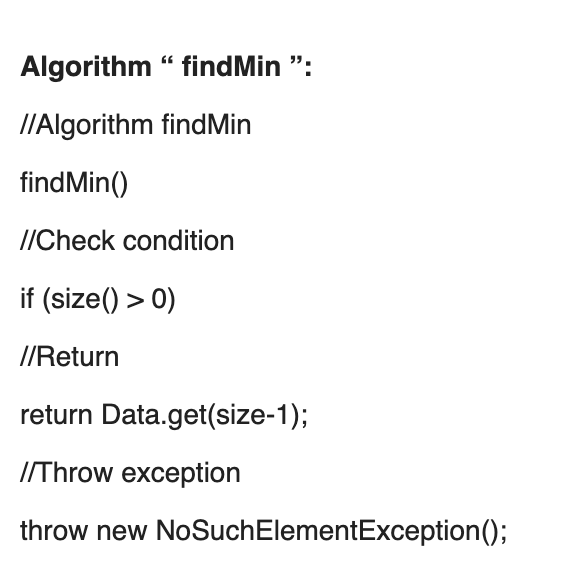
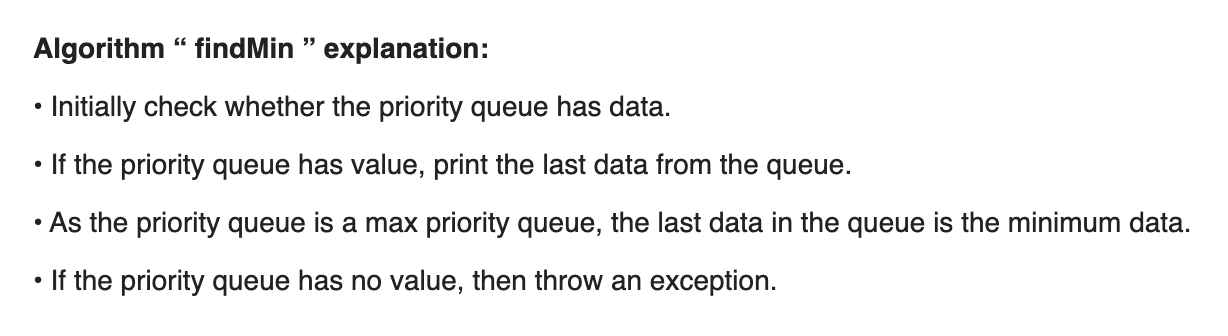
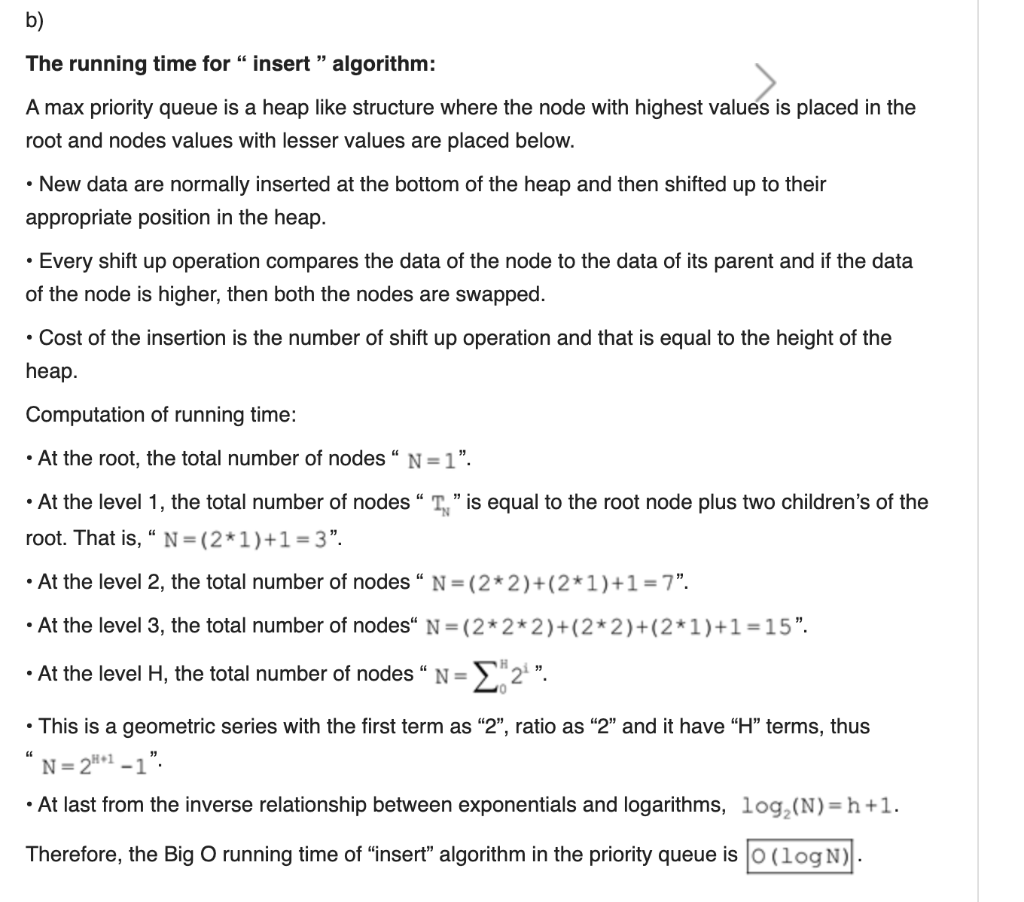
Algorithm insert": l/Algorithm insert insert(key, priority) //Check condition if (size == Capacity) //Call the method grow() grow(2 * Capacity + 1); // Add data Data.add(key); I/Add priority Priorities[size] = priority; [/Call the method heapifyUp() heapifyUp(size); //Increment the size size++; Algorithm insert explanation: For the algorithm insert, the data key" and its priority priority are the inputs. Initially check whether the priority queue is full or not. If the priority queue is full, double the size of the priority queue. If the priority queue is not full, add "key" and it's priority" to the priority queue. Use the method heapifyUp to place the key and its priority in appropriate position in the priority queue. Increase the size of the priority queue. Algorithm findMin ": //Algorithm find Min find Min() //Check condition if (size() > 0) // Return return Data.get(size-1); //Throw exception throw new No SuchElementException(); Algorithm findMin explanation: Initially check whether the priority queue has data. If the priority queue has value, print the last data from the queue. As the priority queue is a max priority queue, the last data in the queue is the minimum data. If the priority queue has no value, then throw an exception. Algorithm delete Min ": l/Algorithm delete Min delete Min() //Remove the last data Data.remove(size-1); //Decrement size size--; Algorithm delete Min explanation: As the priority queue is a max priority queue, the last data in the queue is the minimum data. Just remove the last data and decrement the size of the priority queue. = = = = = = = = = = = = = = = = = = = = = = = = = = = = = = = = = = = = = = = = = = = = = = = = = = = = = = = = = = = = = = = = = = = = = = = = = = = = = = = = = = = = = = = = = = = = = = = = = = = = = = = = = = = = = = = = = = b) The running time for " insert" algorithm: A max priority queue is a heap like structure where the node with highest values is placed in the root and nodes values with lesser values are placed below. New data are normally inserted at the bottom of the heap and then shifted up to their appropriate position in the heap. Every shift up operation compares the data of the node to the data of its parent and if the data of the node is higher, then both the nodes are swapped. . Cost of the insertion is the number of shift up operation and that is equal to the height of the heap. Computation of running time: At the root, the total number of nodes N=1". At the level 1, the total number of nodes "T, is equal to the root node plus two children's of the root. That is, N=(2+1)+1=3". At the level 2, the total number of nodes N=(2*2)+(2+1)+1 = 7". At the level 3, the total number of nodes" N=12*2*2)+(2*2)+(2+1)+1 = 15". At the level H, the total number of nodes N= "2". This is a geometric series with the first term as 2, ratio as 2" and it have H terms, thus N=2H+1 -1. At last from the inverse relationship between exponentials and logarithms, log,(N)= h +1. Therefore, the Big O running time of "insert" algorithm in the priority queue is O(logN)
Step by Step Solution
There are 3 Steps involved in it

Get step-by-step solutions from verified subject matter experts
 Study Help