







Question: Needs to be java and have user input Programming Assignment 2 CSIS4251 Apply both fixed and dynamic memory allocation schemes. Use a memory size of
Needs to be java and have user input
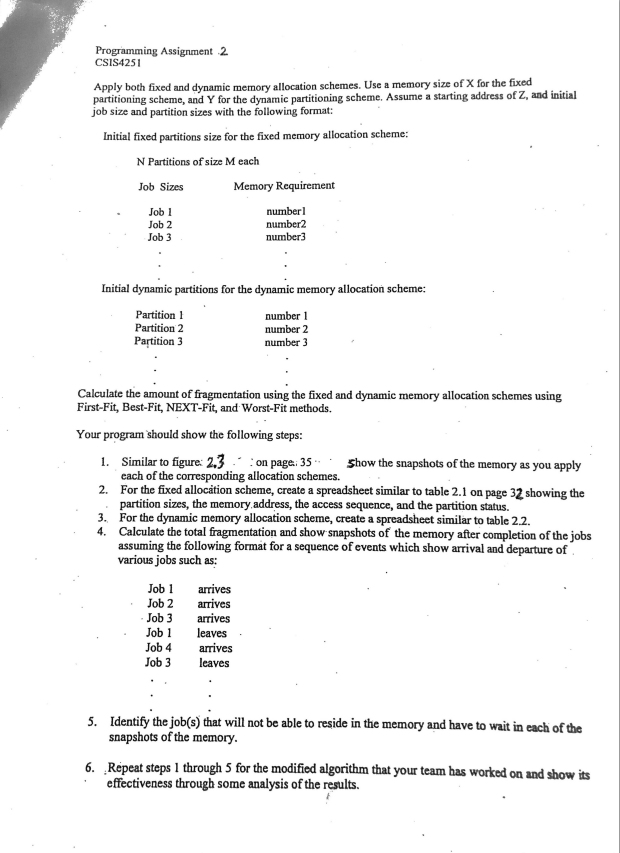
Programming Assignment 2 CSIS4251 Apply both fixed and dynamic memory allocation schemes. Use a memory size of X for the fixed partitioning scheme, and Y for the dynamic partitioning scheme. Assume a starting address of Z, and initial job size and partition sizes with the following format: Initial fixed partitions size for the fixed memory allocation scheme: N Partitions of size M each Job Sizes Memory Requirement Job 1 number 1 Job 2 number2 number3 Job 3 Initial dynamic partitions for the dynamic memory allocation scheme: Partition 1 number 1 Partition 2 number 2 Partition 3 number 3 Calculate the amount of fragmentation using the fixed and dynamic memory allocation schemes using First-Fit, Best-Fit, NEXT-Fit, and Worst-Fit methods. Your program should show the following steps: 1. Similar to figure: 2.3 on page: 35 Show the snapshots of the memory as you apply each of the corresponding allocation schemes. 2. For the fixed allocation scheme, create a spreadsheet similar to table 2.1 on page 32 showing the partition sizes, the memory, address, the access sequence, and the partition status. 3. For the dynamic memory allocation scheme, create a spreadsheet similar to table 22. 4. Calculate the total fragmentation and show snapshots of the memory after completion of the jobs assuming the following format for a sequence of events which show arrival and departure of various jobs such as: Job 1 arrives Job 2 arrives Job 3 arrives Job 1 leaves Job 4 arrives Job 3 leaves 5. Identify the job(s) that will not be able to reside in the memory and have to wait in cach of the snapshots of the memory. 6. Repeat steps 1 through 5 for the modified algorithm that your team has worked on and show its effectiveness through some analysis of the results. Programming Assignment 2 CSIS4251 Apply both fixed and dynamic memory allocation schemes. Use a memory size of X for the fixed partitioning scheme, and Y for the dynamic partitioning scheme. Assume a starting address of Z, and initial job size and partition sizes with the following format: Initial fixed partitions size for the fixed memory allocation scheme: N Partitions of size M each Job Sizes Memory Requirement Job 1 number 1 Job 2 number2 number3 Job 3 Initial dynamic partitions for the dynamic memory allocation scheme: Partition 1 number 1 Partition 2 number 2 Partition 3 number 3 Calculate the amount of fragmentation using the fixed and dynamic memory allocation schemes using First-Fit, Best-Fit, NEXT-Fit, and Worst-Fit methods. Your program should show the following steps: 1. Similar to figure: 2.3 on page: 35 Show the snapshots of the memory as you apply each of the corresponding allocation schemes. 2. For the fixed allocation scheme, create a spreadsheet similar to table 2.1 on page 32 showing the partition sizes, the memory, address, the access sequence, and the partition status. 3. For the dynamic memory allocation scheme, create a spreadsheet similar to table 22. 4. Calculate the total fragmentation and show snapshots of the memory after completion of the jobs assuming the following format for a sequence of events which show arrival and departure of various jobs such as: Job 1 arrives Job 2 arrives Job 3 arrives Job 1 leaves Job 4 arrives Job 3 leaves 5. Identify the job(s) that will not be able to reside in the memory and have to wait in cach of the snapshots of the memory. 6. Repeat steps 1 through 5 for the modified algorithm that your team has worked on and show its effectiveness through some analysis of the results
Step by Step Solution
There are 3 Steps involved in it

Get step-by-step solutions from verified subject matter experts
 Study Help