







Question: Network Security :When a system needs to authenticate a user, it can use proof by knowledge, proof by possession, or proof by property. Briefly explain
Network Security :When a system needs to authenticate a user, it can use proof by knowledge, proof by possession, or proof by property. Briefly explain each of these with suitable examples?
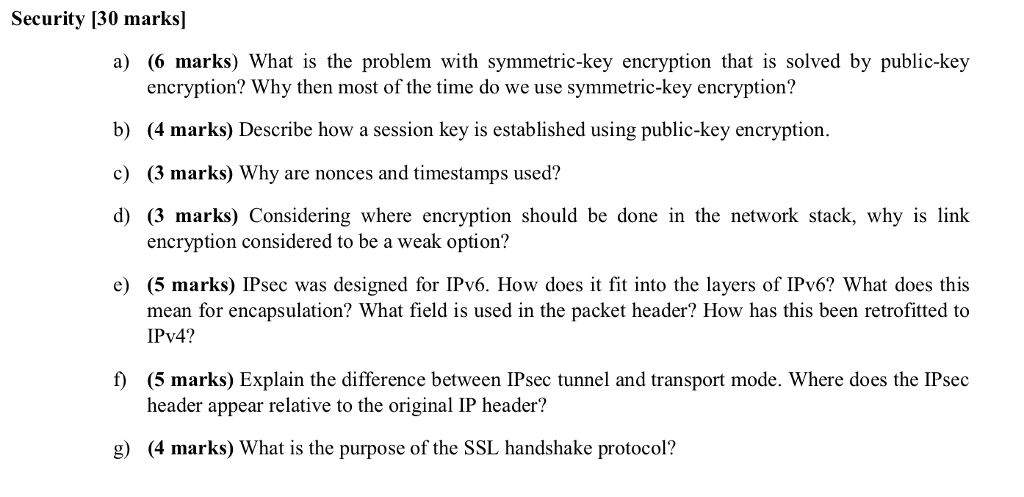
Security [30 marks] a) (6 marks) What is the problem with symmetric-key encryption that is solved by public-key encryption? Why then most of the time do we use symmetric-key encryption? b) (4 marks) Describe how a session key is established using public-key encryption. c) 3 marks) Why are nonces and timestamps used? d) (3 marks) Considering where encryption should be done in the network stack, why is link encryption considered to be a weak option? e) 5 marks) IPsec was designed for IPv6. How does it fit into the layers of IPv6? What does this mean for encapsulation? What field is used in the packet header? How has this been retrofitted to IPv4? f) (5 marks) Explain the difference between IPsec tunnel and transport mode. Where does the IPsec header appear relative to the original IP header? g) (4 marks) What is the purpose of the SSL handshake protocol
Step by Step Solution
There are 3 Steps involved in it

Get step-by-step solutions from verified subject matter experts
 Study Help