







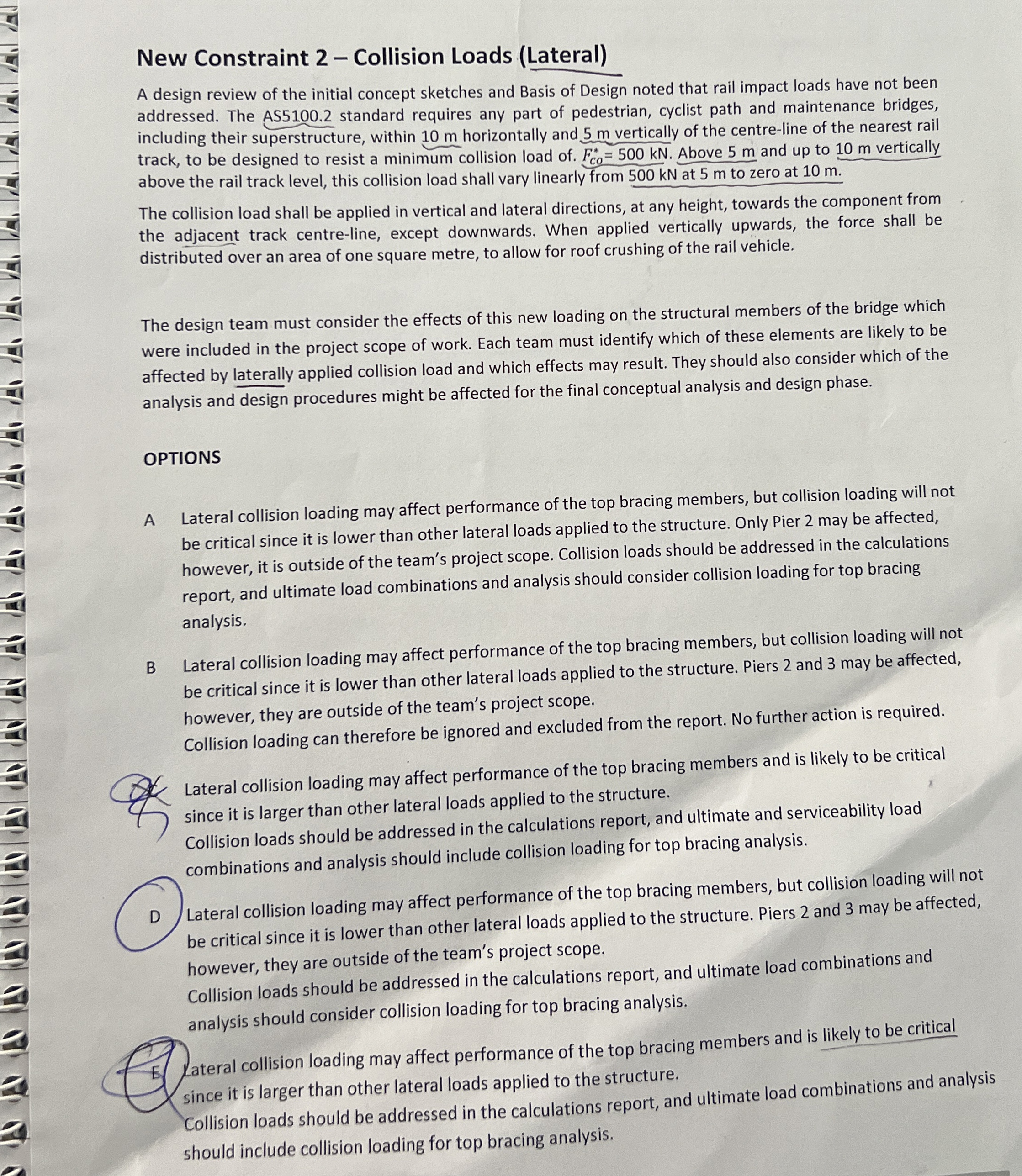
Question: New Constraint 2 - Collision Loads ( Lateral ) A design review of the initial concept sketches and Basis of Design noted that rail impact
New Constraint Collision Loads Lateral
A design review of the initial concept sketches and Basis of Design noted that rail impact loads have not been addressed. The AS standard requires any part of pedestrian, cyclist path and maintenance bridges, including their superstructure, within m horizontally and m vertically of the centreline of the nearest rail track, to be designed to resist a minimum collision load of Above m and up to m vertically above the rail track level, this collision load shall vary linearly from kN at m to zero at m
The collision load shall be applied in vertical and lateral directions, at any height, towards the component from the adjacent track centreline, except downwards. When applied vertically upwards, the force shall be distributed over an area of one square metre, to allow for roof crushing of the rail vehicle.
The design team must consider the effects of this new loading on the structural members of the bridge which were included in the project scope of work. Each team must identify which of these elements are likely to be affected by laterally applied collision load and which effects may result. They should also consider which of the analysis and design procedures might be affected for the final conceptual analysis and design phase.
OPTIONS
A Lateral collision loading may affect performance of the top bracing members, but collision loading will not be critical since it is lower than other lateral loads applied to the structure. Only Pier may be affected, however, it is outside of the team's project scope. Collision loads should be addressed in the calculations report, and ultimate load combinations and analysis should consider collision loading for top bracing analysis.
B Lateral collision loading may affect performance of the top bracing members, but collision loading will not be critical since it is lower than other lateral loads applied to the structure. Piers and may be affected, however, they are outside of the team's project scope.
Collision loading can therefore be ignored and excluded from the report. No further action is required.
Lateral collision loading may affect performance of the top bracing members and is likely to be critical since it is larger than other lateral loads applied to the structure.
Collision loads should be addressed in the calculations report, and ultimate and serviceability load combinations and analysis should include collision loading for top bracing analysis.
Lateral collision loading may affect performance of the top bracing members, but collision loading will not be critical since it is lower than other lateral loads applied to the structure. Piers and may be affected, however, they are outside of the team's project scope.
Collision loads should be addressed in the calculations report, and ultimate load combinations and analysis should consider collision loading for top bracing analysis.
Lateral collision loading may affect performance of the top bracing members and is likely to be critical since it is larger than other lateral loads applied to the structure.
Collision loads should be addressed in the calculations report, and ultimate load combinations and analysis should include collision loading for top bracing analysis.
Step by Step Solution
There are 3 Steps involved in it
1 Expert Approved Answer
Step: 1 Unlock

Question Has Been Solved by an Expert!
Get step-by-step solutions from verified subject matter experts
Step: 2 Unlock
Step: 3 Unlock
 Study Help