







Question: Newton's method 35 Pitfalls of Newton's Method U 1(X)=4-x+1. a. Use Newton's method with xo = -1.5 to approximate a solution of x /5-x+1-0 with
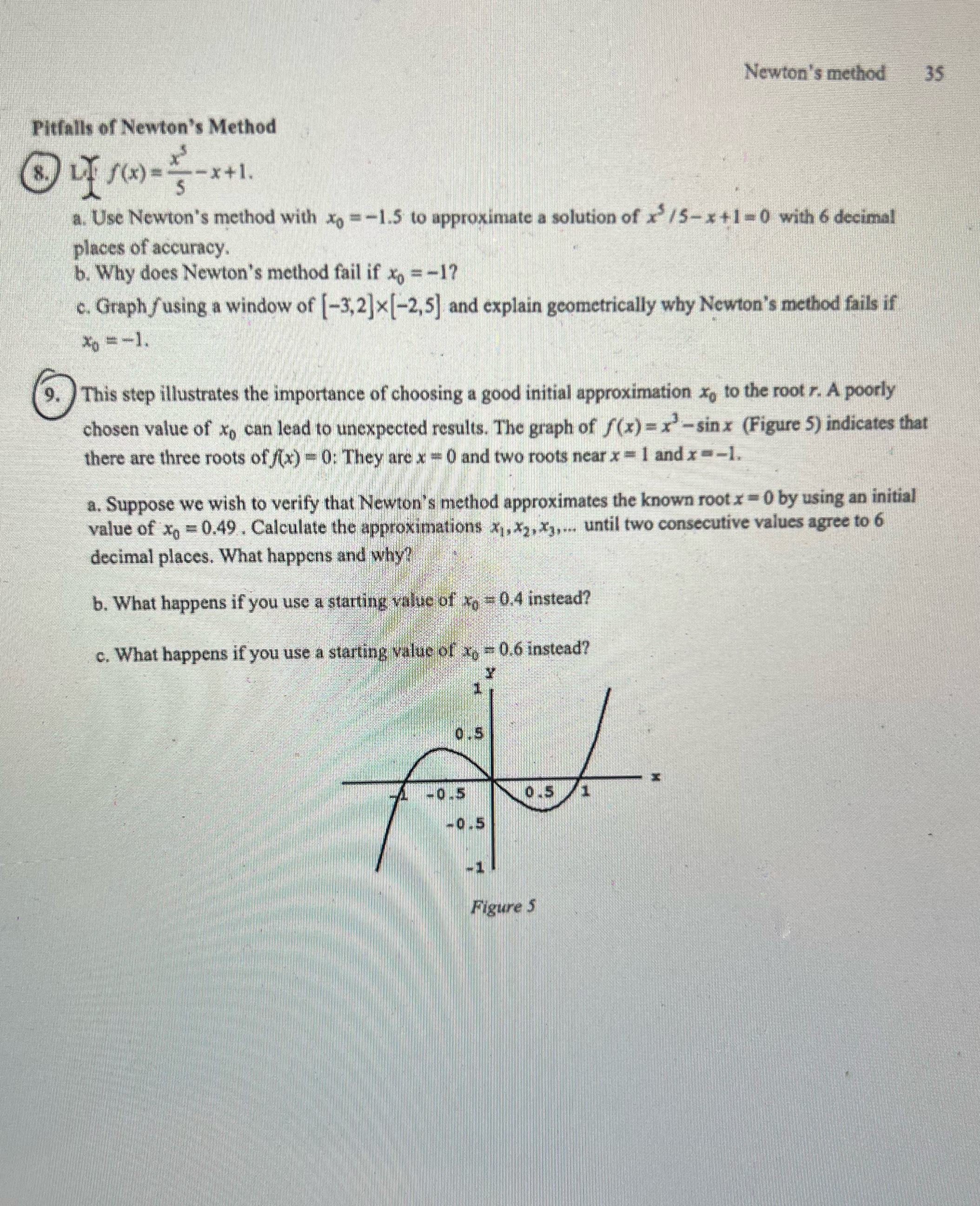
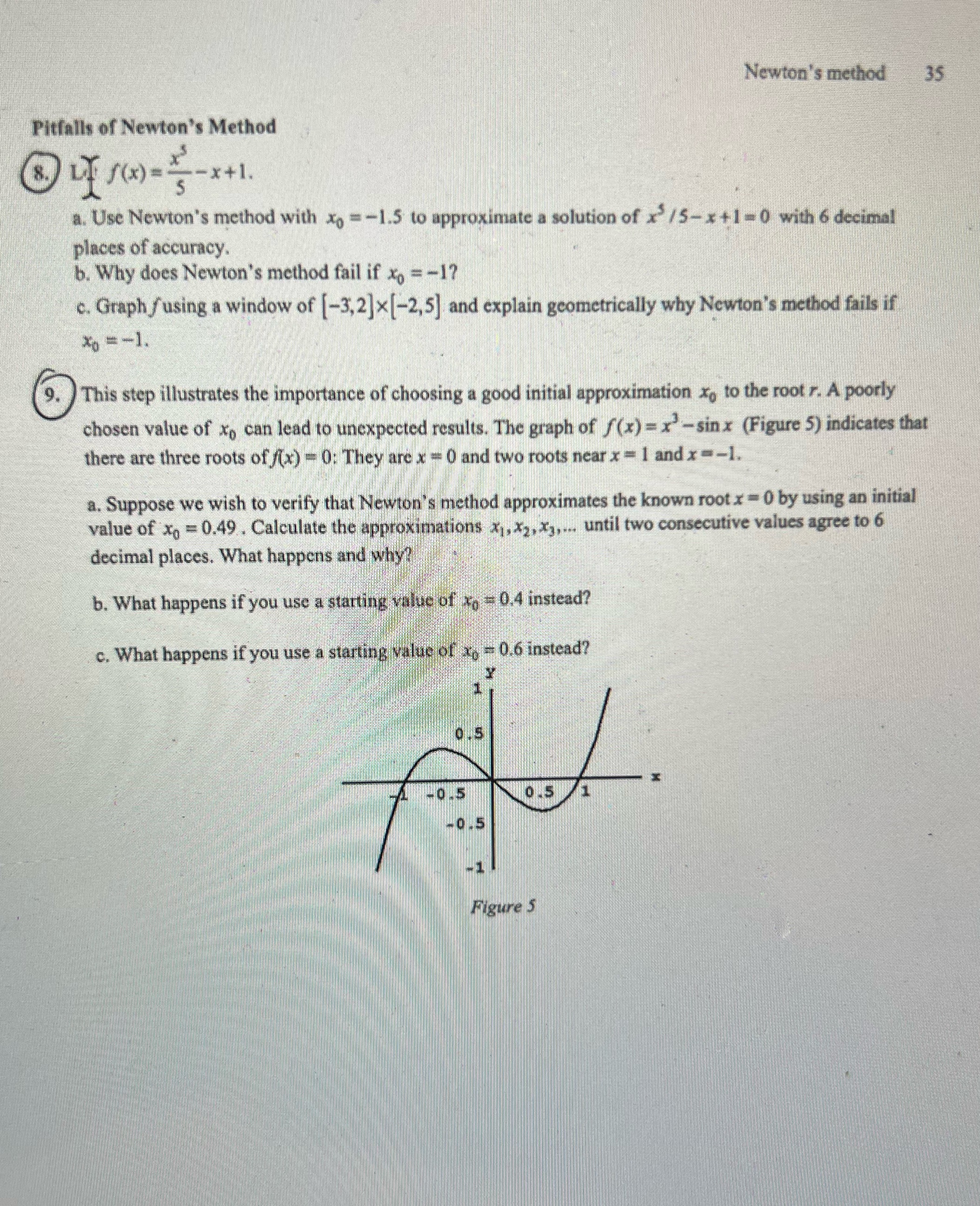
Newton's method 35 Pitfalls of Newton's Method U 1(X)=4-x+1. a. Use Newton's method with xo = -1.5 to approximate a solution of x /5-x+1-0 with 6 decimal places of accuracy. b. Why does Newton's method fail if xo =-17 c. Graph fusing a window of [-3,2]x[-2,5] and explain geometrically why Newton's method fails if Xo = -1. This step illustrates the importance of choosing a good initial approximation x, to the root r. A poorly chosen value of to can lead to unexpected results. The graph of f(x) = x -sinx (Figure 5) indicates that there are three roots of f(x) = 0: They are x = 0 and two roots near x = 1 and x - -1. a. Suppose we wish to verify that Newton's method approximates the known root x - 0 by using an initial value of xo = 0.49 . Calculate the approximations x1,X2,x,,... until two consecutive values agree to 6 decimal places. What happens and why? b. What happens if you use a starting value of to = 0.4 instead? c. What happens if you use a starting value of to = 0.6 instead? -0.5 0.5 -0 .5 Figure 5
Step by Step Solution
There are 3 Steps involved in it

Get step-by-step solutions from verified subject matter experts
 Study Help