







Question: Newton's method provides an interative strategy for solving equations of the form f(x) = 0 The basic idea is to start with some guess
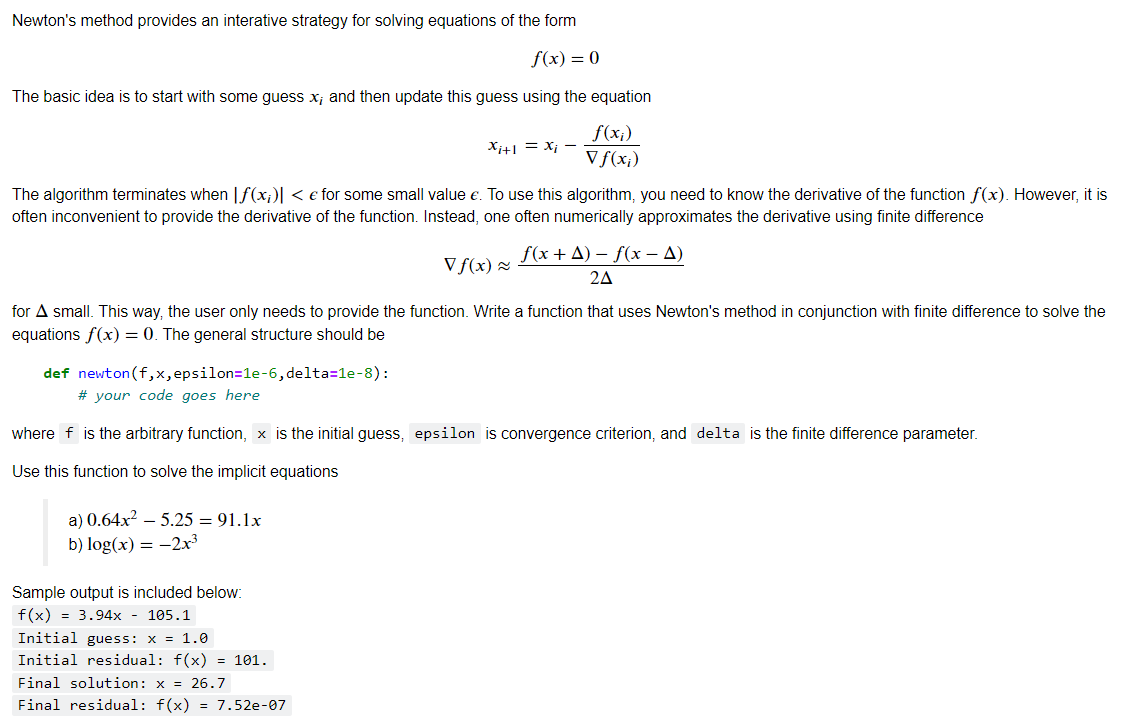
Newton's method provides an interative strategy for solving equations of the form f(x) = 0 The basic idea is to start with some guess x; and then update this guess using the equation xi+1 = xi f(xi) V f(xi) The algorithm terminates when [f(x;)| < for some small value e. To use this algorithm, you need to know the derivative of the function f(x). However, it is often inconvenient to provide the derivative of the function. Instead, one often numerically approximates the derivative using finite difference V f(x) f(x+A) f(x - A) 2A for A small. This way, the user only needs to provide the function. Write a function that uses Newton's method in conjunction with finite difference to solve the equations f(x) = 0. The general structure should be def newton(f,x,epsilon-le-6, delta=1e-8): # your code goes here where f is the arbitrary function, x is the initial guess, epsilon is convergence criterion, and delta is the finite difference parameter. Use this function to solve the implicit equations a) 0.64x2 5.25 = 91.1x b) log(x)=-2x Sample output is included below: f(x) = 3.94x 105.1 Initial guess: x = 1.0 Initial residual: f(x) = 101. Final solution: x = 26.7 Final residual: f(x) = 7.52e-07
Step by Step Solution
There are 3 Steps involved in it

Get step-by-step solutions from verified subject matter experts
 Study Help