





Question: Next consider d2 d3: :3 2 E + $2 + IE +5cosh[m)m = 0. Note that for small t) this is approximately the same as
Next consider d2 d3: :3 2 E + $2 + IE +5cosh[m)m
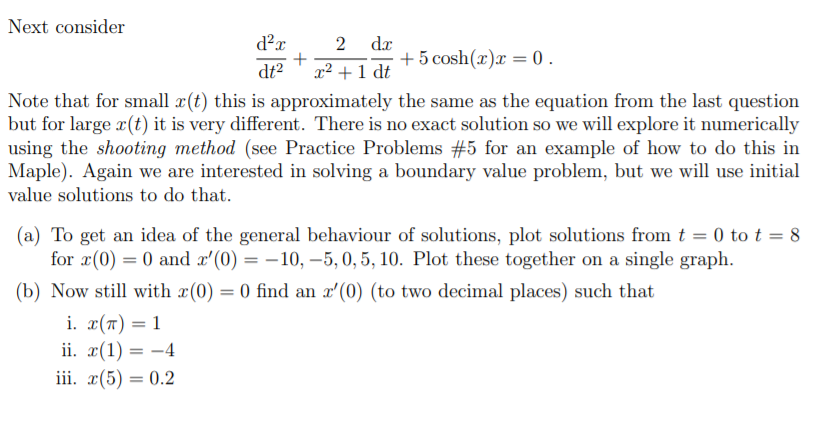
Next consider d2 d3: :3 2 E + $2 + IE +5cosh[m)m = 0. Note that for small t) this is approximately the same as the equation from the last question but for large :3:(t] it is very different. There is no exact solution so we will explore it numerically using the shooting method (see Practice Problems #5 for an example of how to do this in Maple]. Again we are interested in solving a boundary value problem, but we will use initial value solutions to do that. (a) To get an idea of the general behaviour of solutions, plot solutions from t = 0 to t = 8 for :L'{U) = {J and .1910) = 10, 5, U, 5, 10. Plot these together on a single graph. (b) Now still with mm) = i} nd an 3:10) {to two decimal places) such that i. 3(a) = 1 ii. x(1)= 4 iii. 17(5): 0.2

Step by Step Solution

There are 3 Steps involved in it

1 Expert Approved Answer
Step: 1 Unlock blur-text-image

Question Has Been Solved by an Expert!

Get step-by-step solutions from verified subject matter experts

Step: 2 Unlock
Step: 3 Unlock

Students Have Also Explored These Related Mathematics Questions!