







Question: NextGen relies on Global Positioning System ( GPS ) satellite signals to determine each aircraft's precise position in the sky . Aircraft then use Automatic
NextGen relies on Global Positioning System GPS satellite signals to determine each aircraft's precise position in the sky Aircraft then use Automatic Dependent Surveillancebroadcast ADSB technology to periodically broadcast their location information to other aircraft and air traffic control towers in the vicinity.
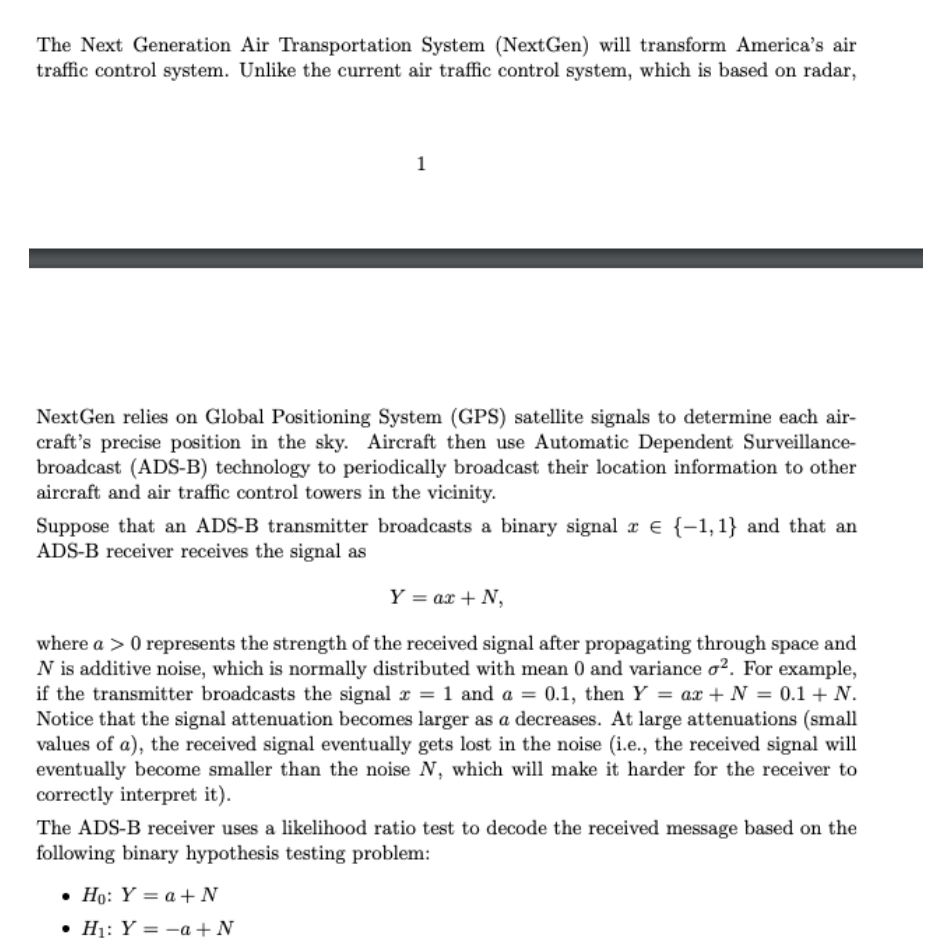
Suppose that an ADSB transmitter broadcasts a binary signal x in and that an ADSB receiver receives the signal as
Ya xN
where a represents the strength of the received signal after propagating through space and N is additive noise, which is normally distributed with mean and variance sigma For example, if the transmitter broadcasts the signal x and a then Ya xNN Notice that the signal attenuation becomes larger as a decreases. At large attenuations small values of a the received signal eventually gets lost in the noise ie the received signal will eventually become smaller than the noise N which will make it harder for the receiver to correctly interpret it
The ADSB receiver uses a likelihood ratio test to decode the received message based on the following binary hypothesis testing problem:
H: YaN
H: YaN
Step by Step Solution
There are 3 Steps involved in it
1 Expert Approved Answer
Step: 1 Unlock

Question Has Been Solved by an Expert!
Get step-by-step solutions from verified subject matter experts
Step: 2 Unlock
Step: 3 Unlock
 Study Help