







Question: ni Project Question PROJECT QUESTION: You are tasked with designing a counter-current shell and tube heat exchanger to cool down the temperature of Fluid
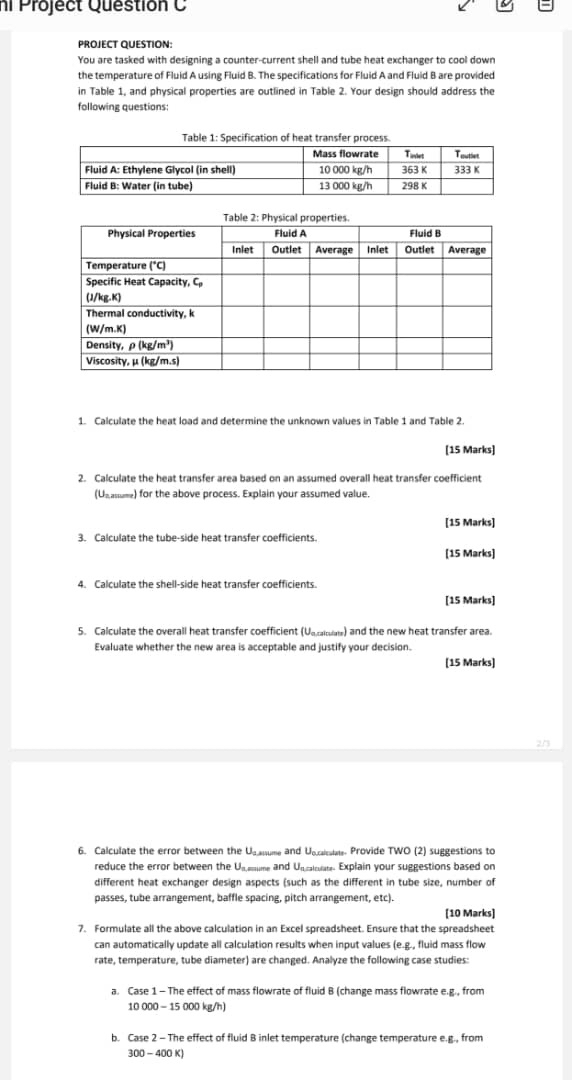
ni Project Question PROJECT QUESTION: You are tasked with designing a counter-current shell and tube heat exchanger to cool down the temperature of Fluid A using Fluid B. The specifications for Fluid A and Fluid B are provided in Table 1, and physical properties are outlined in Table 2. Your design should address the following questions: Table 1: Specification of heat transfer process. Mass flowrate T Toutlet Fluid A: Ethylene Glycol (in shell) 10 000 kg/h 363 K 333 K Fluid B: Water (in tube) 13 000 kg/h 298 K Physical Properties Table 2: Physical properties. Fluid A Inlet Outlet Average Inlet Fluid B Outlet Average Temperature (C) Specific Heat Capacity, C (1/kg.K) Thermal conductivity, k (W/m.K) Density, p (kg/m) Viscosity, (kg/m.s) 1. Calculate the heat load and determine the unknown values in Table 1 and Table 2. [15 Marks) 2. Calculate the heat transfer area based on an assumed overall heat transfer coefficient (Usa) for the above process. Explain your assumed value. 3. Calculate the tube-side heat transfer coefficients. 4. Calculate the shell-side heat transfer coefficients. [15 Marks] [15 Marks) [15 Marks] 5. Calculate the overall heat transfer coefficient (Ucalculate) and the new heat transfer area. Evaluate whether the new area is acceptable and justify your decision. [15 Marks) 6. Calculate the error between the Usume and Ucalculate Provide TWO (2) suggestions to reduce the error between the Usume and Unalate Explain your suggestions based on different heat exchanger design aspects (such as the different in tube size, number of passes, tube arrangement, baffle spacing, pitch arrangement, etc). [10 Marks] 7. Formulate all the above calculation in an Excel spreadsheet. Ensure that the spreadsheet can automatically update all calculation results when input values (e.g., fluid mass flow rate, temperature, tube diameter) are changed. Analyze the following case studies: a. Case 1-The effect of mass flowrate of fluid B (change mass flowrate e.g., from 10 000 - 15 000 kg/h) b. Case 2 - The effect of fluid B inlet temperature (change temperature e.g., from 300-400 K) 275
Step by Step Solution
There are 3 Steps involved in it

Get step-by-step solutions from verified subject matter experts
 Study Help