







Question: n(n+ 1) 2 5 ) for the positive integer n. Let An) be the statement that P+224+ 334+ . +a'= ( Complete the inductive step,

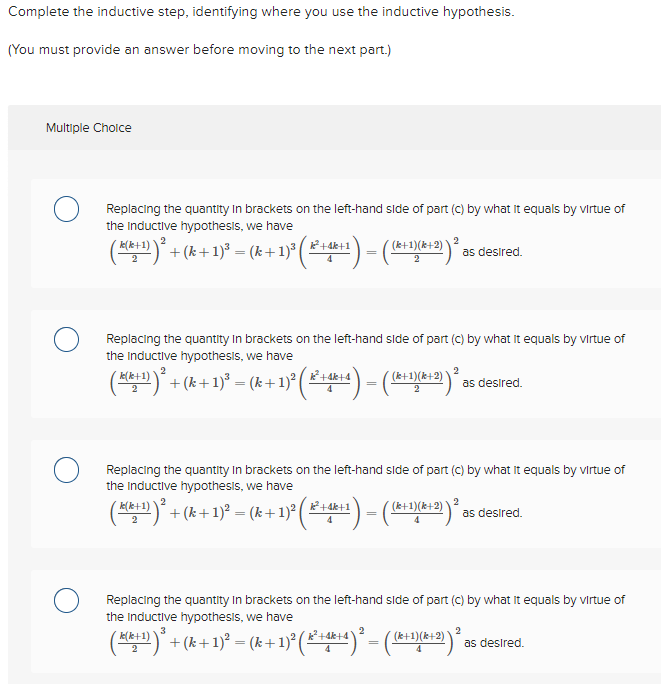
n(n+ 1) 2 5 ) for the positive integer n. Let An) be the statement that P+224+ 334+ . +a'= ( Complete the inductive step, identifying where you use the inductive hypothesis. Complete the inductive step, identifying where you use the inductive hypothesis. (You must provide an answer before moving to the next part.) Multiple Choice O Replacing the quantity In brackets on the left-hand side of part (c) by what it equals by virtue of the Inductive hypothesis, we have (1(1+1) + (k + 1)3 - (k+1)3(12+ak+1 )=[k+1)(k+2) as desired. O Replacing the quantity In brackets on the left-hand side of part (c) by what it equals by virtue of the Inductive hypothesis, we have (1( + 1) ) + ( k + 1)3 - (k+ 1)2(1+ak+ - 4k+4 ) = ( ( * + 1 ) ( * + 2 ) ) as desired. O Replacing the quantity In brackets on the left-hand side of part (c) by what it equals by virtue of the Inductive hypothesis, we have (1(*+1) ) + (k + 1)2 = (k+1)2 (12+ak+1 ) = ([k+1)(1+2) \\2 as desired. O Replacing the quantity In brackets on the left-hand side of part (c) by what it equals by virtue of the Inductive hypothesis, we have -2 ) + ( k + 1) ? = ( k + 1) ? ( 12+ak+4 ) " ( [ k+1)(k+2) ) as desired
Step by Step Solution
There are 3 Steps involved in it

Get step-by-step solutions from verified subject matter experts
 Study Help