







Question: ^ nnu.instructure.com + Textbook:... MInbox (30,... Capstone... Sr. Sem M... Untitled d... 7. Top 1200. the obligation to perform is extinguished. Likewise here, argues case
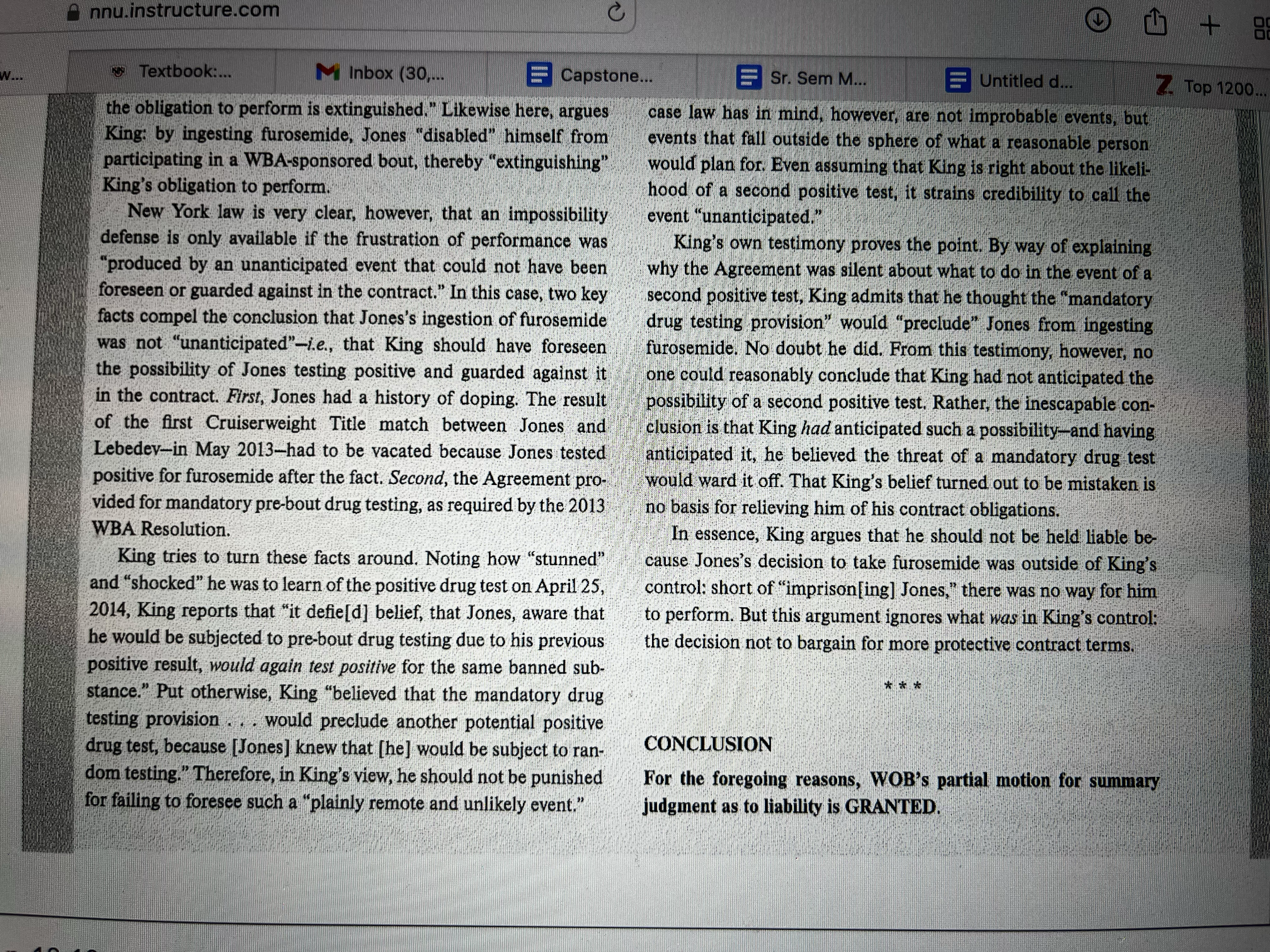
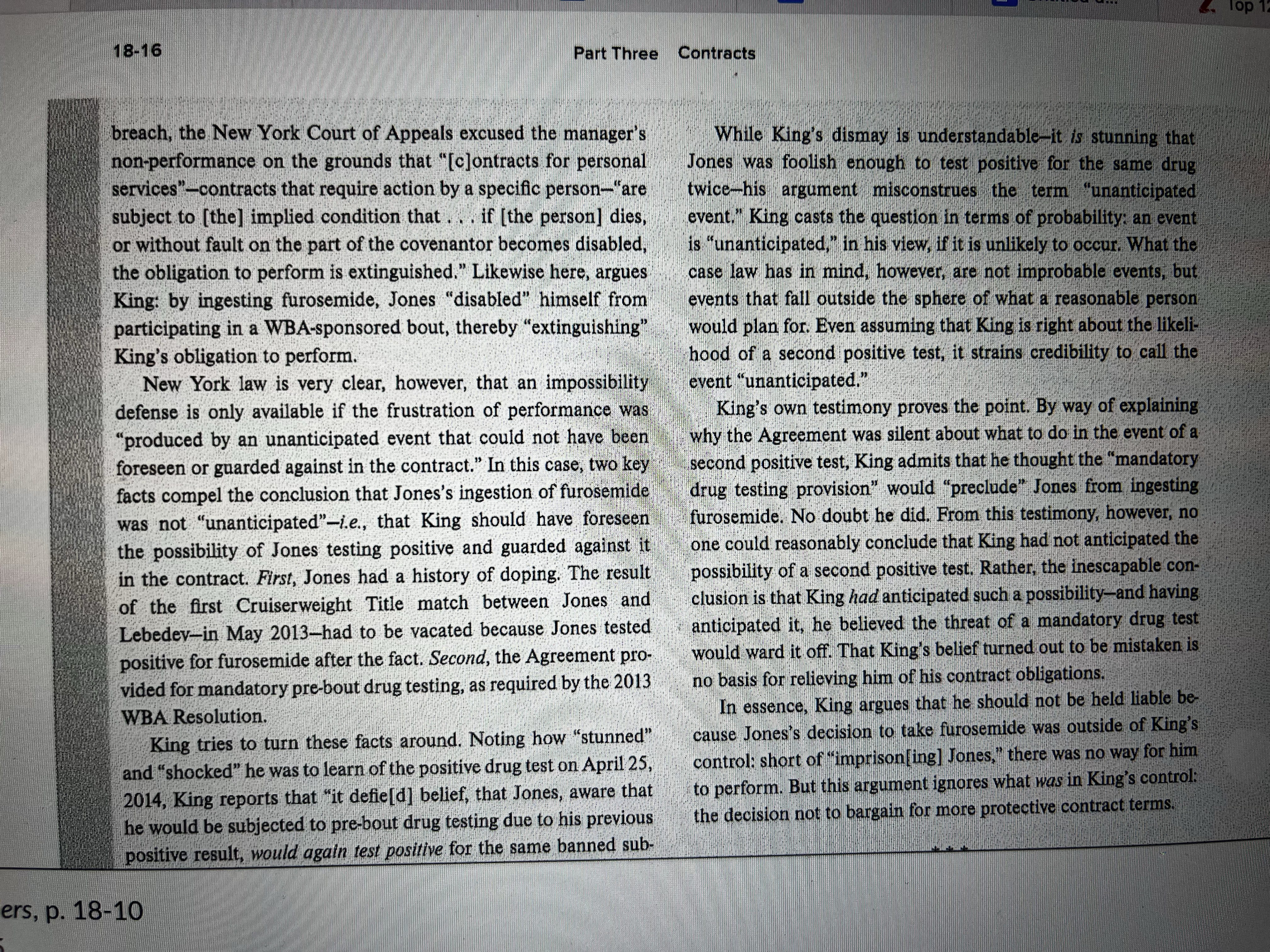
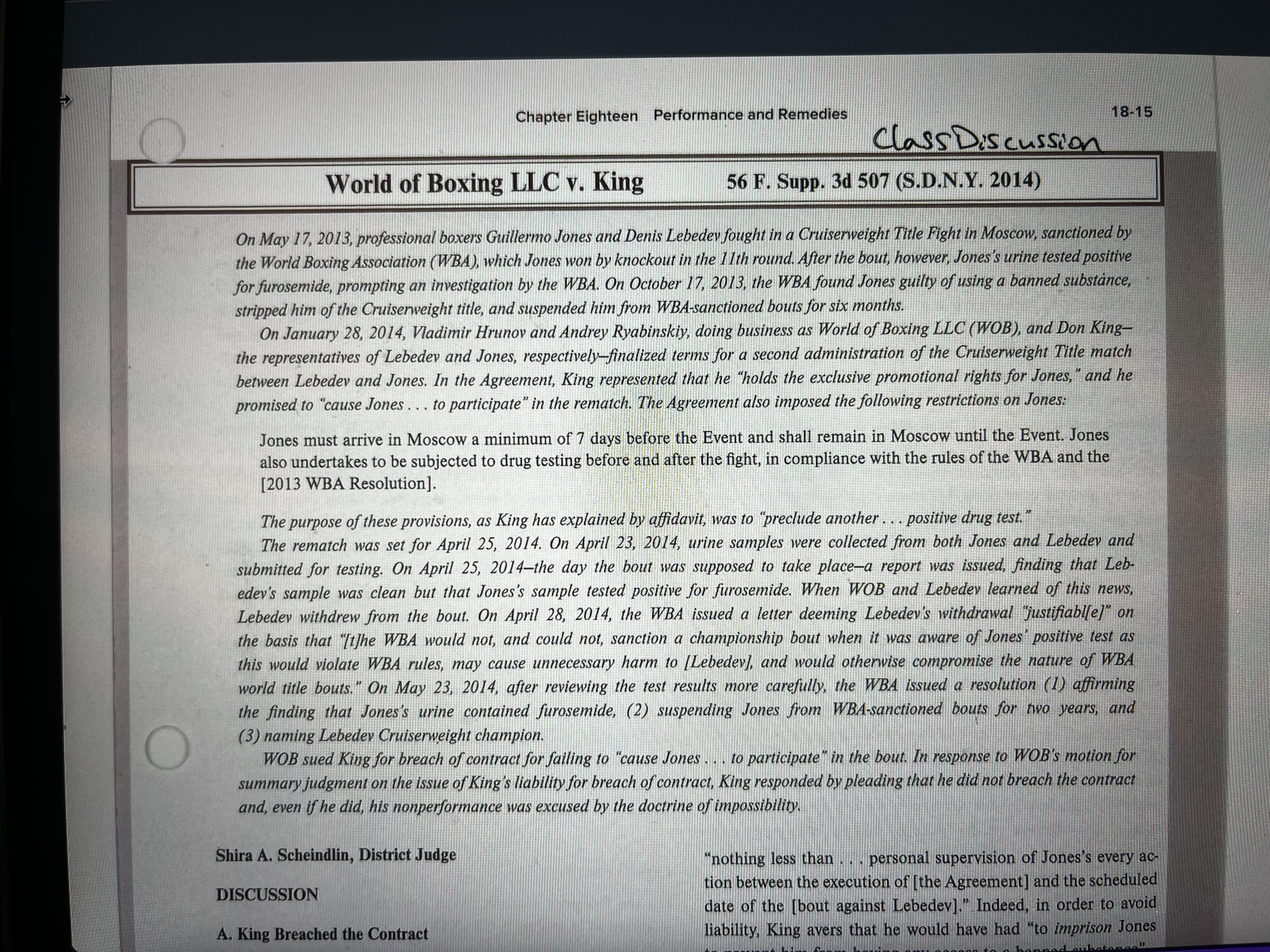
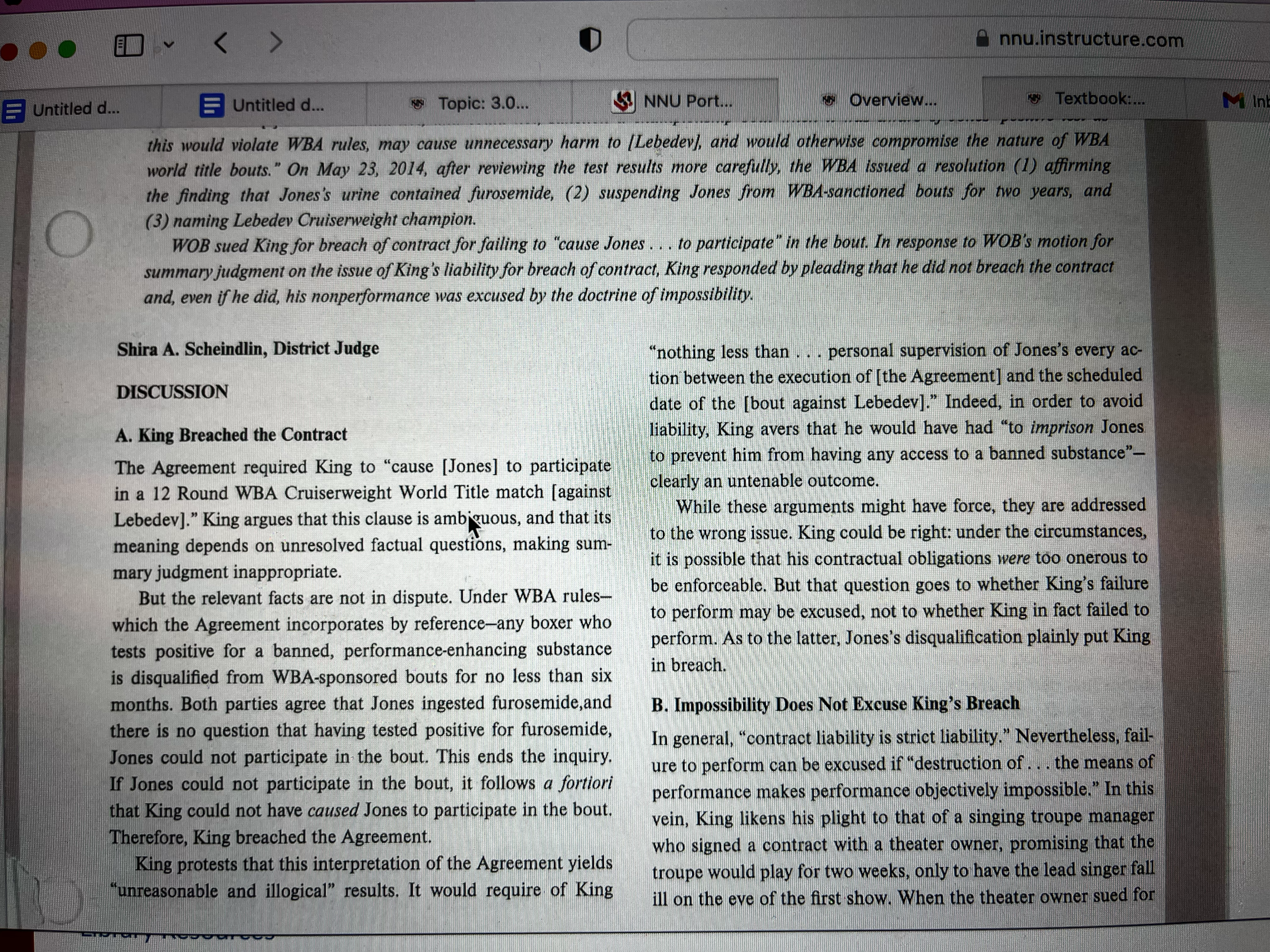
^ nnu.instructure.com + Textbook:... MInbox (30,... Capstone... Sr. Sem M... Untitled d... 7. Top 1200. the obligation to perform is extinguished." Likewise here, argues case law has in mind, however, are not improbable events, but King: by ingesting furosemide, Jones "disabled" himself from events that fall outside the sphere of what a reasonable person participating in a WBA-sponsored bout, thereby "extinguishing" would plan for. Even assuming that King is right about the likeli- King's obligation to perform. hood of a second positive test, it strains credibility to call the New York law is very clear, however, that an impossibility event "unanticipated." defense is only available if the frustration of performance was King's own testimony proves the point. By way of explaining "produced by an unanticipated event that could not have been why the Agreement was silent about what to do in the event of a foreseen or guarded against in the contract." In this case, two key second positive test, King admits that he thought the "mandatory facts compel the conclusion that Jones's ingestion of furosemide drug testing provision" would "preclude" Jones from ingesting was not "unanticipated"-i.e., that King should have foreseen furosemide. No doubt he did. From this testimony, however, no the possibility of Jones testing positive and guarded against it one could reasonably conclude that King had not anticipated the in the contract. First, Jones had a history of doping. The result possibility of a second positive test. Rather, the inescapable con- of the first Cruiserweight Title match between Jones and clusion is that King had anticipated such a possibility-and having Lebedev-in May 2013-had to be vacated because Jones tested anticipated it, he believed the threat of a mandatory drug test positive for furosemide after the fact. Second, the Agreement pro- would ward it off. That King's belief turned out to be mistaken is vided for mandatory pre-bout drug testing, as required by the 2013 no basis for relieving him of his contract obligations. WBA Resolution. In essence, King argues that he should not be held liable be- King tries to turn these facts around. Noting how "stunned" cause Jones's decision to take furosemide was outside of King's and "shocked" he was to learn of the positive drug test on April 25, control: short of "imprison [ing] Jones," there was no way for him 2014, King reports that "it defie[d] belief, that Jones, aware that to perform. But this argument ignores what was in King's control: he would be subjected to pre-bout drug testing due to his previous the decision not to bargain for more protective contract terms. positive result, would again test positive for the same banned sub- stance." Put otherwise, King "believed that the mandatory drug testing provision . . . would preclude another potential positive drug test, because [Jones] knew that [he] would be subject to ran- CONCLUSION dom testing." Therefore, in King's view, he should not be punished For the foregoing reasons, WOB's partial motion for summary for failing to foresee such a "plainly remote and unlikely event." judgment as to liability is GRANTED18-16 Part Three Contracts breach, the New York Court of Appeals excused the manager's While King's dismay is understandable-it is stunning that non-performance on the grounds that "[contracts for personal Jones was foolish enough to test positive for the same drug services"-contracts that require action by a specific person-"are twice-his argument misconstrues the term "unanticipated subject to [the] implied condition that . . . if [the person] dies, event." King casts the question in terms of probability: an event or without fault on the part of the covenantor becomes disabled, is "unanticipated," in his view, if it is unlikely to occur. What the the obligation to perform is extinguished." Likewise here, argues case law has in mind, however, are not improbable events, but King: by ingesting furosemide, Jones "disabled" himself from events that fall outside the sphere of what a reasonable person participating in a WBA-sponsored bout, thereby "extinguishing" would plan for. Even assuming that King is right about the likeli- King's obligation to perform. hood of a second positive test, it strains credibility to call the New York law is very clear, however, that an impossibility event "unanticipated." defense is only available if the frustration of performance was King's own testimony proves the point. By way of explaining "produced by an unanticipated event that could not have been why the Agreement was silent about what to do in the event of a foreseen or guarded against in the contract." In this case, two key second positive test, King admits that he thought the "mandatory facts compel the conclusion that Jones's ingestion of furosemide drug testing provision" would "preclude" Jones from ingesting was not "unanticipated"-i.e., that King should have foreseen furosemide. No doubt he did. From this testimony, however, no the possibility of Jones testing positive and guarded against it one could reasonably conclude that King had not anticipated the in the contract. First, Jones had a history of doping. The result possibility of a second positive test. Rather, the inescapable con- of the first Cruiserweight Title match between Jones and clusion is that King had anticipated such a possibility-and having Lebedev-in May 2013-had to be vacated because Jones tested anticipated it, he believed the threat of a mandatory drug test positive for furosemide after the fact. Second, the Agreement pro- would ward it off. That King's belief turned out to be mistaken is vided for mandatory pre-bout drug testing, as required by the 2013 no basis for relieving him of his contract obligations. WBA Resolution. In essence, King argues that he should not be held liable be- King tries to turn these facts around. Noting how "stunned" cause Jones's decision to take furosemide was outside of King's and "shocked" he was to learn of the positive drug test on April 25, control: short of "'imprison[ing] Jones," there was no way for him 2014, King reports that "it defie[d] belief, that Jones, aware that to perform. But this argument ignores what was in King's control: he would be subjected to pre-bout drug testing due to his previous the decision not to bargain for more protective contract terms. positive result, would again test positive for the same banned sub- ers, p. 18-10Chapter Eighteen Performance and Remedies 18-15 Class Discussion World of Boxing LLC v. King 56 F. Supp. 3d 507 (S.D.N.Y. 2014) On May 17, 2013, professional boxers Guillermo Jones and Denis Lebedev fought in a Cruiserweight Title Fight in Moscow, sanctioned by the World Boxing Association (WBA), which Jones won by knockout in the 1 1th round. After the bout, however, Jones's urine tested positive for furosemide, prompting an investigation by the WBA. On October 17, 2013, the WBA found Jones guilty of using a banned substance, stripped him of the Cruiserweight title, and suspended him from WBA-sanctioned bouts for six months. On January 28, 2014, Vladimir Hrunov and Andrey Ryabinskiy, doing business as World of Boxing LLC (WOB), and Don King- the representatives of Lebedev and Jones, respectively-finalized terms for a second administration of the Cruiserweight Title match between Lebedev and Jones. In the Agreement, King represented that he "holds the exclusive promotional rights for Jones," and he promised to "cause Jones . . . to participate" in the rematch. The Agreement also imposed the following restrictions on Jones: Jones must arrive in Moscow a minimum of 7 days before the Event and shall remain in Moscow until the Event. Jones also undertakes to be subjected to drug testing before and after the fight, in compliance with the rules of the WBA and the [2013 WBA Resolution]. The purpose of these provisions, as King has explained by affidavit, was to "preclude another . . . positive drug test." The rematch was set for April 25, 2014. On April 23, 2014, urine samples were collected from both Jones and Lebedev and submitted for testing. On April 25, 2014-the day the bout was supposed to take place-a report was issued, finding that Leb- edev's sample was clean but that Jones's sample tested positive for furosemide. When WOB and Lebedev learned of this news, Lebedev withdrew from the bout. On April 28, 2014, the WBA issued a letter deeming Lebedev's withdrawal "justifiable]" on the basis that "[the WBA would not, and could not, sanction a championship bout when it was aware of Jones' positive test as this would violate WBA rules, may cause unnecessary harm to [Lebedev], and would otherwise compromise the nature of WBA world title bouts. " On May 23, 2014, after reviewing the test results more carefully, the WBA issued a resolution (1) affirming the finding that Jones's urine contained furosemide, (2) suspending Jones from WBA-sanctioned bouts for two years, and O (3) naming Lebedev Cruiserweight champion. WOB sued King for breach of contract for failing to "cause Jones . . . to participate" in the bout. In response to WOB's motion for summary judgment on the issue of King's liability for breach of contract, King responded by pleading that he did not breach the contract and, even if he did, his nonperformance was excused by the doctrine of impossibility. Shira A. Scheindlin, District Judge "nothing less than . . , personal supervision of Jones's every ac- DISCUSSION tion between the execution of [the Agreement] and the scheduled date of the [bout against Lebedev]." Indeed, in order to avoid A. King Breached the Contract liability, King avers that he would have had "to imprison Jonesnnu.instructure.com Untitled d... Untitled d... Topic: 3.0... $3NNU Port... Overview... Textbook:... M In this would violate WBA rules, may cause unnecessary harm to [Lebedev], and would otherwise compromise the nature of WBA world title bouts. " On May 23, 2014, after reviewing the test results more carefully, the WBA issued a resolution (1) affirming the finding that Jones's urine contained furosemide, (2) suspending Jones from WBA-sanctioned bouts for two years, and (3) naming Lebedev Cruiserweight champion. WOB sued King for breach of contract for failing to "cause Jones . . . to participate" in the bout. In response to WOB's motion for summary judgment on the issue of King's liability for breach of contract, King responded by pleading that he did not breach the contract and, even if he did, his nonperformance was excused by the doctrine of impossibility. Shira A. Scheindlin, District Judge "nothing less than . . . personal supervision of Jones's every ac- DISCUSSION tion between the execution of [the Agreement] and the scheduled date of the [bout against Lebedev]." Indeed, in order to avoid A. King Breached the Contract liability, King avers that he would have had "to imprison Jones The Agreement required King to "cause [Jones] to participate to prevent him from having any access to a banned substance"- in a 12 Round WBA Cruiserweight World Title match [against clearly an untenable outcome. Lebedev]." King argues that this clause is ambiguous, and that its While these arguments might have force, they are addressed meaning depends on unresolved factual questions, making sum- to the wrong issue. King could be right: under the circumstances, mary judgment inappropriate. it is possible that his contractual obligations were too onerous to But the relevant facts are not in dispute. Under WBA rules- be enforceable. But that question goes to whether King's failure which the Agreement incorporates by reference-any boxer who to perform may be excused, not to whether King in fact failed to tests positive for a banned, performance-enhancing substance perform. As to the latter, Jones's disqualification plainly put King is disqualified from WBA-sponsored bouts for no less than six in breach. months. Both parties agree that Jones ingested furosemide, and B. Impossibility Does Not Excuse King's Breach there is no question that having tested positive for furosemide, In general, "contract liability is strict liability." Nevertheless, fail- Jones could not participate in the bout. This ends the inquiry. ure to perform can be excused if "destruction of . . . the means of If Jones could not participate in the bout, it follows a fortiori performance makes performance objectively impossible." In this that King could not have caused Jones to participate in the bout. vein, King likens his plight to that of a singing troupe manager Therefore, King breached the Agreement. who signed a contract with a theater owner, promising that the King protests that this interpretation of the Agreement yields troupe would play for two weeks, only to have the lead singer fall "unreasonable and illogical" results. It would require of King ill on the eve of the first show. When the theater owner sued for
Step by Step Solution
There are 3 Steps involved in it

Get step-by-step solutions from verified subject matter experts
 Study Help