







Question: No 3. Consider three securities: Asset 1 with expected return of 14% and standard deviation of return of 6%, Asset 2 with average return of
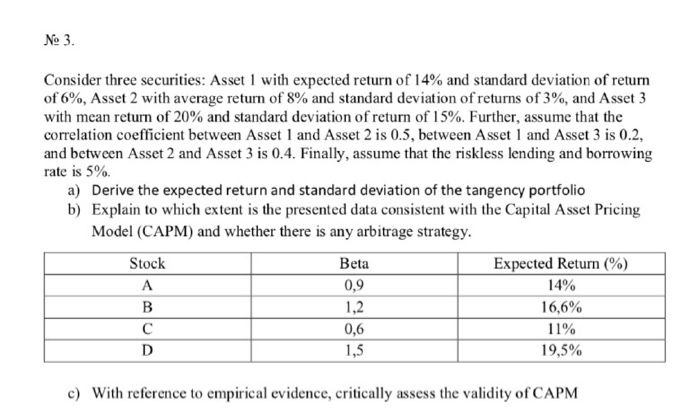
No 3. Consider three securities: Asset 1 with expected return of 14% and standard deviation of return of 6%, Asset 2 with average return of 8% and standard deviation of returns of 3%, and Asset 3 with mean return of 20% and standard deviation of return of 15%. Further, assume that the correlation coefficient between Asset 1 and Asset 2 is 0.5, between Asset 1 and Asset 3 is 0.2, and between Asset 2 and Asset 3 is 0.4. Finally, assume that the riskless lending and borrowing rate is 5%. a) Derive the expected return and standard deviation of the tangency portfolio b) Explain to which extent is the presented data consistent with the Capital Asset Pricing Model (CAPM) and whether there is any arbitrage strategy. Stock Beta Expected Return (%) 0,9 14% 1,2 16,6% 0,6 11% 19,5% 1,5 c) With reference to empirical evidence, critically assess the validity of CAPM No 3. Consider three securities: Asset 1 with expected return of 14% and standard deviation of return of 6%, Asset 2 with average return of 8% and standard deviation of returns of 3%, and Asset 3 with mean return of 20% and standard deviation of return of 15%. Further, assume that the correlation coefficient between Asset 1 and Asset 2 is 0.5, between Asset 1 and Asset 3 is 0.2, and between Asset 2 and Asset 3 is 0.4. Finally, assume that the riskless lending and borrowing rate is 5%. a) Derive the expected return and standard deviation of the tangency portfolio b) Explain to which extent is the presented data consistent with the Capital Asset Pricing Model (CAPM) and whether there is any arbitrage strategy. Stock Beta Expected Return (%) 0,9 14% 1,2 16,6% 0,6 11% 19,5% 1,5 c) With reference to empirical evidence, critically assess the validity of CAPM
Step by Step Solution
There are 3 Steps involved in it

Get step-by-step solutions from verified subject matter experts
 Study Help