







Question: NO CODE REQUIRED 2. A solution to the problem is any partitioning of all the intervals into compatible sub- sets. A solution is optimal if
NO CODE REQUIRED
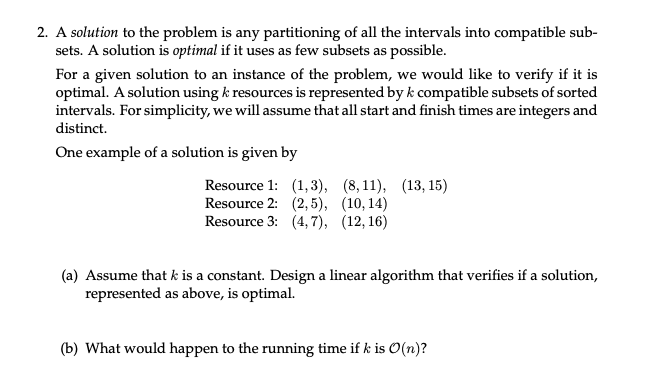
2. A solution to the problem is any partitioning of all the intervals into compatible sub- sets. A solution is optimal if it uses as few subsets as possible. For a given solution to an instance of the problem, we would like to verify if it is optimal. A solution using k resources is represented by k compatible subsets of sorted intervals. For simplicity, we will assume that all start and finish times are integers and distinct. One example of a solution is given by Resource 1: (1,3), (8,11), (13, 15) Resource 2: (2,5), (10, 14) Resource 3: (4,7), (12, 16) (a) Assume that k is a constant. Design a linear algorithm that verifies if a solution, represented as above, is optimal. (b) What would happen to the running time if k is O(n)? 2. A solution to the problem is any partitioning of all the intervals into compatible sub- sets. A solution is optimal if it uses as few subsets as possible. For a given solution to an instance of the problem, we would like to verify if it is optimal. A solution using k resources is represented by k compatible subsets of sorted intervals. For simplicity, we will assume that all start and finish times are integers and distinct. One example of a solution is given by Resource 1: (1,3), (8,11), (13, 15) Resource 2: (2,5), (10, 14) Resource 3: (4,7), (12, 16) (a) Assume that k is a constant. Design a linear algorithm that verifies if a solution, represented as above, is optimal. (b) What would happen to the running time if k is O(n)
Step by Step Solution
There are 3 Steps involved in it

Get step-by-step solutions from verified subject matter experts
 Study Help