







Question: No coding language just pseudo-code. hw3 (3).pdf 2.4 CHALLENGE Mike Rowe is the President, CEO, and only employee of Mike RoweSoft Corporation. He is working
No coding language just pseudo-code.
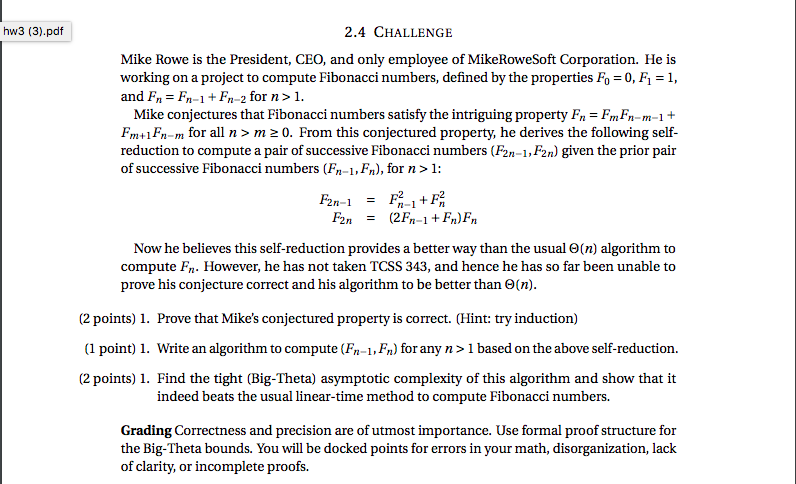
hw3 (3).pdf 2.4 CHALLENGE Mike Rowe is the President, CEO, and only employee of Mike RoweSoft Corporation. He is working on a project to compute Fibonacci numbers, defined by the properties Fo = 0, F1 = 1, and Fn = Fn-1 + Fn-2 for n>1. Mike conjectures that Fibonacci numbers satisfy the intriguing property Fn = FmFn-m-1+ Fm+1 Fn-m for all n>m > 0. From this conjectured property, he derives the following self- reduction to compute a pair of successive Fibonacci numbers (F2n-1,F2) given the prior pair of successive Fibonacci numbers (Fn-1,Fn), for n> 1: F2n-1 = P2-1+F? F2n = (2Fn-1 +Fn)Fn Now he believes this self-reduction provides a better way than the usual O(n) algorithm to compute Fn. However, he has not taken TCSS 343, and hence he has so far been unable to prove his conjecture correct and his algorithm to be better than (n). (2 points) 1. Prove that Mike's conjectured property is correct. (Hint: try induction) (1 point) 1. Write an algorithm to compute (Fn-1,Fn) for any n> 1 based on the above self-reduction. (2 points) 1. Find the tight (Big-Theta) asymptotic complexity of this algorithm and show that it indeed beats the usual linear-time method to compute Fibonacci numbers. Grading Correctness and precision are of utmost importance. Use formal proof structure for the Big-Theta bounds. You will be docked points for errors in your math, disorganization, lack of clarity, or incomplete proofs. hw3 (3).pdf 2.4 CHALLENGE Mike Rowe is the President, CEO, and only employee of Mike RoweSoft Corporation. He is working on a project to compute Fibonacci numbers, defined by the properties Fo = 0, F1 = 1, and Fn = Fn-1 + Fn-2 for n>1. Mike conjectures that Fibonacci numbers satisfy the intriguing property Fn = FmFn-m-1+ Fm+1 Fn-m for all n>m > 0. From this conjectured property, he derives the following self- reduction to compute a pair of successive Fibonacci numbers (F2n-1,F2) given the prior pair of successive Fibonacci numbers (Fn-1,Fn), for n> 1: F2n-1 = P2-1+F? F2n = (2Fn-1 +Fn)Fn Now he believes this self-reduction provides a better way than the usual O(n) algorithm to compute Fn. However, he has not taken TCSS 343, and hence he has so far been unable to prove his conjecture correct and his algorithm to be better than (n). (2 points) 1. Prove that Mike's conjectured property is correct. (Hint: try induction) (1 point) 1. Write an algorithm to compute (Fn-1,Fn) for any n> 1 based on the above self-reduction. (2 points) 1. Find the tight (Big-Theta) asymptotic complexity of this algorithm and show that it indeed beats the usual linear-time method to compute Fibonacci numbers. Grading Correctness and precision are of utmost importance. Use formal proof structure for the Big-Theta bounds. You will be docked points for errors in your math, disorganization, lack of clarity, or incomplete proofs
Step by Step Solution
There are 3 Steps involved in it

Get step-by-step solutions from verified subject matter experts
 Study Help