



Question: No explanation for this problem is necessary. Thank you. Consider the following Cobb-Douglas production function: =2 x / 1/413/4. This production function implies that If
No explanation for this problem is necessary. Thank you.


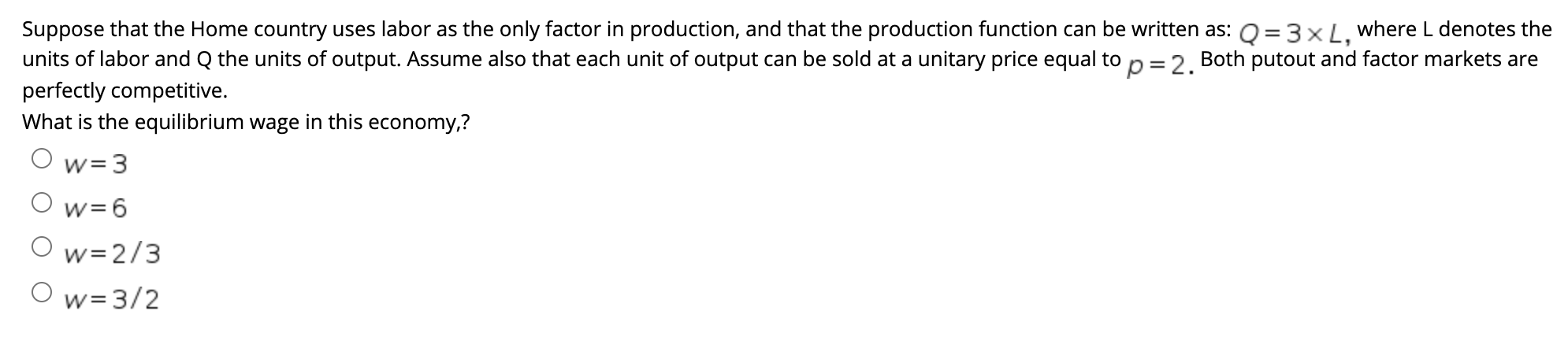
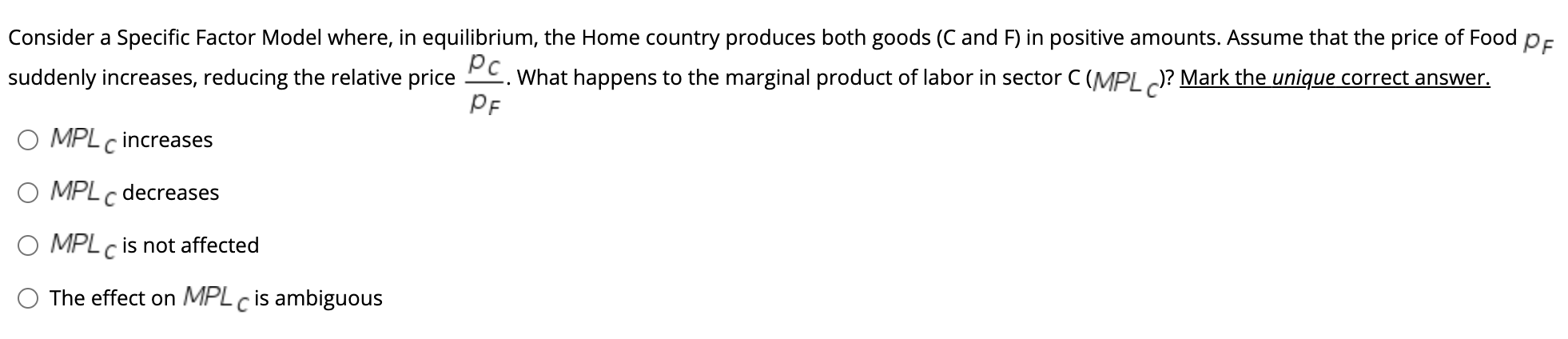
Consider the following Cobb-Douglas production function: =2 x / 1/413/4. This production function implies that If the country wants to increase the marginal product of capital (MPK) by a factor @, it has to proportionally increase all inputs by the same factor a. O True O FalseConsider the following production function Y= 2K1 / 2L1 / 2, where Y denotes units of output and capital is a fixed factor, as in the specic factor modeli Suppose that following growth in the capital sector, the country can now use 4 extra units of capital at no cost. How does growth affect the marginal productivity of labor (i.e., the MPL)? O MPL is unaffected by the shock O MPL is twice as large after the shock O MPL halves after the shock O MPL is four times as large after the shock Suppose that the Home country uses labor as the only factor in production, and that the production function can be written as: Q = 3 x L, where L denotes the units of labor and Q the units of output Assume also that each unit of output can be sold at a unitary price equal to p = 2 . Both putout and factor markets are perfectly competitive. What is the equilibrium wage in this economy,? 0 W=3 Ow=6 O w=2/3 Consider a Specific Factor Model where, in equilibrium, the Home country produces both goods (C and F) in positive amounts. Assume that the price of Food pF suddenly increases, reducing the relative price p_C. What happens to the marginal product of labor in sector C (MPL C)? Mark the unique correct answer. PF 0 MPLC increases 0 MPL C decreases O MPL C is not affected 0 The effect on MPLC is ambiguous
Step by Step Solution
There are 3 Steps involved in it

Get step-by-step solutions from verified subject matter experts