







Question: No missing data or material. hw help. Question 6. A pharmaceutical company decides how to allocate the resources between production/ development of 2 drugs -
No missing data or material. hw help.
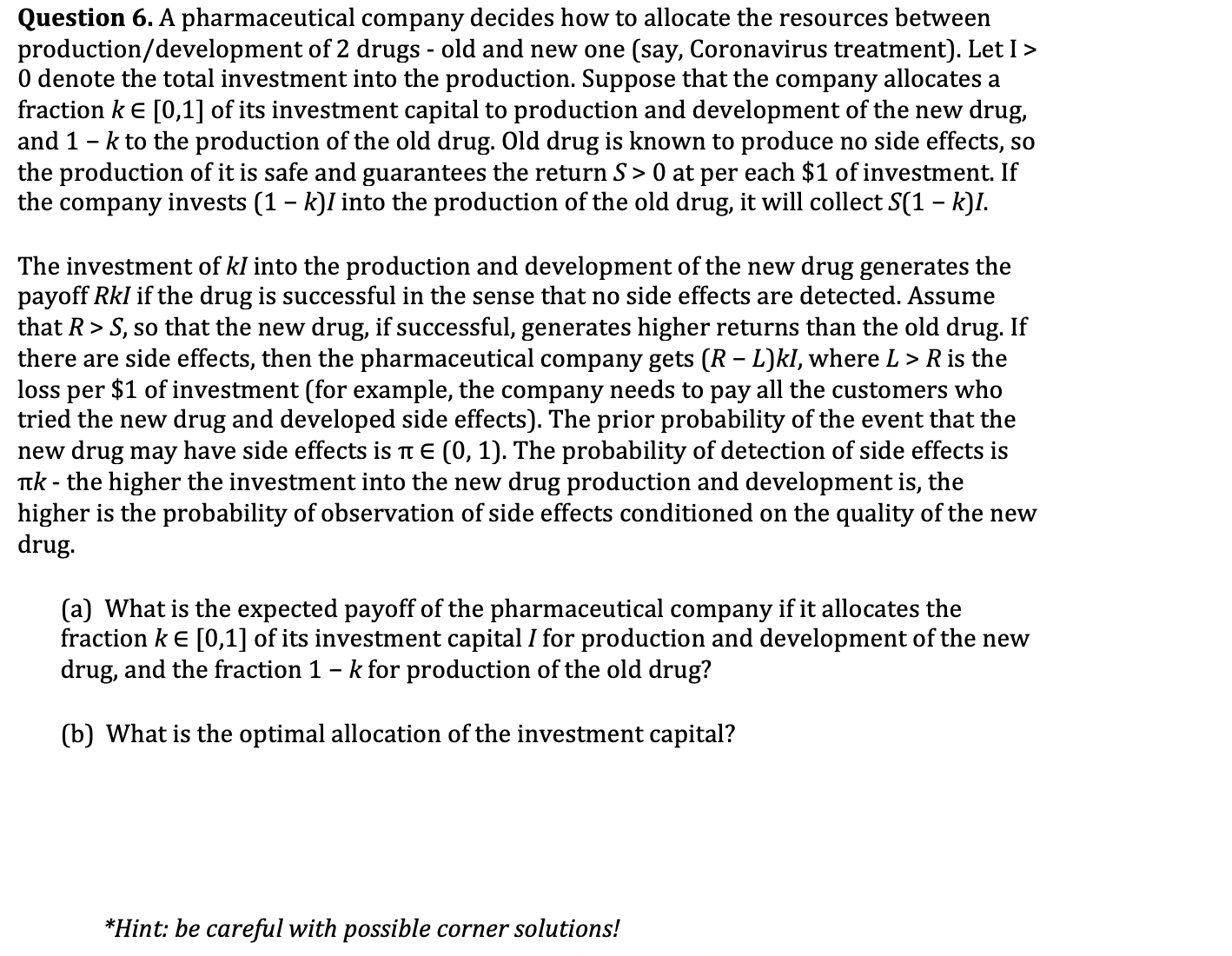
Question 6. A pharmaceutical company decides how to allocate the resources between production/ development of 2 drugs - old and new one (say, Coronavirus treatment). Let I > 0 denote the total investment into the production. Suppose that the company allocates a fraction k E [0,1] of its investment capital to production and development of the new drug, and 1 k to the production of the old drug. 01d drug is known to produce no side effects, so the production of it is safe and guarantees the return 3 > 0 at per each $1 of investment. If the company invests [1 k)! into the production of the old drug, it will collect 3(1 k)I. The investment of RI into the production and development of the new drug generates the payoff Rk! if the drug is successful in the sense that no side effects are detected. Assume that R > S, so that the new drug, if successful, generates higher returns than the old drug. If there are side effects, then the pharmaceutical company gets [R L)kI, where L > R is the loss per $1 of investment (for example, the company needs to pay all the customers who tried the new drug and developed side effects). The prior probability of the event that the new drug may have side effects is 11 E (0, 1). The probability of detection of side effects is 11k - the higher the investment into the new drug production and development is, the higher is the probability of observation of side effects conditioned on the quality of the new drug. (a) What is the expected payoff of the pharmaceutical company if it allocates the fraction k E [0,1] of its investment capital I for production and development of the new drug, and the fraction 1 k for production of the old drug? (b) What is the optimal allocation of the investment capital? *Hin t: be careJl with possible corner solutions
Step by Step Solution
There are 3 Steps involved in it

Get step-by-step solutions from verified subject matter experts
 Study Help