







Question: No need solutions, just final answer will do Let U be the universal set and let A and B be subsets of U. What is
No need solutions, just final answer will do
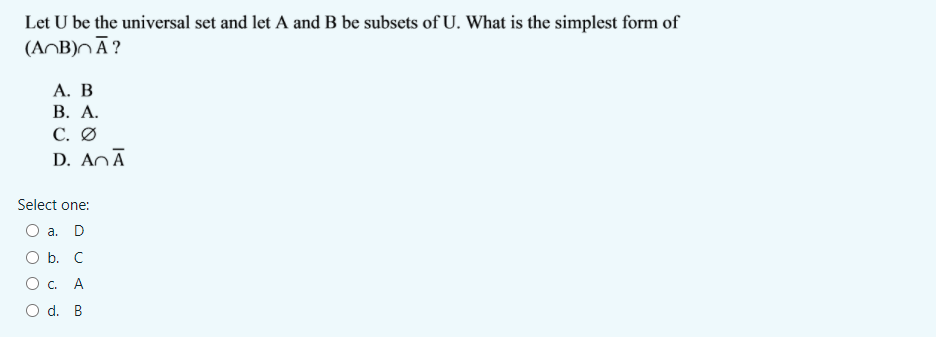
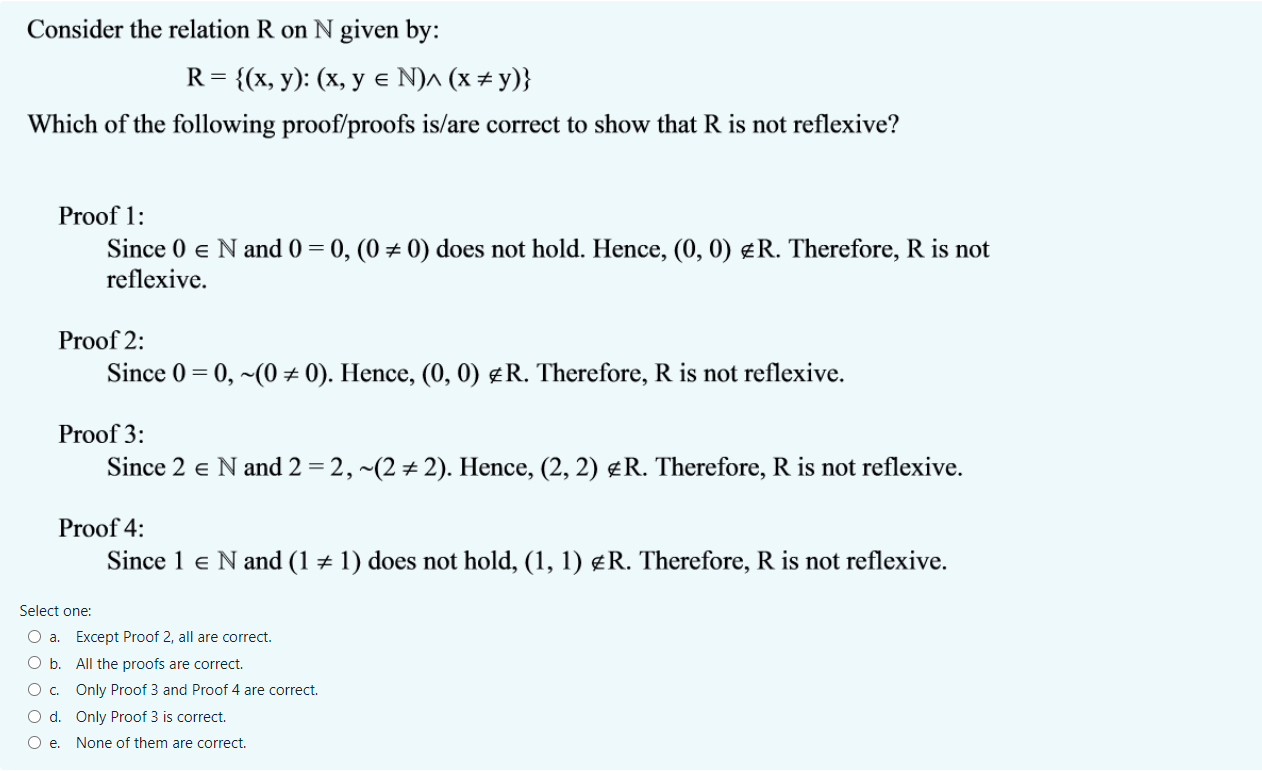
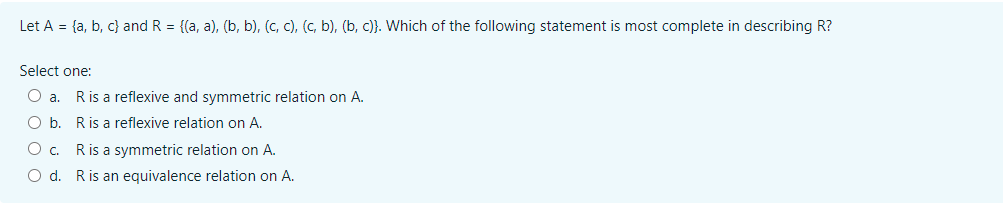
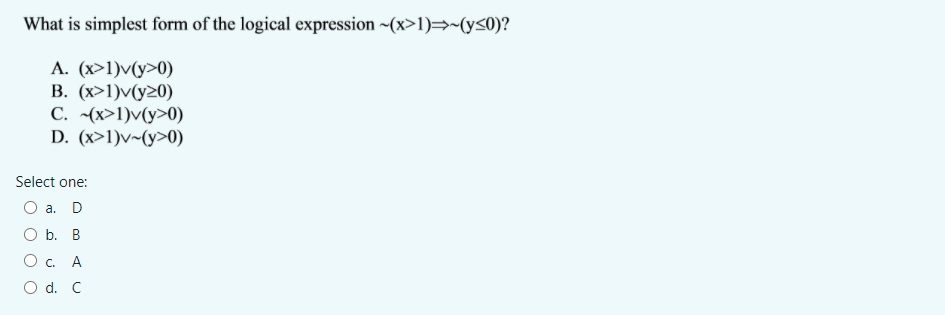
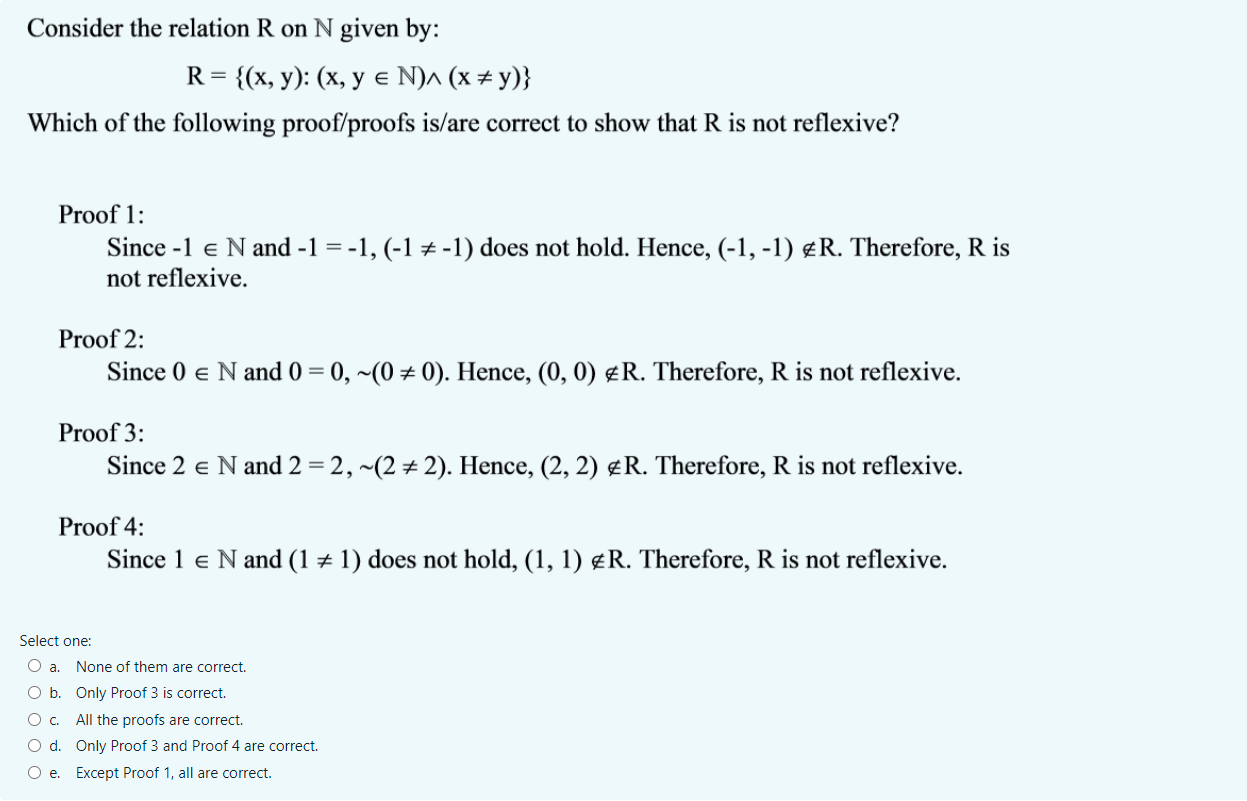
Let U be the universal set and let A and B be subsets of U. What is the simplest form of (AB) ? A. B B. A. C. 8 D. AR Select one: O a. D O b. C C. A O d. B Consider the relation R on N given by: R= {(x, y): (x, y N)^ (x + y)} Which of the following proof/proofs is/are correct to show that R is not reflexive? Proof 1: Since 0 N and 0 = 0, (0 = 0) does not hold. Hence, (0, 0) R. Therefore, R is not reflexive. Proof 2: Since () = 0, -(070). Hence, (0,0) R. Therefore, R is not reflexive. Proof 3: Since 2 e N and 2 = 2, -(2 # 2). Hence, (2, 2) R. Therefore, R is not reflexive. Proof 4: Since 1 e N and (1 # 1) does not hold, (1, 1) R. Therefore, R is not reflexive. Select one: O a. Except Proof 2, all are correct. Ob All the proofs are correct. Oc Only Proof 3 and Proof 4 are correct. O d. Only Proof 3 is correct. Oe. None of them are correct. Let A = {a,b,c} and R = {(a, a), (b, b), (c), (cb), (b, c)}. Which of the following statement is most complete in describing R? Select one: O a. R is a reflexive and symmetric relation on A. Ob R is a reflexive relation on A. O c. R is a symmetric relation on A. O d. R is an equivalence relation on A. What is simplest form of the logical expression -(x>1)=-(y=0)? A. (x>1)Vy>0) B. (x>1)/(y20) C. (x>1) (y>0) D. (x>1)-(y>0) Select one: O a. D O b. B . O d. C Consider the relation R on N given by: R= = {(x, y): (x, y e N)^ (x y)} Which of the following proof/proofs is/are correct to show that R is not reflexive? Proof 1: Since -1 e N and -1 = -1, (-1 6-1) does not hold. Hence, (-1, -1) R. Therefore, R is not reflexive. Proof 2: Since 0 e N and 0 = 0, -(0 = 0). Hence, (0, 0) R. Therefore, R is not reflexive. Proof 3: Since 2 e N and 2 = 2, -(2 # 2). Hence, (2, 2) R. Therefore, R is not reflexive. Proof 4: Since 1 e N and (1 # 1) does not hold, (1, 1) R. Therefore, R is not reflexive. Select one: O a. None of them are correct. O b. Only Proof 3 is correct. oc All the proofs are correct. O d. Only Proof 3 and Proof 4 are correct. O e. Except Proof 1, all are correct
Step by Step Solution
There are 3 Steps involved in it

Get step-by-step solutions from verified subject matter experts
 Study Help