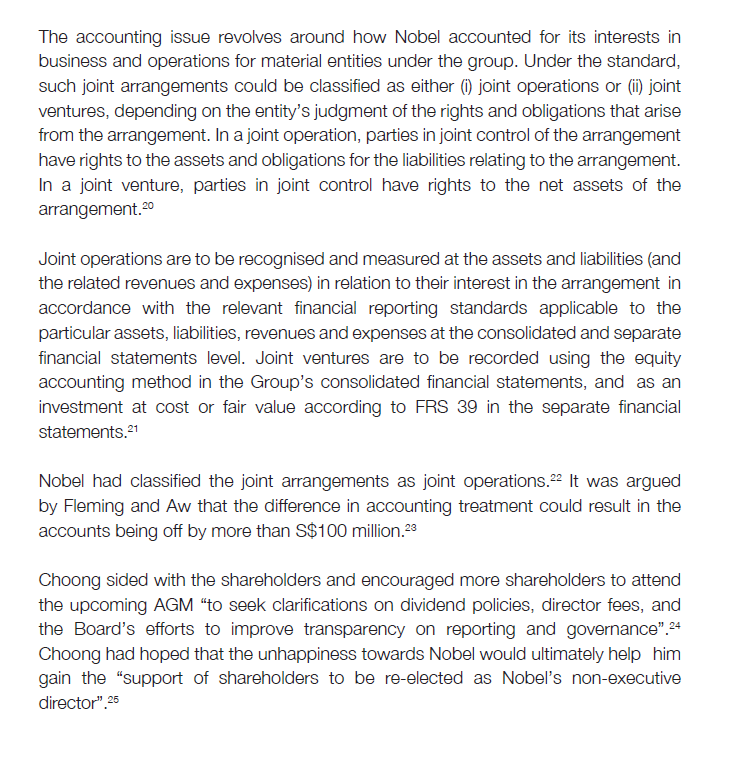
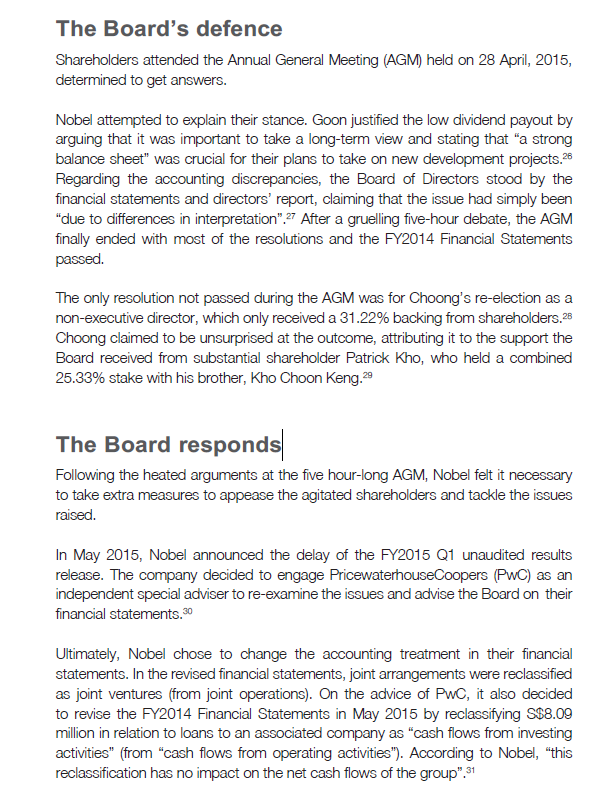
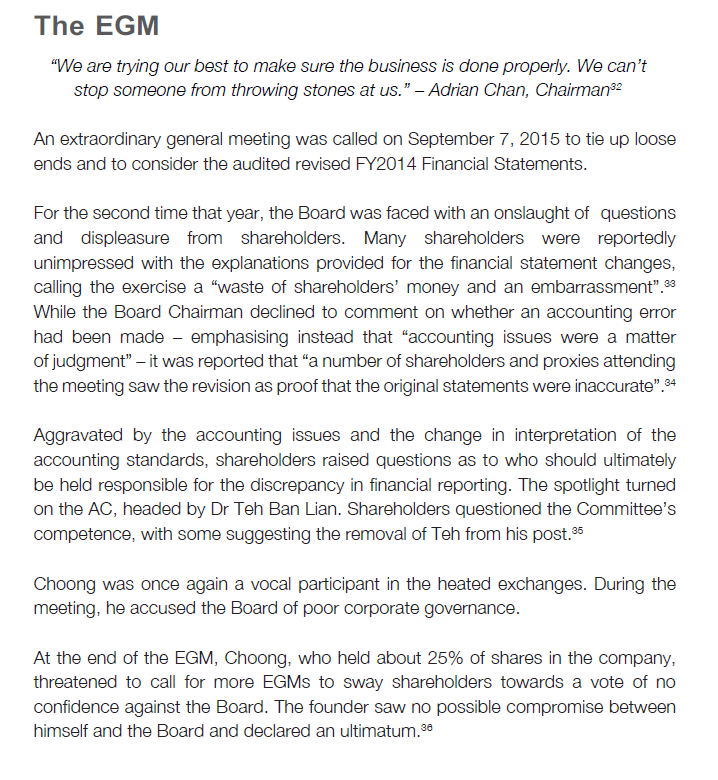
Question: NOBEL DESIGN: THE FOUNDER STRIKES BACK Case overview The discovery of Studio 216, a furniture retailer incorporated in Kuala Lumpur, led to the unearthing of
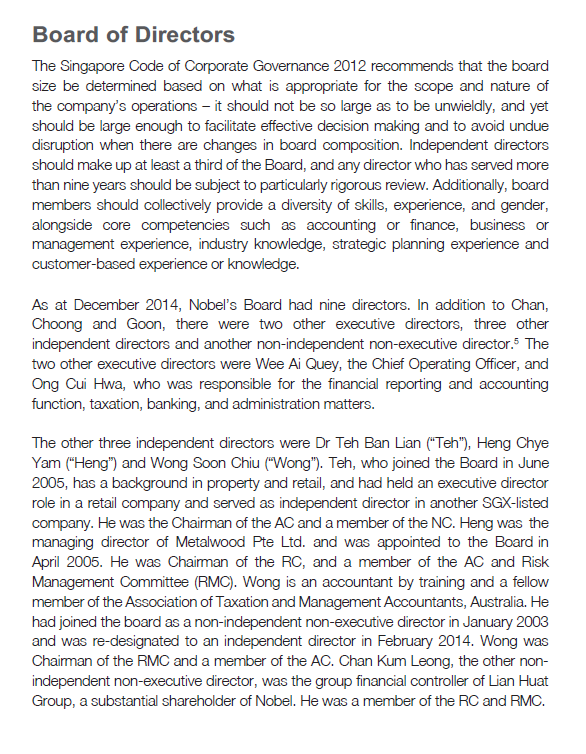
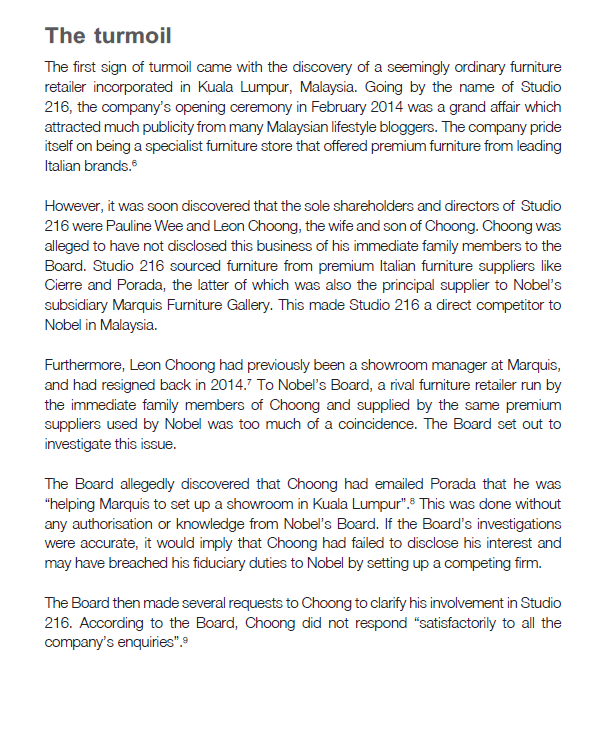
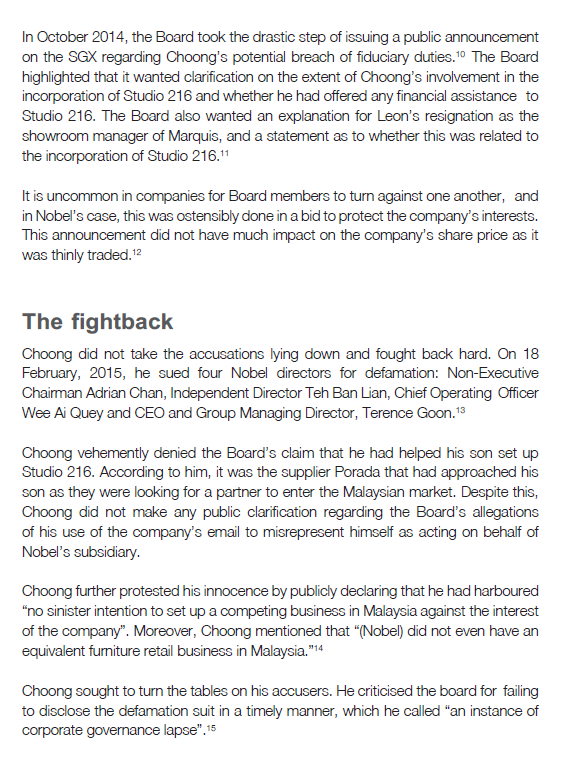
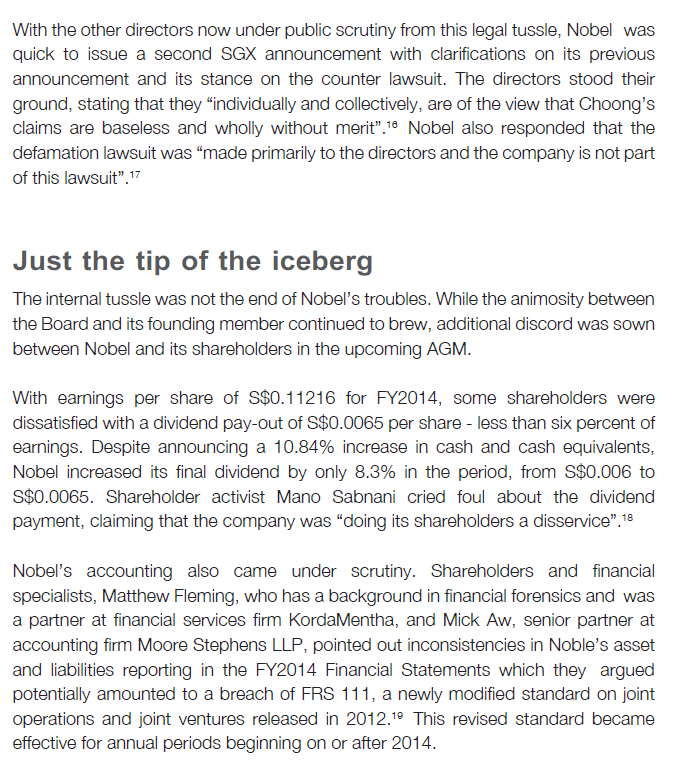
NOBEL DESIGN: THE FOUNDER STRIKES BACK Case overview The discovery of Studio 216, a furniture retailer incorporated in Kuala Lumpur, led to the unearthing of several corporate governance and management issues plaguing Nobel Design Holdings Lid ("Nobel"), including allegations of breach of fiduciary duties by Nobel's founder and its former Chairman, Choong Chee Peng Bert ("Choong"). This led to a bitter feud between the firm's current Board of Directors and Choong. The objective of this case is to allow a discussion of issues such as the duties and responsibilities of directors; conflict of interest; role and competencies of the Audit Committee (AC); accounting treatment for interest in other businesses; and responsible shareholder activism. The birth of Nobel Design Holdings Incorporated in 1982, Nobel Design Holdings Lid ("Nobel") was founded by Choong Chee Peng Bert ("Choong") and Wee Ai Quey ("Wee"). Despite humble beginnings, the company had great ambition and aimed to be a trendsetter in lifestyle furnishing. This is the abridged version of a case prepared by Chan Slong Woon, Lim Yi Xiu, Shannon Chan, Gan Jia Hui and Toh Xiu Han under the supervision of Professor Mak Yuen Teen. The case was developed from published sources solely for class discussion and is not intended to serve as illustrations of effective or ineffective management or governance. The interpretations and perspectives in this case are not necessarily those of the organisations named in the case, or any of their directors or employees. This abridged version was edited by Chua Chloe under the supervision of Professor Mak Yuen Teen."I have to protect my rights. And if I don't take the stand, what will happen to the smaller shareholders? This is a house which I own 25 per cent, and we can't Stay together. Either they go, or I go." - Choong, founder and former CEO37 Amidst the ruckus raised by his predecessor, Chairman Chan remained unfazed. He claimed that Nobel's Board was "quite confident" of support from the broader base of shareholders.38 A game of scrabble? During the EGM, a resolution was also passed to change its external auditor from Nexia TS to Ernst & Young, despite an earlier approved resolution in the April AGM to reappoint Nexia TS as the external auditor. Additionally, Teh would be replaced by Wong as AC Chairman. In turn, Teh would assume Wong's role as RMC Chairman. 40 A flourishing past and an uncertain future After over three decades of success and impressive growth, Nobel faced one of its toughest challenges due to the bitter feud and discontentment of some of its shareholders. The end of the saga is not yet in sight, with some critics predicting a possible buyout of Choong's shares in future to resolve the conflict. It is also not clear if shareholders will be appeased by the remedial actions taken by the company and if Nobel would be able to regain the confidence and support from the shareholders.Discussion questions 1. Were Bert Choong's actions justifiable? Discuss his actions in terms of his fiduciary duties, as well as his actions in response to being sued by the Board for a breach of fiduciary duties. 2. Who are responsible for ensuring the accuracy of financial statements? Comment on the role of management, the AC, the Board and the external auditors. 3. Evaluate the company's communications with stakeholders following the discovery of the financial statement discrepancy. Do you believe that the Board's response was adequate? 4. What were the remedial actions Nobel took in response to this crisis? Do you think they are sufficient? What other actions do you recommend? 5. Evaluate the composition of the Board and the AC. Do you think it could have contributed to the issues faced by the company? What improvements to the corporate governance of Nobel would you recommend? 6. There has been a rise in shareholder activism. Explain the goals of shareholder activism. How effective were shareholder activists in ensuring that Nobel complied with strict regulatory and corporate governance guidelines? How can a company guard itself against these shareholder activists? In the case of Nobel, do you think that the shareholder activists were acting responsibly? 7. Explain whether you agree with Nobel Board chairman's statement that "accounting issues were a matter of judgment". Do you think that an accounting error had been made (intentionally or otherwise) in Nobel's case? For joint arrangements, explain how a company should determine the appropriate accounting treatment. Are there any reasons why Nobel might be motivated to classify its joint arrangements as joint operations instead of joint ventures initially?Nobel flourished despite the tough competitive environment in the furniture industry." It quickly grew to become the exclusive distributor for fine imported European home fumishings brands, and even began designing its own house- label furniture. Nobel was able to achieve strong growth by strategically looking beyond Singapore and expanding its business internationally. The founding father As the founder, Choong was primarily responsible for the growth and development of Nobel until its listing in 1996. Choong held the role of Chief Executive Officer (CEO) of Nobel upon its listing, and continued to provide leadership, vision and guidance to the Board and overall operations of the group. Aside from his appointment as CEO, Choong sat on the Board and served as the Executive Chairman. In March 2010, Choong stepped down from his role as CEO after having served for 14 years. Terence Goon ("Goon"), personally groomed for the role by Choong, became the new CEO and Managing Director, while Choong remained as the Group Executive Chairman.2 In 2013, the Board claimed that Choong's business strategies had resulted in significant losses, and that his track record in managing the company was "unsatisfactory". Facing pressure from the Board to step down, and coupled with the lapse of his contract on 30 April, 2013, Choong relinquished his position as Chairman and remained on the board as a non-independent non-executive director. Adrian Chan ("Chan") was appointed as the new independent Chairman.* Chan is a senior partner in the law firm Lee & Lee, was first Vice-Chairman of the Singapore Institute of Directors and serves on the boards of five other companies listed on the Singapore Exchange (SGX). Chan chairs the Nominating Committee (NC) of Nobel and is a member of its Audit Committee (AC) and Remuneration Committee (RC).Board of Directors The Singapore Code of Corporate Governance 2012 recommends that the board size be determined based on what is appropriate for the scope and nature of the company's operations - it should not be so large as to be unwieldly, and yet should be large enough to facilitate effective decision making and to avoid undue disruption when there are changes in board composition. Independent directors should make up at least a third of the Board, and any director who has served more than nine years should be subject to particularly rigorous review. Additionally, board members should collectively provide a diversity of skills, experience, and gender, alongside core competencies such as accounting or finance, business or management experience, industry knowledge, strategic planning experience and customer-based experience or knowledge. As at December 2014, Nobel's Board had nine directors. In addition to Chan, Choong and Goon, there were two other executive directors, three other independent directors and another non-independent non-executive director. The two other executive directors were Wee Ai Quey, the Chief Operating Officer, and Ong Cui Hwa, who was responsible for the financial reporting and accounting function, taxation, banking, and administration matters. The other three independent directors were Dr Teh Ban Lian ("Teh"), Heng Chye Yam ("Heng") and Wong Soon Chiu ("Wong"). Teh, who joined the Board in June 2005, has a background in property and retail, and had held an executive director role in a retail company and served as independent director in another SGX-listed company. He was the Chairman of the AC and a member of the NC. Heng was the managing director of Metalwood Pte Lid. and was appointed to the Board in April 2005. He was Chairman of the RC, and a member of the AC and Risk Management Committee (RMC). Wong is an accountant by training and a fellow member of the Association of Taxation and Management Accountants, Australia. He had joined the board as a non-independent non-executive director in January 2003 and was re-designated to an independent director in February 2014. Wong was Chairman of the RMC and a member of the AC. Chan Kum Leong, the other non- independent non-executive director, was the group financial controller of Lian Huat Group, a substantial shareholder of Nobel. He was a member of the RC and RMC.The turmoil The first sign of turmoil came with the discovery of a seemingly ordinary furniture retailer incorporated in Kuala Lumpur, Malaysia. Going by the name of Studio 216, the company's opening ceremony in February 2014 was a grand affair which attracted much publicity from many Malaysian lifestyle bloggers. The company pride itself on being a specialist fumiture store that offered premium furniture from leading Italian brands. However, it was soon discovered that the sole shareholders and directors of Studio 216 were Pauline Wee and Leon Choong, the wife and son of Choong. Choong was alleged to have not disclosed this business of his immediate family members to the Board. Studio 216 sourced furniture from premium Italian furniture suppliers like Cierre and Porada, the latter of which was also the principal supplier to Nobel's subsidiary Marquis Furniture Gallery. This made Studio 216 a direct competitor to Nobel in Malaysia. Furthermore, Leon Choong had previously been a showroom manager at Marquis, and had resigned back in 2014.7 To Nobel's Board, a rival furniture retailer run by the immediate family members of Choong and supplied by the same premium suppliers used by Nobel was too much of a coincidence. The Board set out to investigate this issue. The Board allegedly discovered that Choong had emailed Porada that he was "helping Marquis to set up a showroom in Kuala Lumpur". This was done without any authorisation or knowledge from Nobel's Board. If the Board's investigations were accurate, it would imply that Choong had failed to disclose his interest and may have breached his fiduciary duties to Nobel by setting up a competing firm. The Board then made several requests to Choong to clarify his involvement in Studio 216. According to the Board, Choong did not respond "satisfactorily to all the company's enquiries".In October 2014, the Board took the drastic step of issuing a public announcement on the SGX regarding Choong's potential breach of fiduciary duties." The Board highlighted that it wanted clarification on the extent of Choong's involvement in the incorporation of Studio 216 and whether he had offered any financial assistance to Studio 216. The Board also wanted an explanation for Leon's resignation as the showroom manager of Marquis, and a statement as to whether this was related to the incorporation of Studio 216.11 It is uncommon in companies for Board members to turn against one another, and in Nobel's case, this was ostensibly done in a bid to protect the company's interests. This announcement did not have much impact on the company's share price as it was thinly traded. 12 The fightback Choong did not take the accusations lying down and fought back hard. On 18 February, 2015, he sued four Nobel directors for defamation: Non-Executive Chairman Adrian Chan, Independent Director Teh Ban Lian, Chief Operating Officer Wee Ai Quey and CEO and Group Managing Director, Terence Goon. 13 Choong vehemently denied the Board's claim that he had helped his son set up Studio 216. According to him, it was the supplier Porada that had approached his son as they were looking for a partner to enter the Malaysian market. Despite this, Choong did not make any public clarification regarding the Board's allegations of his use of the company's email to misrepresent himself as acting on behalf of Nobel's subsidiary. Choong further protested his innocence by publicly declaring that he had harboured "no sinister intention to set up a competing business in Malaysia against the interest of the company". Moreover, Choong mentioned that "(Nobel) did not even have an equivalent furniture retail business in Malaysia."14 Choong sought to turn the tables on his accusers. He criticised the board for failing to disclose the defamation suit in a timely manner, which he called "an instance of corporate governance lapse", 15With the other directors now under public scrutiny from this legal tussle, Nobel was quick to issue a second SGX announcement with clarifications on its previous announcement and its stance on the counter lawsuit. The directors stood their ground, stating that they "individually and collectively, are of the view that Choong's claims are baseless and wholly without merit"." Nobel also responded that the defamation lawsuit was "made primarily to the directors and the company is not part of this lawsuit" . 17 Just the tip of the iceberg The internal tussle was not the end of Nobel's troubles. While the animosity between the Board and its founding member continued to brew, additional discord was sown between Nobel and its shareholders in the upcoming AGM. With earnings per share of S$0.11216 for FY2014, some shareholders were dissatisfied with a dividend pay-out of S$0.0065 per share - less than six percent of earnings. Despite announcing a 10.84% increase in cash and cash equivalents, Nobel increased its final dividend by only 8.3% in the period, from S$0.006 to S$0.0065. Shareholder activist Mano Sabnani cried foul about the dividend payment, claiming that the company was "doing its shareholders a disservice". 18 Nobel's accounting also came under scrutiny. Shareholders and financial specialists, Matthew Fleming, who has a background in financial forensics and was a partner at financial services firm KordaMentha, and Mick Aw, senior partner at accounting firm Moore Stephens LLP, pointed out inconsistencies in Noble's asset and liabilities reporting in the FY2014 Financial Statements which they argued potentially amounted to a breach of FRS 111, a newly modified standard on joint operations and joint ventures released in 2012." This revised standard became effective for annual periods beginning on or after 2014.The accounting issue revolves around how Nobel accounted for its interests in business and operations for material entities under the group. Under the standard, such joint arrangements could be classified as either (i) joint operations or (ii) joint ventures, depending on the entity's judgment of the rights and obligations that arise from the arrangement. In a joint operation, parties in joint control of the arrangement have rights to the assets and obligations for the liabilities relating to the arrangement. In a joint venture, parties in joint control have rights to the net assets of the arrangement. 20 Joint operations are to be recognised and measured at the assets and liabilities (and the related revenues and expenses) in relation to their interest in the arrangement in accordance with the relevant financial reporting standards applicable to the particular assets, liabilities, revenues and expenses at the consolidated and separate financial statements level. Joint ventures are to be recorded using the equity accounting method in the Group's consolidated financial statements, and as an investment at cost or fair value according to FRS 39 in the separate financial statements. 21 Nobel had classified the joint arrangements as joint operations." It was argued by Fleming and Aw that the difference in accounting treatment could result in the accounts being off by more than S$100 million.23 Choong sided with the shareholders and encouraged more shareholders to attend the upcoming AGM "to seek clarifications on dividend policies, director fees, and the Board's efforts to improve transparency on reporting and governance".24 Choong had hoped that the unhappiness towards Nobel would ultimately help him gain the "support of shareholders to be re-elected as Nobel's non-executive director" . 25The Board's defence Shareholders attended the Annual General Meeting (AGM) held on 28 April, 2015, determined to get answers. Nobel attempted to explain their stance. Goon justified the low dividend payout by arguing that it was important to take a long-term view and stating that "a strong balance sheet" was crucial for their plans to take on new development projects.25 Regarding the accounting discrepancies, the Board of Directors stood by the financial statements and directors' report, claiming that the issue had simply been "due to differences in interpretation".27 After a gruelling five-hour debate, the AGM finally ended with most of the resolutions and the FY2014 Financial Statements passed. The only resolution not passed during the AGM was for Choong's re-election as a non-executive director, which only received a 31.22% backing from shareholders.25 Choong claimed to be unsurprised at the outcome, attributing it to the support the Board received from substantial shareholder Patrick Kho, who held a combined 25.33% stake with his brother, Kho Choon Keng. 25 The Board responds Following the heated arguments at the five hour-long AGM, Nobel felt it necessary to take extra measures to appease the agitated shareholders and tackle the issues raised. In May 2015, Nobel announced the delay of the FY2015 Q1 unaudited results release. The company decided to engage PricewaterhouseCoopers (PWC) as an independent special adviser to re-examine the issues and advise the Board on their financial statements.30 Ultimately, Nobel chose to change the accounting treatment in their financial statements. In the revised financial statements, joint arrangements were reclassified as joint ventures (from joint operations). On the advice of PWC, it also decided to revise the FY2014 Financial Statements in May 2015 by reclassifying S$8.09 million in relation to loans to an associated company as "cash flows from investing activities" (from "cash flows from operating activities"). According to Nobel, "this reclassification has no impact on the net cash flows of the group". 31The EGM \"We are trying our best to make sure the business is done propeny. We can't stop someone from throwing stones at us. \" Adrian Chan, Chairman\" An extraordinary general meeting was called on September 7, 2015 to tie up loose ends and to consider the audited revised FY2014 Financial Statements. F0r the second time that year, the Board was faced with an onslaught of questions and displeasure from shareholders. Many shareholders were reportedly unimpressed with the explanations provided for the nancial statement changes, calling the exercise a "waste of shareholders' money and an embarrassment"?3 While the Board Chairman declined to comment on whether an accounting error had been made emphasising instead that \"accounting issues were a matter ofjudgment" it was reported that \"a number of shareholders and proxies attending the meeting saw the revision as proof that the original statements were inaco..rrate".34 Aggravated by the accounting issues and the change in interpretation of the accounting standards, shareholders raised questions as to who should ultimately be held responsible for the discrepancy in nancial reporting. The spotlight tumed on the AC, headed by Dr Teh Ban Lian. Shareholders questioned the Committee's competence, with some suggesting the removal of Teh from his post.35 Choong was once again a vocal participant in the heated exchanges. During the meeting, he accused the Board of poor corporate governance. At the end of the EGM, Choong, who held about 25% of shares in the company, threatened to call for more EGMs to sway shareholders towards a vote of no condence against the Board. The founder saw no possible compromise between himself and the Board and declared an ultimatum.5a
Step by Step Solution
There are 3 Steps involved in it
1 Expert Approved Answer
Step: 1 Unlock
Question Has Been Solved by an Expert!
Get step-by-step solutions from verified subject matter experts
Step: 2 Unlock
Step: 3 Unlock
Students Have Also Explored These Related Accounting Questions!