







Question: Non-Polynomial Models (Transforming the Data) The four data points at right are measurements of the amount of mustard (y;) left behind in a container as
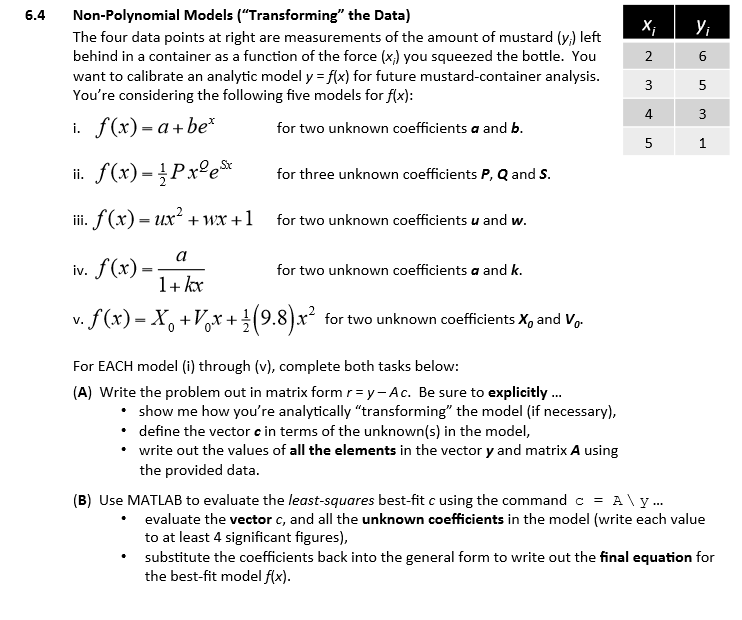
Non-Polynomial Models ("Transforming" the Data) The four data points at right are measurements of the amount of mustard (y;) left behind in a container as a function of the force (x) you squeezed the bottle. You want to calibrate an analytic model y =f(x) for future mustard-container analysis You're considering the following five models for f(x) 6.4 6 4 i. f(x)-a+be for two unknown coefficients a and b for three unknown coefficients P, Q and S iii. f(x)-11x2 + 11x + 1 . f(x)a for two unknown coefficients u and w. for two unknown coefficients a and k (x)-x, + Kx +(9.8) f for two unknown coefficients X and V 002 For EACH model (i) through (v), complete both tasks below (A) Write the problem out in matrix form r y-Ac. Be sure to explicitly show me how you're analytically "transforming" the model (if necessary), define the vector c in terms of the unknown(s) in the model, write out the values of all the elements in the vector y and matrix A using the provided data (B) Use MATLAB to evaluate the least-squares best-fit c using the command cA\y... evaluate the vector c, and all the unknown coefficients in the model (write each value to at least 4 significant figures), substitute the coefficients back into the general form to write out the final equation for the best-fit model f(x)
Step by Step Solution
There are 3 Steps involved in it

Get step-by-step solutions from verified subject matter experts
 Study Help