







Question: NONPROFIT MANAGEMENT: please help answer case questions after reading case 14.3 The Organic Nonprofit: Feet First thank you! CASE 14.3 THE ORGANIC NONPROFIT: FEET FIRST
NONPROFIT MANAGEMENT:
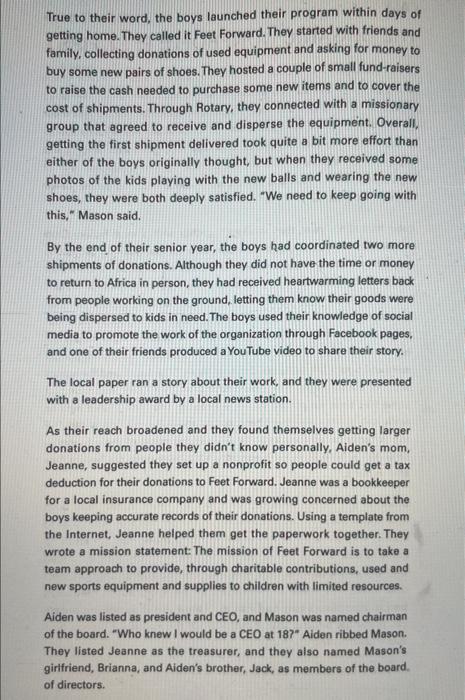
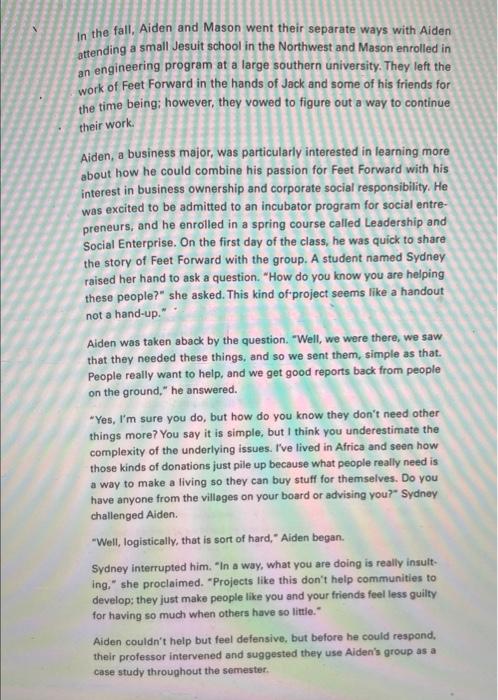
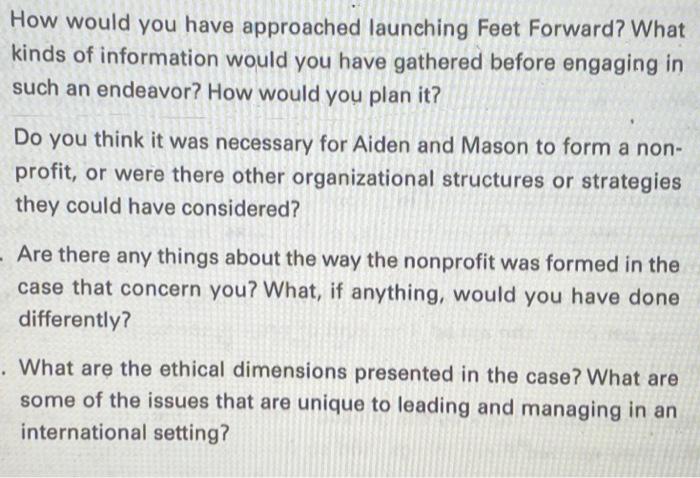
CASE 14.3 THE ORGANIC NONPROFIT: FEET FIRST Alden Roberts and Mason Fielder have been best friends since kindergarten. Raised in an upper-middle-class community, the boys enjoyed a rather idyllic boyhood. Every afternoon after school and most weekends were filled with some sort of sporting activity, usually soccer or baseball. Their families enthusiastically supported their efforts and enjoyed cheering them on from the stands. In their freshman year of high school, both Alden and Mason were selected to play on the junior varsity soccer team. Later that same year, they worked together with a local Rotary Club where Mason's father was a member, on a service learning project to help raise money to build clean water drinking wells in rural African villages. They enjoyed their work on the project and became interested in visiting Africa. The opportunity came in their junior year when they were offered the chance to participate in a 2-week-long Rotary Interna- tional sponsored exchange program with one of the villages. In a letter home to his parents, Aiden described how incredibly friendly the people were and how it felt really good to help them. The kids loved the school supplies we delivered. You should have seen their faces. When we had some free time we played soccer with them. They don't have nets or really any sports equipment here, but we made it work," he wrote. The trip not only raised their awareness about the needs of the villagers in rural Africa; both boys were also struck by "how good we have it," as Mason put it. Discussing it on the long trip back to the United States, they both agreed that they wanted to do more to help the kids they had come to know. "We can really do something to help those kids. We know so many people who would be willing to give them something." Aiden said. Before the plane landed, they had come up with an idea to collect used sports equipment and donations of new shoes and to send them back to the villages they had visited. "I think this is something people can really get behind, plus it connects all the things we love to do, Aiden commented. It won't look bad on a college application either," Mason kidded. True to their word, the boys launched their program within days of getting home. They called it Feet Forward. They started with friends and family, collecting donations of used equipment and asking for money to buy some new pairs of shoes. They hosted a couple of small fund-raisers to raise the cash needed to purchase some new items and to cover the cost of shipments. Through Rotary, they connected with a missionary group that agreed to receive and disperse the equipment. Overall, getting the first shipment delivered took quite a bit more effort than either of the boys originally thought, but when they received some photos of the kids playing with the new balls and wearing the new shoes, they were both deeply satisfied. "We need to keep going with this, Mason said. By the end of their senior year, the boys had coordinated two more shipments of donations. Although they did not have the time or money to return to Africa in person, they had received heartwarming letters back from people working on the ground, letting them know their goods were being dispersed to kids in need. The boys used their knowledge of social media to promote the work of the organization through Facebook pages, and one of their friends produced a YouTube video to share their story. The local paper ran a story about their work, and they were presented with a leadership award by a local news station. As their reach broadened and they found themselves getting larger donations from people they didn't know personally, Aiden's mom, Jeanne, suggested they set up a nonprofit so people could get a tax deduction for their donations to Feet Forward. Jeanne was a bookkeeper for a local insurance company and was growing concerned about the boys keeping accurate records of their donations. Using a template from the Internet, Jeanne helped them get the paperwork together. They wrote a mission statement: The mission of Feet Forward is to take a team approach to provide, through charitable contributions, used and new sports equipment and supplies to children with limited resources. Aiden was listed as president and CEO, and Mason was named chairman of the board. "Who knew I would be a CEO at 187" Aiden ribbed Mason. They listed Jeanne as the treasurer, and they also named Mason's girlfriend, Brianna, and Aiden's brother, Jack, as members of the board. of directors, in the fall, Aiden and Mason went their separate ways with Aiden attending a small Jesuit school in the Northwest and Mason enrolled in an engineering program at a large southern university. They left the work of Feet Forward in the hands of Jack and some of his friends for the time being; however, they vowed to figure out a way to continue their work Aiden, a business major, was particularly interested in learning more about how he could combine his passion for Feet Forward with his interest in business ownership and corporate social responsibility. He was excited to be admitted to an incubator program for social entre- preneurs, and he enrolled in a spring course called Leadership and Social Enterprise. On the first day of the class, he was quick to share the story of Feet Forward with the group. A student named Sydney raised her hand to ask a question. "How do you know you are helping these people?" she asked. This kind of project seems like a handout not a hand-up." Aiden was taken aback by the question. "Well, we were there, we saw that they needed these things, and so we sent them, simple as that. People really want to help, and we get good reports back from people on the ground," he answered. "Yes, I'm sure you do, but how do you know they don't need other things more? You say it is simple, but I think you underestimate the complexity of the underlying issues. I've lived in Africa and seen how those kinds of donations just pile up because what people really need is a way to make a living so they can buy stuff for themselves. Do you have anyone from the villages on your board or advising you?" Sydney challenged Alden "Well, logistically, that is sort of hard," Aiden began. Sydney interrupted him. "In a way, what you are doing is really insult ing," she proclaimed Projects like this don't help communities to develop: they just make people like you and your friends feel less guilty for having so much when others have so little." Aiden couldn't help but feel defensive, but before he could respond. their professor intervened and suggested they use Alden's group as a case study throughout the semester How would you have approached launching Feet Forward? What kinds of information would you have gathered before engaging in such an endeavor? How would you plan it? Do you think it was necessary for Aiden and Mason to form a non- profit, or were there other organizational structures or strategies they could have considered? - Are there any things about the way the nonprofit was formed in the case that concern you? What, if anything, would you have done differently? . What are the ethical dimensions presented in the case? What are some of the issues that are unique to leading and managing in an international setting
please help answer case questions after reading case 14.3 "The Organic Nonprofit: Feet First"
thank you! 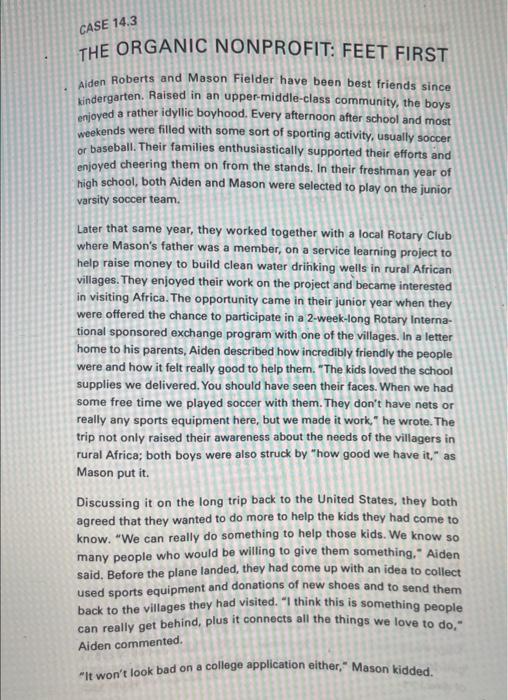
Step by Step Solution
There are 3 Steps involved in it
1 Expert Approved Answer
Step: 1 Unlock

Question Has Been Solved by an Expert!
Get step-by-step solutions from verified subject matter experts
Step: 2 Unlock
Step: 3 Unlock
 Study Help