







Question: (Non-textbook) Knowing how two functions change with their input, tells you how their combinations change with its input. Assume that the functions f and g
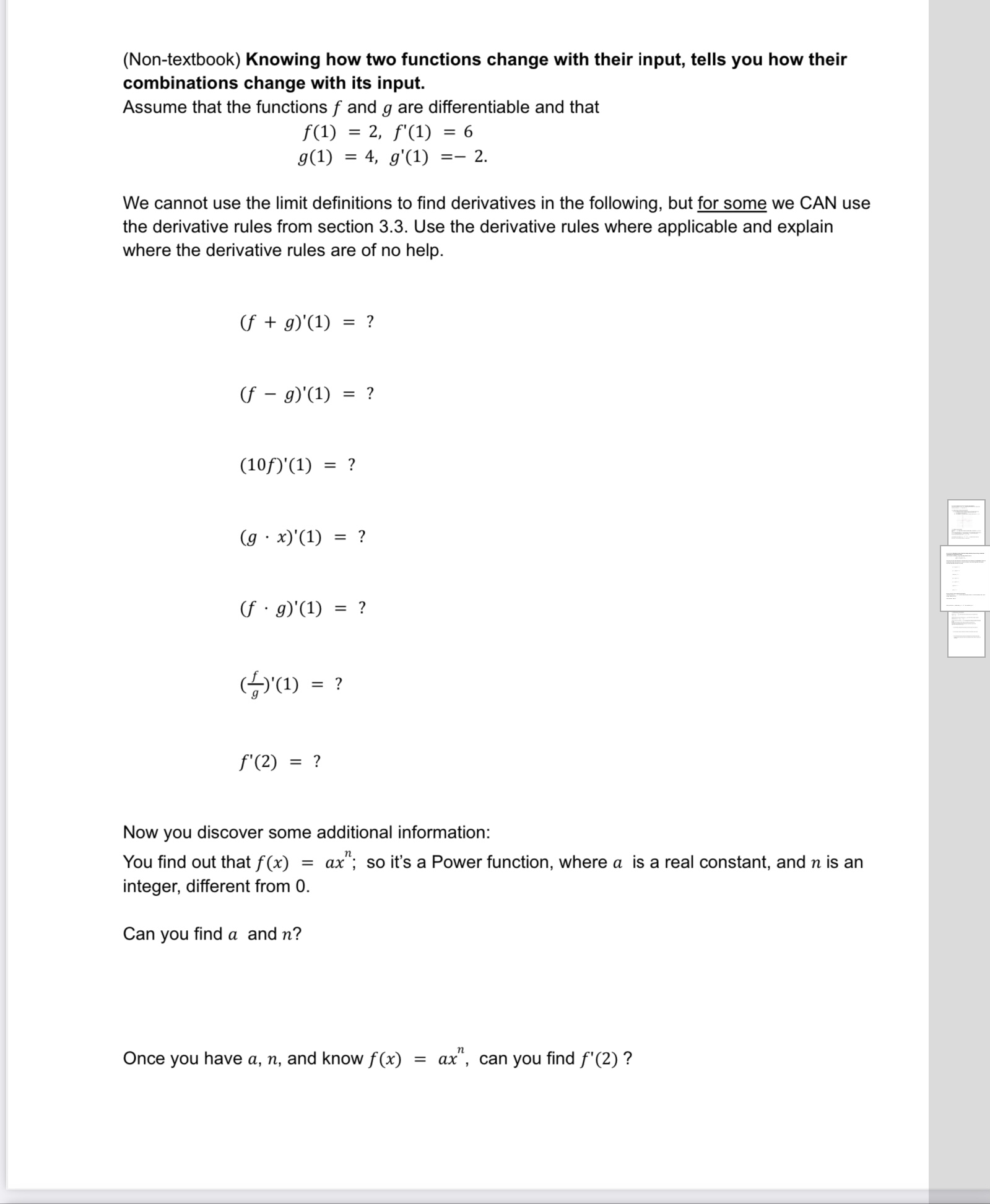
(Non-textbook) Knowing how two functions change with their input, tells you how their combinations change with its input. Assume that the functions f and g are differentiable and that f (1) = 2, f'(1) = 6 g(1) = 4, g'(1) =- 2. We cannot use the limit definitions to find derivatives in the following, but for some we CAN use the derivative rules from section 3.3. Use the derivative rules where applicable and explain where the derivative rules are of no help. (f + g)'(1) = ? (f - g)'(1) = ? (10f)'(1) = ? (g . x)'(1) = ? (f . g)'(1) = ? ()' (1) = ? f'(2) = ? Now you discover some additional information: You find out that f(x) = ax"; so it's a Power function, where a is a real constant, and n is an integer, different from 0. Can you find a and n? Once you have a, n, and know f(x) = ax , can you find f'(2) ?(Non-textbook) Knowing how two functions change with their input, tells you how their combinations change with its input. Assume that the functions f and g are differentiable and that f (1) = 2, f'(1) = 6 g(1) = 4, g'(1) =- 2. We cannot use the limit definitions to find derivatives in the following, but for some we CAN use the derivative rules from section 3.3. Use the derivative rules where applicable and explain where the derivative rules are of no help. (f + g)'(1) = ? (f - g)'(1) = ? (10f)'(1) = ? (g . x)'(1) = ? (f . g)'(1) = ? ()' (1) = ? f'(2) = ? Now you discover some additional information: You find out that f(x) = ax"; so it's a Power function, where a is a real constant, and n is an integer, different from 0. Can you find a and n? Once you have a, n, and know f(x) = ax , can you find f'(2)
Step by Step Solution
There are 3 Steps involved in it

Get step-by-step solutions from verified subject matter experts
 Study Help