







Question: Nonvalue - Added Costs, Activity Costs, Activity Cost Reduction John Thomas, vice president of Mallett Company ( a producer of a variety of plastic products
NonvalueAdded Costs, Activity Costs, Activity Cost Reduction
John Thomas, vice president of Mallett Company a producer of a variety of plastic products has been supervising the implementation of an ABC management system. John wants to improve process efficiency by improving the activities that define the processes. To illustrate the potential of the new system to the president, John has decided to focus on two processes: production and customer service.
Within each process, one activity will be selected for improvement: materials usage for production and sustaining engineering for customer service sustaining engineers are responsible for redesigning products based on customer needs and feedback Valueadded standards are identified for each activity. For materials usage, the valueadded standard calls for pounds per unit of output the products differ in shape and function, but their weight is uniform The valueadded standard is based on the elimination of all waste due to defective molds. The standard price of materials is $ per pound. For sustaining engineering, the standard is of current practical activity capacity. This standard is based on the fact that about of the complaints have to do with design features that could have been avoided or anticipated by the company.
Current practical capacity at the end of X is defined by the following requirements: engineering hours for each product group that has been on the market or in development for years or less and hours per product group of more than years. Four product groups have less than years' experience, and product groups have more. Each of the engineers is paid a salary of $ Each engineer can provide hours of service per year. No other significant costs are incurred for the engineering activity.
Actual materials usage for X was above the level called for by the valueadded standard; engineering usage was hours. A total of units of output were produced. John and the operational managers have selected some improvement measures that promise to reduce nonvalueadded activity usage by in X Selected actual results achieved for X are as follows:
Line Item Description Numerical Value
Units produced
Materials used
Engineering hours
The actual prices paid for materials and engineering hours are identical to the standard or budgeted prices.
Required:
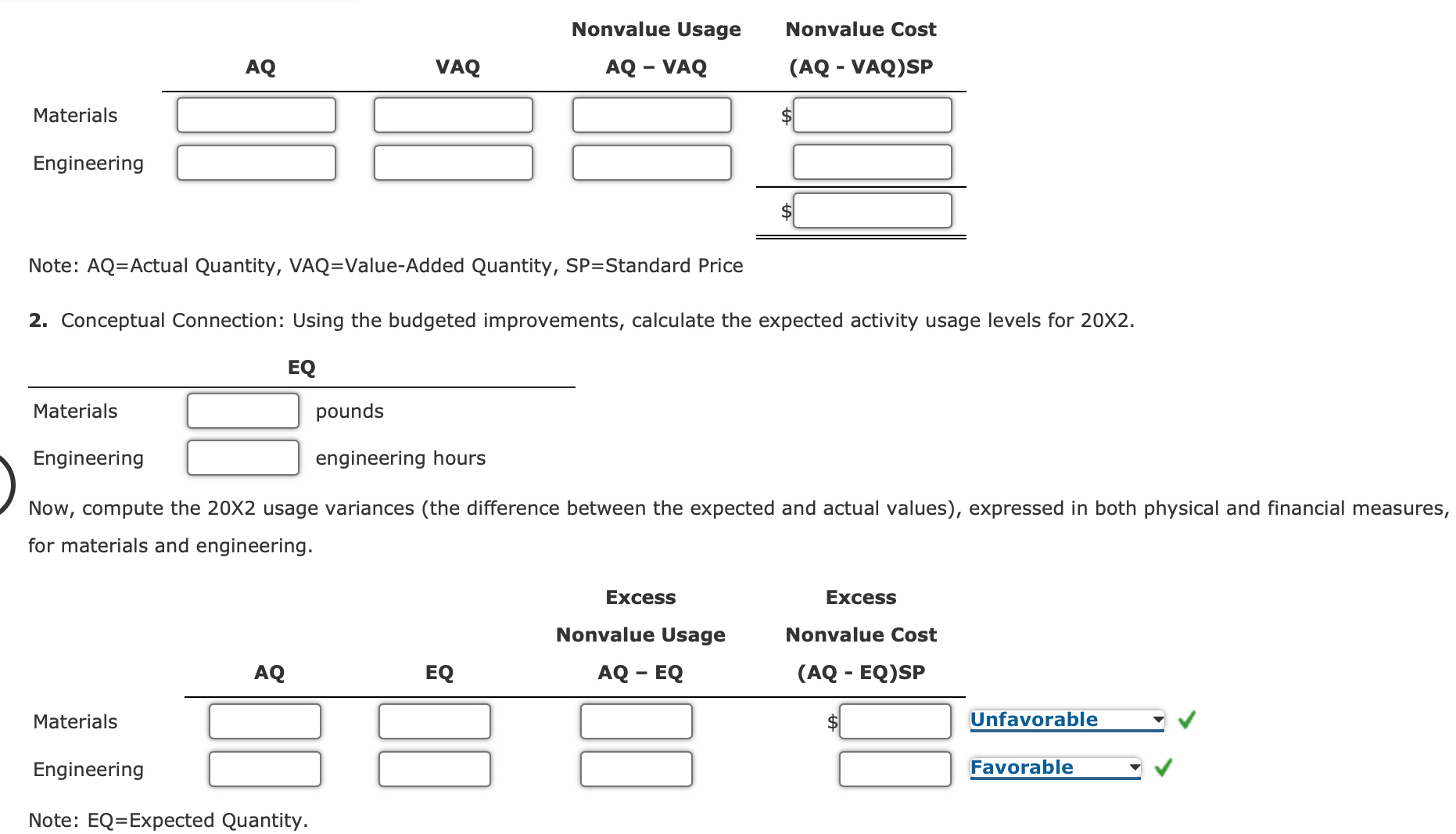
For X calculate the nonvalueadded usage and costs for materials usage and sustaining engineering.
Step by Step Solution
There are 3 Steps involved in it
1 Expert Approved Answer
Step: 1 Unlock

Question Has Been Solved by an Expert!
Get step-by-step solutions from verified subject matter experts
Step: 2 Unlock
Step: 3 Unlock
 Study Help