







Question: ***not a coding assignment** Following the logic we used to justify the range of integer numeric data types, try to create the smallest and greatest
 ***not a coding assignment**
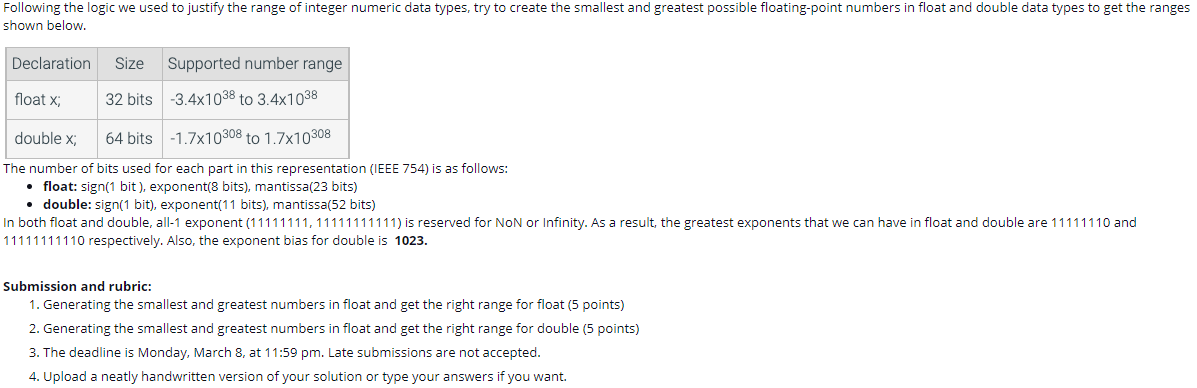
Following the logic we used to justify the range of integer numeric data types, try to create the smallest and greatest possible floating-point numbers in float and double data types to get the ranges shown below. Declaration Size Supported number range 32 bits -3.4x1038 to 3.4x1038 float x; double x; 64 bits -1.7x10308 to 1.7x10308 The number of bits used for each part in this representation (IEEE 754) is as follows: float: sign(1 bit), exponent(8 bits), mantissa(23 bits) double: sign(1 bit), exponent(11 bits), mantissa(52 bits) In both float and double, all-1 exponent (11111111, 11111111111) is reserved for Non or Infinity. As a result, the greatest exponents that we can have in float and double are 11111110 and 11111111110 respectively. Also, the exponent bias for double is 1023. Submission and rubric: 1. Generating the smallest and greatest numbers in float and get the right range for float (5 points) 2. Generating the smallest and greatest numbers in float and get the right range for double (5 points) 3. The deadline is Monday, March 8, at 11:59 pm. Late submissions are not accepted. 4. Upload a neatly handwritten version of your solution or type your answers if you want
Step by Step Solution
There are 3 Steps involved in it

Get step-by-step solutions from verified subject matter experts
 Study Help