







Question: Not sure what additional information is needed here as this is the entire problem. Please advise or help! Need Help! Suppose that you have estimated
Not sure what additional information is needed here as this is the entire problem. Please advise or help!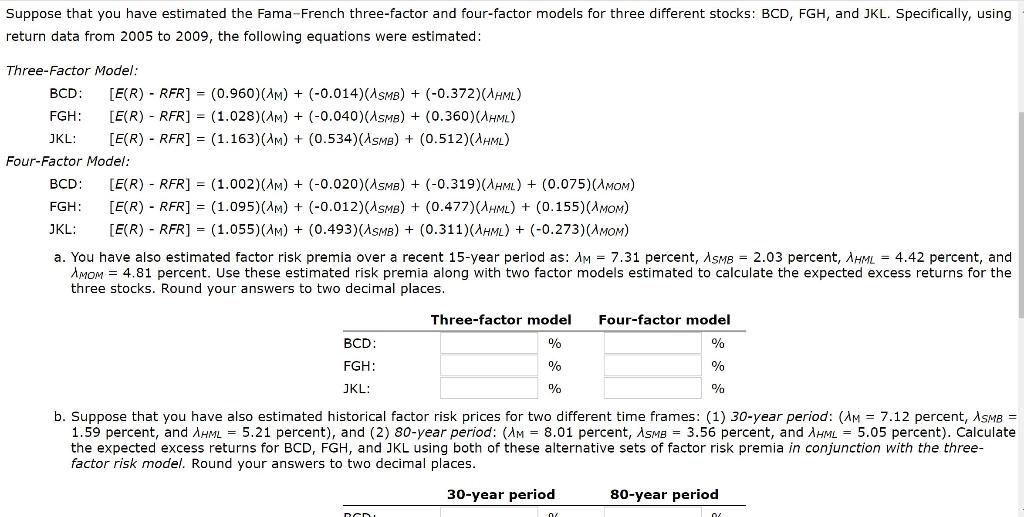
 Need Help!
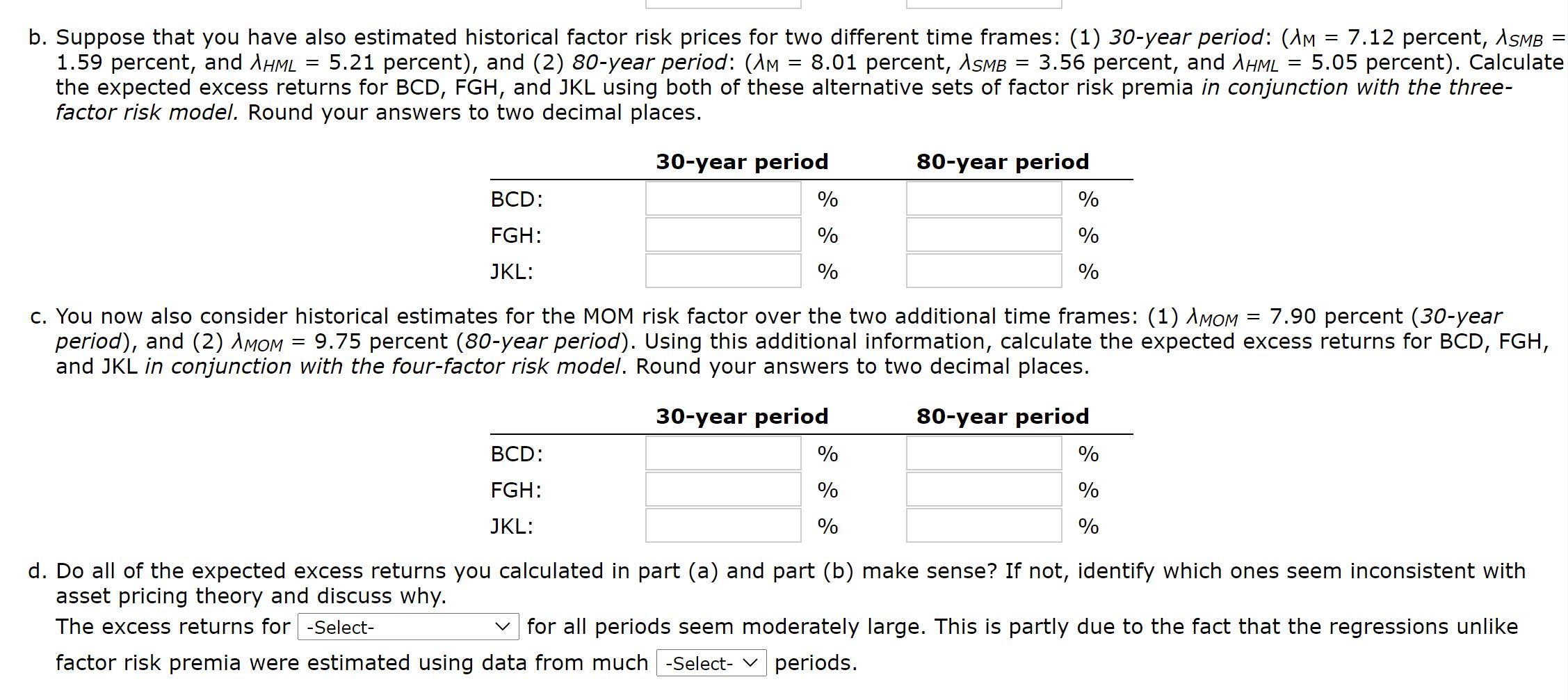
Suppose that you have estimated the Fama-French three-factor and four-factor models for three different stocks: BCD, FGH, and JKL. Specifically, using return data from 2005 to 2009, the following equations were estimated: Three-Factor Model: BCD: [E(R) - RFR] = (0.960) (AM) + (-0.014)(AsMB) + (-0.372) (AHM) FGH: [E(R) - RFR] = (1.028) (AM) + (-0.040)(ASMB) + (0.360) (AHM) JKL: [E(R) - RFR] = (1.163) (AM) + (0.534) (Asme) + (0.512) (AHM) Four-Factor Model: BCD: [E(R) - RFR] = (1.002)(AM) + (-0.020) (Asme) + (-0.319) (AHM) + (0.075)(Amom) FGH: [E(R) - RFR] = (1.095) (AM) + (-0.012) (Asme) + (0.477)(AHM) + (0.155)(Amom) JKL: [E(R) - RFR] = (1.055) (AM) + (0.493) (ASMB) + (0.311) (AHM) + (-0.273) (AMOM) a. You have also estimated factor risk premia over a recent 15-year period as: AM = 7.31 percent, 15MB = 2.03 percent, AHML = 4.42 percent, and AMOM = 4.81 percent. Use these estimated risk premia along with two factor models estimated to calculate the expected excess returns for the three stocks. Round your answers to two decimal places. Three-factor model Four-factor model BCD: % % FGH: % % JKL: % % b. Suppose that you have also estimated historical factor risk prices for two different time frames: (1) 30-year period: (M = 7.12 percent, AMB = 1.59 percent, and AHML = 5.21 percent), and (2) 80-year period: (M = 8.01 percent, Asme = 3.56 percent, and AHML = 5.05 percent). Calculate the expected excess returns for BCD, FGH, and JKL using both of these alternative sets of factor risk premia in conjunction with the three- factor risk model. Round your answers to two decimal places. 30-year period 80-year period - b. Suppose that you have also estimated historical factor risk prices for two different time frames: (1) 30-year period: (am = 7.12 percent, 1SMB 1.59 percent, and AHML = 5.21 percent), and (2) 80-year period: (am = 8.01 percent, 'SMB = 3.56 percent, and AHML 5.05 percent). Calculate the expected excess returns for BCD, FGH, and JKL using both of these alternative sets of factor risk premia in conjunction with the three- factor risk model. Round your answers to two decimal places. 30-year period 80-year period BCD: % % FGH: % % JKL: % % c. You now also consider historical estimates for the MOM risk factor over the two additional time frames: (1) IMOM 7.90 percent (30-year period), and (2) IMOM 9.75 percent (80-year period). Using this additional information, calculate the expected excess returns for BCD, FGH, and JKL in conjunction with the four-factor risk model. Round your answers to two decimal places. 30-year period 80-year period BCD: % % FGH: % % JKL: % % d. Do all of the expected excess returns you calculated in part (a) and part (b) make sense? If not, identify which ones seem inconsistent with asset pricing theory and discuss why. The excess returns for -Select- v for all periods seem moderately large. This is partly due to the fact that the regressions unlike factor risk premia were estimated using data from much -Select- v periods. Suppose that you have estimated the Fama-French three-factor and four-factor models for three different stocks: BCD, FGH, and JKL. Specifically, using return data from 2005 to 2009, the following equations were estimated: Three-Factor Model: BCD: [E(R) - RFR] = (0.960) (AM) + (-0.014)(AsMB) + (-0.372) (AHM) FGH: [E(R) - RFR] = (1.028) (AM) + (-0.040)(ASMB) + (0.360) (AHM) JKL: [E(R) - RFR] = (1.163) (AM) + (0.534) (Asme) + (0.512) (AHM) Four-Factor Model: BCD: [E(R) - RFR] = (1.002)(AM) + (-0.020) (Asme) + (-0.319) (AHM) + (0.075)(Amom) FGH: [E(R) - RFR] = (1.095) (AM) + (-0.012) (Asme) + (0.477)(AHM) + (0.155)(Amom) JKL: [E(R) - RFR] = (1.055) (AM) + (0.493) (ASMB) + (0.311) (AHM) + (-0.273) (AMOM) a. You have also estimated factor risk premia over a recent 15-year period as: AM = 7.31 percent, 15MB = 2.03 percent, AHML = 4.42 percent, and AMOM = 4.81 percent. Use these estimated risk premia along with two factor models estimated to calculate the expected excess returns for the three stocks. Round your answers to two decimal places. Three-factor model Four-factor model BCD: % % FGH: % % JKL: % % b. Suppose that you have also estimated historical factor risk prices for two different time frames: (1) 30-year period: (M = 7.12 percent, AMB = 1.59 percent, and AHML = 5.21 percent), and (2) 80-year period: (M = 8.01 percent, Asme = 3.56 percent, and AHML = 5.05 percent). Calculate the expected excess returns for BCD, FGH, and JKL using both of these alternative sets of factor risk premia in conjunction with the three- factor risk model. Round your answers to two decimal places. 30-year period 80-year period - b. Suppose that you have also estimated historical factor risk prices for two different time frames: (1) 30-year period: (am = 7.12 percent, 1SMB 1.59 percent, and AHML = 5.21 percent), and (2) 80-year period: (am = 8.01 percent, 'SMB = 3.56 percent, and AHML 5.05 percent). Calculate the expected excess returns for BCD, FGH, and JKL using both of these alternative sets of factor risk premia in conjunction with the three- factor risk model. Round your answers to two decimal places. 30-year period 80-year period BCD: % % FGH: % % JKL: % % c. You now also consider historical estimates for the MOM risk factor over the two additional time frames: (1) IMOM 7.90 percent (30-year period), and (2) IMOM 9.75 percent (80-year period). Using this additional information, calculate the expected excess returns for BCD, FGH, and JKL in conjunction with the four-factor risk model. Round your answers to two decimal places. 30-year period 80-year period BCD: % % FGH: % % JKL: % % d. Do all of the expected excess returns you calculated in part (a) and part (b) make sense? If not, identify which ones seem inconsistent with asset pricing theory and discuss why. The excess returns for -Select- v for all periods seem moderately large. This is partly due to the fact that the regressions unlike factor risk premia were estimated using data from much -Select- v periods
Step by Step Solution
There are 3 Steps involved in it

Get step-by-step solutions from verified subject matter experts
 Study Help