







Question: Notation: For sampling in each of the following problems, we employ an ideal impulse-train sam- pling function s(t) with sampling freq. 2. = 27/T: s(t)
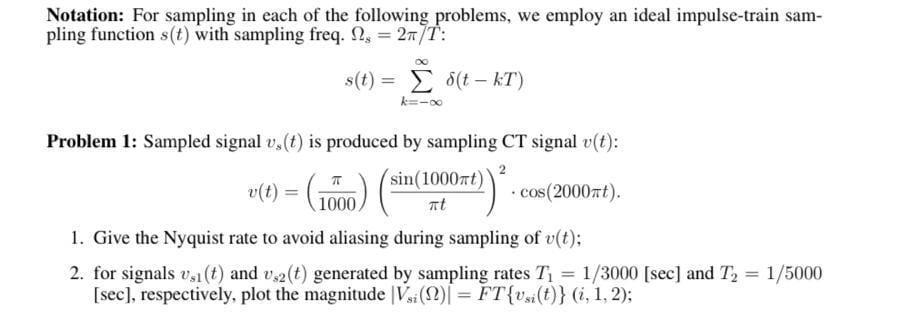
Notation: For sampling in each of the following problems, we employ an ideal impulse-train sam- pling function s(t) with sampling freq. 2. = 27/T: s(t) = (t - KT) k=- 2 Problem 1: Sampled signal v,(t) is produced by sampling CT signal v(t): TT sin(1000) v(t) = cos(2000nt). 1000 it 1. Give the Nyquist rate to avoid aliasing during sampling of v(t); 2. for signals vsi(t) and v.2(t) generated by sampling rates T= 1/3000 [sec] and T, [sec), respectively, plot the magnitude Vi(22) = FT{vsi(t)} (1,1,2); 1/5000 Notation: For sampling in each of the following problems, we employ an ideal impulse-train sam- pling function s(t) with sampling freq. 2. = 27/T: s(t) = (t - KT) k=- 2 Problem 1: Sampled signal v,(t) is produced by sampling CT signal v(t): TT sin(1000) v(t) = cos(2000nt). 1000 it 1. Give the Nyquist rate to avoid aliasing during sampling of v(t); 2. for signals vsi(t) and v.2(t) generated by sampling rates T= 1/3000 [sec] and T, [sec), respectively, plot the magnitude Vi(22) = FT{vsi(t)} (1,1,2); 1/5000
Step by Step Solution
There are 3 Steps involved in it

Get step-by-step solutions from verified subject matter experts
 Study Help