







Question: Notation: Here, f is a function, and a and L are real numbers. When we write lim f(x) = L we mean, For values

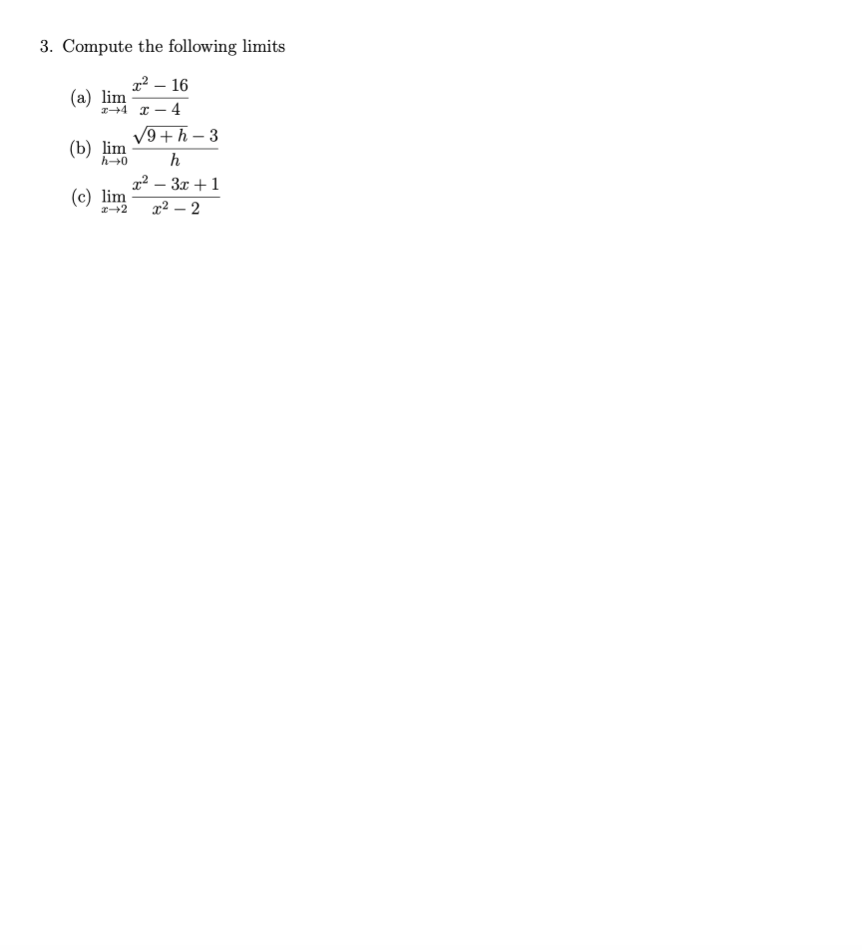
Notation: Here, f is a function, and a and L are real numbers. When we write lim f(x) = L we mean, "For values of x less than a, as the value of z gets closer to a, the value of f(x) gets closer to L." When we write lim f(x) = L we mean, "For values of a greater than a, as the value of x gets closer to a, the value of f(z) gets closer to L." z-a+ When we write lim f(x) = L we mean that both lim f(x) = L and lim f(x) = L. I-G z-ta+ In the case that lim f(z) # lim f(x), we say that lim f(x) does not exist. 2-0" z-g+ I-a 1. Use the graph of y = h(r) below to complete the table. Use DNE for "does not exist" where needed. lim h(x) lim h(x) lim h(x) h(a) Ha za+ Y 3 2 1 O y=h(r) 3 4 I a 0 1 2 3 4 5 1 2. List the a values from #1 for which lim h(x) = h(a). Using complete sentences, describe any differences you notice between how the graph looks at these a values compared to the others in the table. 3. Compute the following limits x - 16 (a) lim x4 x 4 (b) lim h0 (c) lim x2 9+h-3 h x-3x+1 x - 2
Step by Step Solution
There are 3 Steps involved in it

Get step-by-step solutions from verified subject matter experts
 Study Help