



Question: NOTE: All analytical solutions should be represented as fractions. Submissions should be in pdf form. Deviation from this instruction will lead to point deductions. 1.
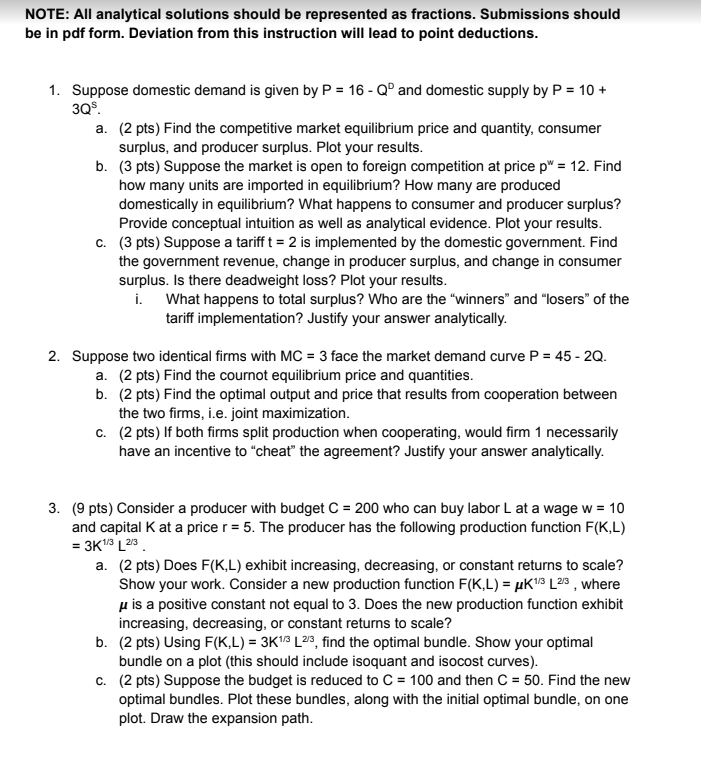
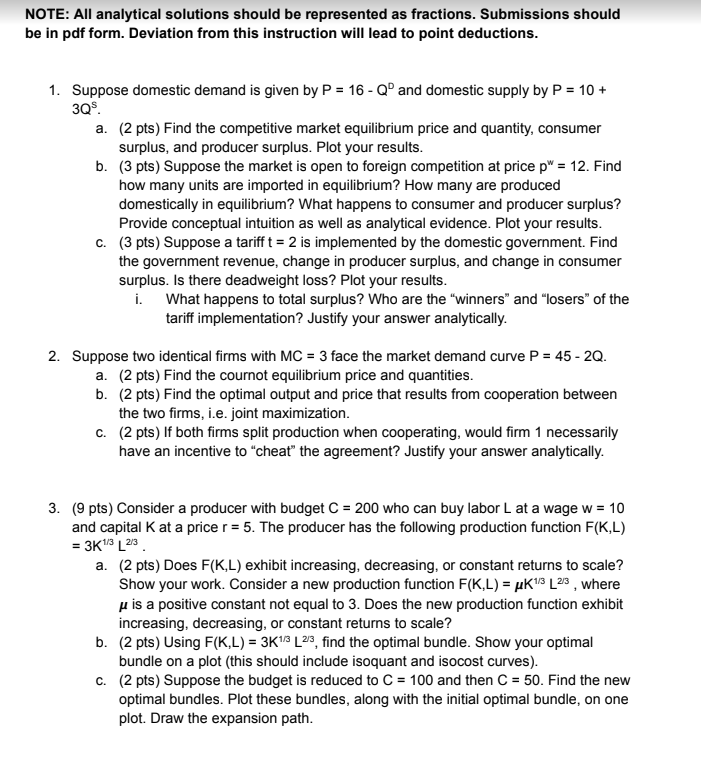
NOTE: All analytical solutions should be represented as fractions. Submissions should be in pdf form. Deviation from this instruction will lead to point deductions. 1. Suppose domestic demand is given by P = 16 - Q" and domestic supply by P = 10+ 3Qs. a. (2 pts) Find the competitive market equilibrium price and quantity, consumer surplus, and producer surplus. Plot your results. b. (3 pts) Suppose the market is open to foreign competition at price p" = 12. Find how many units are imported in equilibrium? How many are produced domestically in equilibrium? What happens to consumer and producer surplus? Provide conceptual intuition as well as analytical evidence. Plot your results. c. (3 pts) Suppose a tariff t = 2 is implemented by the domestic government. Find the government revenue, change in producer surplus, and change in consumer surplus. Is there deadweight loss? Plot your results. i. What happens to total surplus? Who are the "winners" and "losers" of the tariff implementation? Justify your answer analytically. 2. Suppose two identical firms with MC = 3 face the market demand curve P = 45 - 2Q. a. (2 pts) Find the cournot equilibrium price and quantities. b. (2 pts) Find the optimal output and price that results from cooperation between the two firms, i.e. joint maximization. c. (2 pts) If both firms split production when cooperating, would firm 1 necessarily have an incentive to "cheat" the agreement? Justify your answer analytically. 3. (9 pts) Consider a producer with budget C = 200 who can buy labor L at a wage w = 10 and capital K at a price r = 5. The producer has the following production function F(K,L) = 3K 1/3 L 2/3 a. (2 pts) Does F(K,L) exhibit increasing, decreasing, or constant returns to scale? Show your work. Consider a new production function F(K,L) = pK1/3 23 , where is a positive constant not equal to 3. Does the new production function exhibit increasing, decreasing, or constant returns to scale? b. (2 pts) Using F(K,L) = 3K1/5 L23, find the optimal bundle. Show your optimal bundle on a plot (this should include isoquant and isocost curves). c. (2 pts) Suppose the budget is reduced to C = 100 and then C = 50. Find the new optimal bundles. Plot these bundles, along with the initial optimal bundle, on one plot. Draw the expansion path
Step by Step Solution
There are 3 Steps involved in it

Get step-by-step solutions from verified subject matter experts