







Question: NOTE: All problem sets must be hand-written (not typed) to receive full credit. Typed answers will receive a zero. Round all answers that are decimals
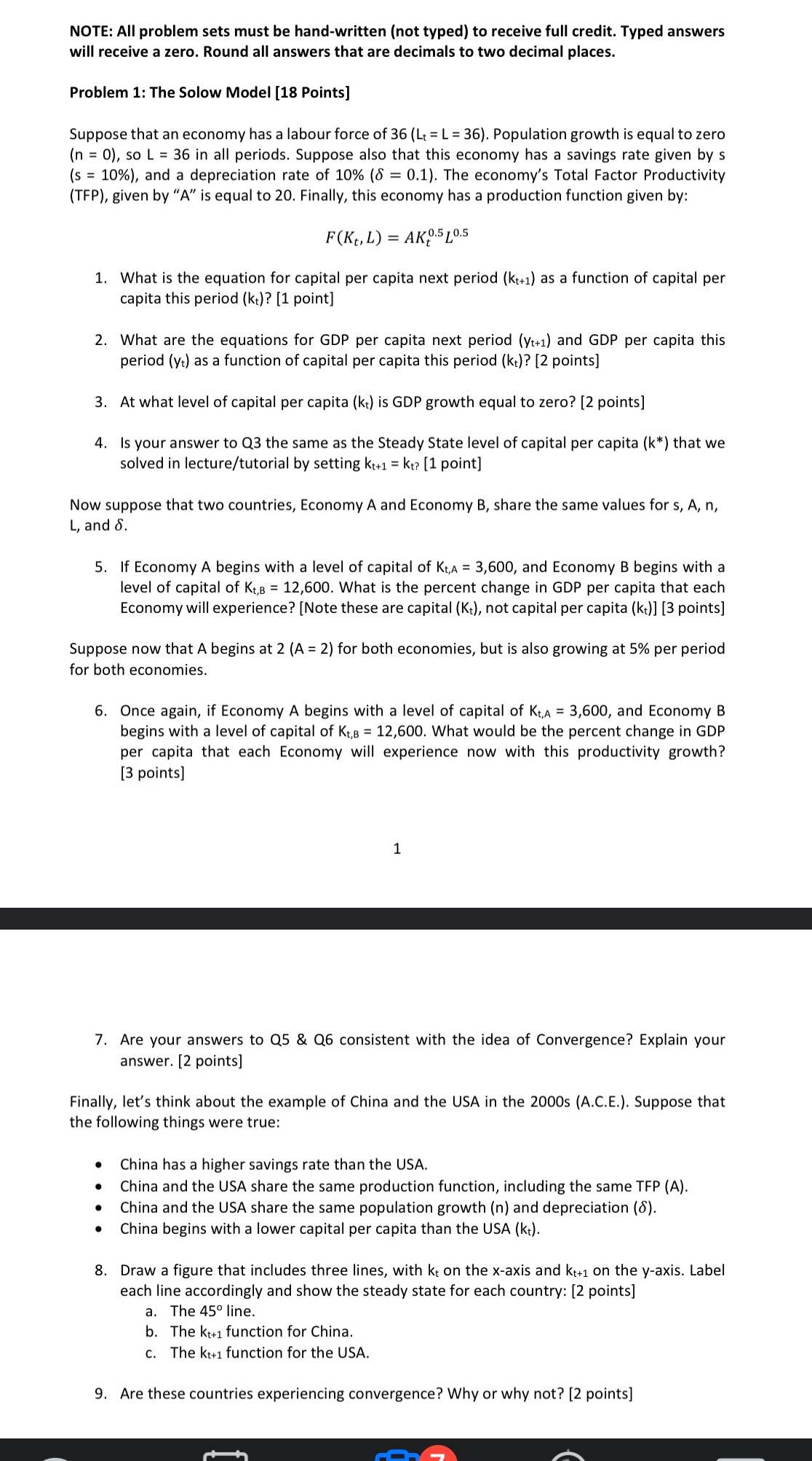
NOTE: All problem sets must be hand-written (not typed) to receive full credit. Typed answers will receive a zero. Round all answers that are decimals to two decimal places. Problem 1: The Solow Model [18 Points] Suppose that an economy has a labour force of 36 (Ly = L = 36). Population growth is equal to zero (n =0), soL =36in all periods. Suppose also that this economy has a savings rate given by s (s = 10%), and a depreciation rate of 10% (& = 0.1). The economy's Total Factor Productivity (TFP), given by \"A\" is equal to 20. Finally, this economy has a production function given by: F(K. L) = AKOSLOS 1. What is the equation for capital per capita next period (k:+1) as a function of capital per capita this period (k:)? [1 point] 2. What are the equations for GDP per capita next period (yw1) and GDP per capita this period (y:) as a function of capital per capita this period (k:)? [2 points] 3. At what level of capital per capita (k) is GDP growth equal to zero? [2 points] 4. |s your answer to Q3 the same as the Steady State level of capital per capita (k*) that we solved in lecture/tutorial by setting ki1 = ke [1 point] Now suppose that two countries, Economy A and Economy B, share the same values for s, A, n, L, and &. 5. If Economy A begins with a level of capital of Kia = 3,600, and Economy B begins with a level of capital of Kis = 12,600. What is the percent change in GDP per capita that each Economy will experience? [Note these are capital (K:), not capital per capita (ki)] [3 points] Suppose now that A begins at 2 (A = 2) for both economies, but is also growing at 5% per period for both economies. 6. Once again, if Economy A begins with a level of capital of K;a = 3,600, and Economy B begins with a level of capital of Kis = 12,600. What would be the percent change in GDP per capita that each Economy will experience now with this productivity growth? [3 points] 7. Are your answers to Q5 & Q6 consistent with the idea of Convergence? Explain your answer. [2 points] Finally, let's think about the example of China and the USA in the 2000s (A.C.E.). Suppose that the following things were true: * China has a higher savings rate than the USA. e China and the USA share the same production function, including the same TFP (A). China and the USA share the same population growth (n) and depreciation (8). e China begins with a lower capital per capita than the USA (k). 8. Draw a figure that includes three lines, with ki on the x-axis and ki1 on the y-axis. Label each line accordingly and show the steady state for each country: [2 points] a. The 45 line. b. The ks function for China. c. The kw1 function for the USA. 9. Are these countries experiencing convergence? Why or why not? [2 points]
Step by Step Solution
There are 3 Steps involved in it

Get step-by-step solutions from verified subject matter experts
 Study Help