







Question: Note: All problems in this problem set consider the efficient extraction of a non-renewable (depletable) resource over N- periods using the two-figure model developed in
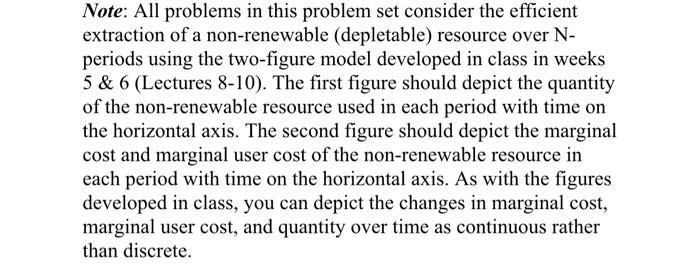
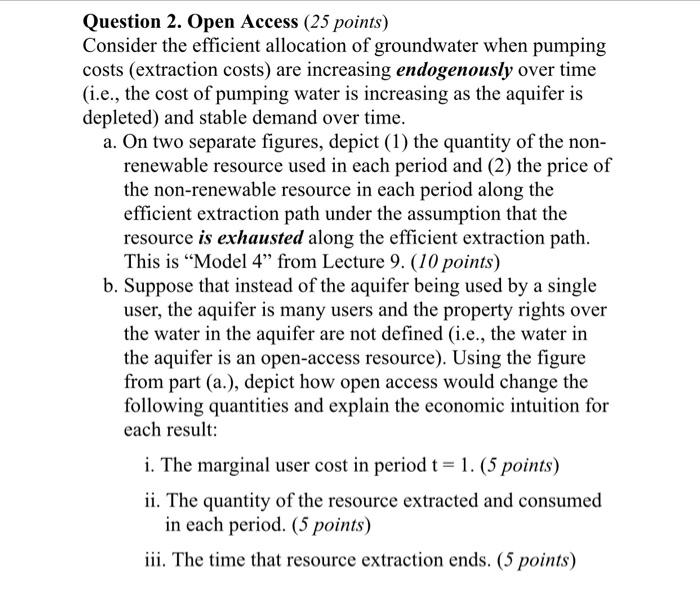
Note: All problems in this problem set consider the efficient extraction of a non-renewable (depletable) resource over N- periods using the two-figure model developed in class in weeks 5 & 6 (Lectures 8-10). The first figure should depict the quantity of the non-renewable resource used in each period with time on the horizontal axis. The second figure should depict the marginal cost and marginal user cost of the non-renewable resource in each period with time on the horizontal axis. As with the figures developed in class, you can depict the changes in marginal cost, marginal user cost, and quantity over time as continuous rather than discrete Question 2. Open Access (25 points) Consider the efficient allocation of groundwater when pumping costs (extraction costs) are increasing endogenously over time (i.e., the cost of pumping water is increasing as the aquifer is depleted) and stable demand over time. a. On two separate figures, depict (1) the quantity of the non- renewable resource used in each period and (2) the price of the non-renewable resource in each period along the efficient extraction path under the assumption that the resource is exhausted along the efficient extraction path. This is "Model 4" from Lecture 9. (10 points) b. Suppose that instead of the aquifer being used by a single user, the aquifer is many users and the property rights over the water in the aquifer are not defined (i.e., the water in the aquifer is an open-access resource). Using the figure from part (a.), depict how open access would change the following quantities and explain the economic intuition for each result: i. The marginal user cost in period t = 1. (5 points) ii. The quantity of the resource extracted and consumed in each period. (5 points) iii. The time that resource extraction ends. (5 points) Note: All problems in this problem set consider the efficient extraction of a non-renewable (depletable) resource over N- periods using the two-figure model developed in class in weeks 5 & 6 (Lectures 8-10). The first figure should depict the quantity of the non-renewable resource used in each period with time on the horizontal axis. The second figure should depict the marginal cost and marginal user cost of the non-renewable resource in each period with time on the horizontal axis. As with the figures developed in class, you can depict the changes in marginal cost, marginal user cost, and quantity over time as continuous rather than discrete Question 2. Open Access (25 points) Consider the efficient allocation of groundwater when pumping costs (extraction costs) are increasing endogenously over time (i.e., the cost of pumping water is increasing as the aquifer is depleted) and stable demand over time. a. On two separate figures, depict (1) the quantity of the non- renewable resource used in each period and (2) the price of the non-renewable resource in each period along the efficient extraction path under the assumption that the resource is exhausted along the efficient extraction path. This is "Model 4" from Lecture 9. (10 points) b. Suppose that instead of the aquifer being used by a single user, the aquifer is many users and the property rights over the water in the aquifer are not defined (i.e., the water in the aquifer is an open-access resource). Using the figure from part (a.), depict how open access would change the following quantities and explain the economic intuition for each result: i. The marginal user cost in period t = 1. (5 points) ii. The quantity of the resource extracted and consumed in each period. (5 points) iii. The time that resource extraction ends. (5 points)
Step by Step Solution
There are 3 Steps involved in it

Get step-by-step solutions from verified subject matter experts
 Study Help