Question: Note Chapter 4 Question 2 Students will research REI website and answer the four tests of competitive power Question 3 Research Boll and Branch's website
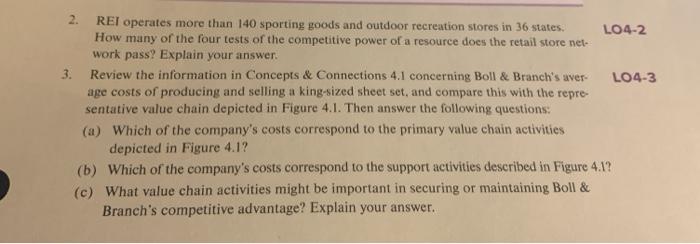
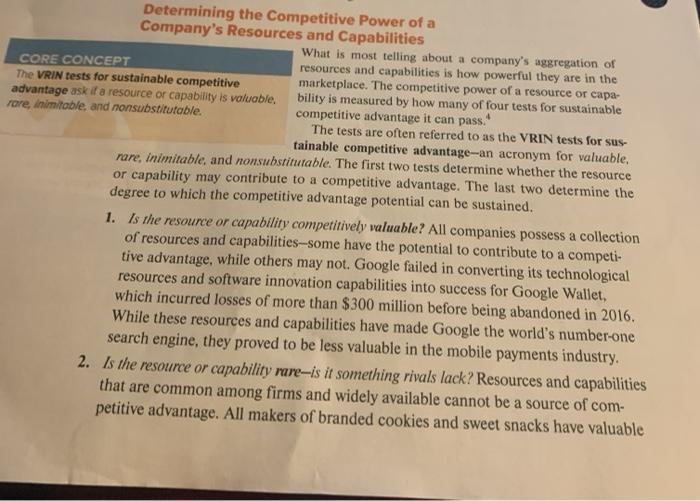
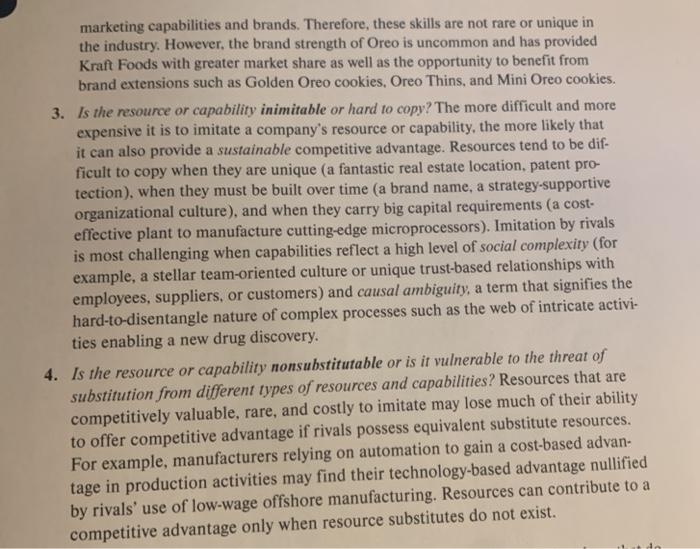
Note Chapter 4 Question 2 Students will research REI website and answer the four tests of competitive power Question 3 Research Boll and Branch's website and the information provided the textbook (Chapter 3) Concepts & Connections 4.1 (page 74) and answer four questions (pages 68/69) regarding the companies value chain activities ASSIGNMENTSUBMISSION 2. REI operates more than 140 sporting goods and outdoor recreation stores in 36 states. LO4-2 How many of the four tests of the competitive power of a resource does the retail store net- work pass? Explain your answer. 3. Review the information in Concepts & Connections 4.1 concerning Boll & Branch's aver LO4-3 age costs of producing and selling a king-sized sheet set, and compare this with the repre sentative value chain depicted in Figure 4.1. Then answer the following questions: (a) Which of the company's costs correspond to the primary value chain activities depicted in Figure 4.1? (b) Which of the company's costs correspond to the support activities described in Figure 4.1? (c) What value chain activities might be important in securing or maintaining Boll & Branch's competitive advantage? Explain your answer. Determining the Competitive Power of a Company's Resources and Capabilities What is most telling about a company's aggregation of CORE CONCEPT resources and capabilities is how powerful they are in the The VRIN tests for sustainable competitive marketplace. The competitive power of a resource or capa advantage ask it a resource or capability is valuable bility is measured by how many of four tests for sustainable rore, inimitable and nonsubstitutable. competitive advantage it can pass. The tests are often referred to as the VRIN tests for sus- tainable competitive advantage-an acronym for valuable. rare, inimitable, and nonsubstitutable. The first two tests determine whether the resource or capability may contribute to a competitive advantage. The last two determine the degree to which the competitive advantage potential can be sustained. 1. Is the resource or capability competitively valuable? All companies possess a collection of resources and capabilities-some have the potential to contribute to a competi- tive advantage, while others may not. Google failed in converting its technological resources and software innovation capabilities into success for Google Wallet, which incurred losses of more than $300 million before being abandoned in 2016, While these resources and capabilities have made Google the world's number one search engine, they proved to be less valuable in the mobile payments industry. 2. Is the resource or capability rare-is it something rivals lack? Resources and capabilities that are common among firms and widely available cannot be a source of com- petitive advantage. All makers of branded cookies and sweet snacks have valuable marketing capabilities and brands. Therefore, these skills are not rare or unique in the industry. However, the brand strength of Oreo is uncommon and has provided Kraft Foods with greater market share as well as the opportunity to benefit from brand extensions such as Golden Oreo cookies, Oreo Thins, and Mini Oreo cookies. 3. Is the resource or capability inimitable or hard to copy? The more difficult and more expensive it is to imitate a company's resource or capability, the more likely that it can also provide a sustainable competitive advantage. Resources tend to be dif- ficult to copy when they are unique (a fantastic real estate location, patent pro- tection), when they must be built over time (a brand name, a strategy-supportive organizational culture), and when they carry big capital requirements (a cost- effective plant to manufacture cutting-edge microprocessors). Imitation by rivals is most challenging when capabilities reflect a high level of social complexity (for example, a stellar team-oriented culture or unique trust-based relationships with employees, suppliers, or customers) and causal ambiguity, a term that signifies the hard-to-disentangle nature of complex processes such as the web of intricate activi- ties enabling a new drug discovery. 4. Is the resource or capability nonsubstitutable or is it vulnerable to the threat of substitution from different types of resources and capabilities? Resources that are competitively valuable, rare, and costly to imitate may lose much of their ability to offer competitive advantage if rivals possess equivalent substitute resources. For example, manufacturers relying on automation to gain a cost-based advan- tage in production activities may find their technology-based advantage nullified by rivals' use of low-wage offshore manufacturing. Resources can contribute to a competitive advantage only when resource substitutes do not exist. Note Chapter 4 Question 2 Students will research REI website and answer the four tests of competitive power Question 3 Research Boll and Branch's website and the information provided the textbook (Chapter 3) Concepts & Connections 4.1 (page 74) and answer four questions (pages 68/69) regarding the companies value chain activities ASSIGNMENTSUBMISSION 2. REI operates more than 140 sporting goods and outdoor recreation stores in 36 states. LO4-2 How many of the four tests of the competitive power of a resource does the retail store net- work pass? Explain your answer. 3. Review the information in Concepts & Connections 4.1 concerning Boll & Branch's aver LO4-3 age costs of producing and selling a king-sized sheet set, and compare this with the repre sentative value chain depicted in Figure 4.1. Then answer the following questions: (a) Which of the company's costs correspond to the primary value chain activities depicted in Figure 4.1? (b) Which of the company's costs correspond to the support activities described in Figure 4.1? (c) What value chain activities might be important in securing or maintaining Boll & Branch's competitive advantage? Explain your answer. Determining the Competitive Power of a Company's Resources and Capabilities What is most telling about a company's aggregation of CORE CONCEPT resources and capabilities is how powerful they are in the The VRIN tests for sustainable competitive marketplace. The competitive power of a resource or capa advantage ask it a resource or capability is valuable bility is measured by how many of four tests for sustainable rore, inimitable and nonsubstitutable. competitive advantage it can pass. The tests are often referred to as the VRIN tests for sus- tainable competitive advantage-an acronym for valuable. rare, inimitable, and nonsubstitutable. The first two tests determine whether the resource or capability may contribute to a competitive advantage. The last two determine the degree to which the competitive advantage potential can be sustained. 1. Is the resource or capability competitively valuable? All companies possess a collection of resources and capabilities-some have the potential to contribute to a competi- tive advantage, while others may not. Google failed in converting its technological resources and software innovation capabilities into success for Google Wallet, which incurred losses of more than $300 million before being abandoned in 2016, While these resources and capabilities have made Google the world's number one search engine, they proved to be less valuable in the mobile payments industry. 2. Is the resource or capability rare-is it something rivals lack? Resources and capabilities that are common among firms and widely available cannot be a source of com- petitive advantage. All makers of branded cookies and sweet snacks have valuable marketing capabilities and brands. Therefore, these skills are not rare or unique in the industry. However, the brand strength of Oreo is uncommon and has provided Kraft Foods with greater market share as well as the opportunity to benefit from brand extensions such as Golden Oreo cookies, Oreo Thins, and Mini Oreo cookies. 3. Is the resource or capability inimitable or hard to copy? The more difficult and more expensive it is to imitate a company's resource or capability, the more likely that it can also provide a sustainable competitive advantage. Resources tend to be dif- ficult to copy when they are unique (a fantastic real estate location, patent pro- tection), when they must be built over time (a brand name, a strategy-supportive organizational culture), and when they carry big capital requirements (a cost- effective plant to manufacture cutting-edge microprocessors). Imitation by rivals is most challenging when capabilities reflect a high level of social complexity (for example, a stellar team-oriented culture or unique trust-based relationships with employees, suppliers, or customers) and causal ambiguity, a term that signifies the hard-to-disentangle nature of complex processes such as the web of intricate activi- ties enabling a new drug discovery. 4. Is the resource or capability nonsubstitutable or is it vulnerable to the threat of substitution from different types of resources and capabilities? Resources that are competitively valuable, rare, and costly to imitate may lose much of their ability to offer competitive advantage if rivals possess equivalent substitute resources. For example, manufacturers relying on automation to gain a cost-based advan- tage in production activities may find their technology-based advantage nullified by rivals' use of low-wage offshore manufacturing. Resources can contribute to a competitive advantage only when resource substitutes do not exist










 Study Help