







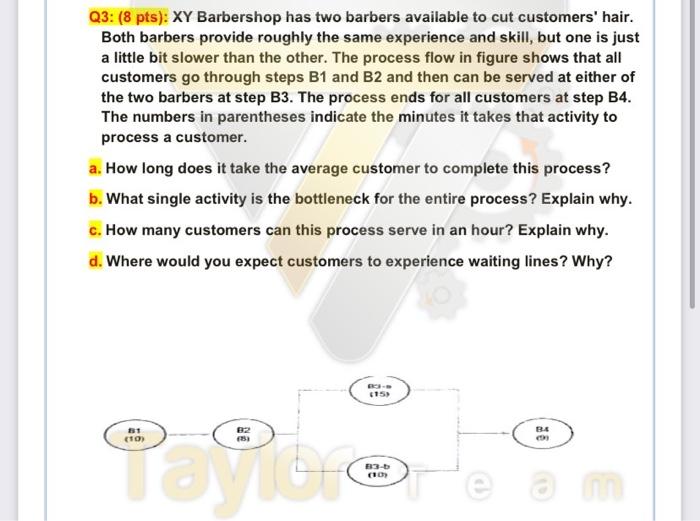
Question: note: i dont want to answer the question below i want you to explain only my questions i will ask now... b1=10 62=8 b3-a=15 b3-b=10
note: i dont want to answer the question below i want you to explain only my questions i will ask now...
b1=10
62=8
b3-a=15
b3-b=10
b4=9
i want to ask... now in question a...when i want to
calculate the time needed.. i should take the
longest way?
i mean 10 + 8 +15 + 9=42
or i need to take the average in b3 then calculate
them
10+8 +(15+10)/2 +9 = 39.5
or calculate the lower and upper bound...the is upper i calculate it up
the lower i will take the lowest time in b3
SO
10+8+10+9=37
then take the average from upper and lower bound
(37+42\/2 =39.5 or what exactly??
other question.about the bottle neck and waiting
time..if i assume that b1 which is the first step or
process is the lowest capacitance which is the
highest step or process takes time i can say that it's
the bottle neck and the waiting time is on it?
because the first process isn't from the original
processes it's actually the process that from it the customers come on to the other processes b2,b3-a....
i say assume that b1 (first process or step) is the
highest time needed in all processes and for sure it will be the lowest capacitancecan i answer that it is the actually bottle neck and the waiting time will be in it?
or he should give me more informations about
what is before b1 so i can say if there is waiting
time on it or no.
if you don't understand my question i want you to see question b and d and assume b1 is the highest process takes time which is the lowest
capacitance and answer me.
for the question the maximum customers per
hour depends on the bottleneck capacitance
right?
thanks you.please answer carefully i have an exam,and i want right answers
Step by Step Solution
There are 3 Steps involved in it
1 Expert Approved Answer
Step: 1 Unlock

Question Has Been Solved by an Expert!
Get step-by-step solutions from verified subject matter experts
Step: 2 Unlock
Step: 3 Unlock
 Study Help