







Question: NOTE: In Python 4. (Higher Order Function) execute(funDict, fun, args) 20% Write a function execute(funDict, fun, args) that takes a dictionary (funDict), a function name
NOTE: In Python
4. (Higher Order Function) execute(funDict, fun, args) 20% Write a function execute(funDict, fun, args) that takes a dictionary (funDict), a function name (fun), and the list of arguments that will be passed to the function fun. In funDict, the keys are the function names and values are the functions themselves. execute calls the function fun with the provided arguments in args and returns whatever fun returns. (You may assume that the functions in funDict has at most 3 arguments) Example: funDict = {"add": lambda x,y: (x+y), "concat3": lambda a,b,c: (a+","+b+","+c),"mod2": lambda n: (n % 2)} execute(funDict, "concat3", ["one","two","three"] returns one,two,three execute(funDict, "mod2", [40]) returns 0 You can start with the following code: def execute(funDict, fun, args): #write your code here pass def testexecute(): #write your code here; see the sample test function on page#4 pass
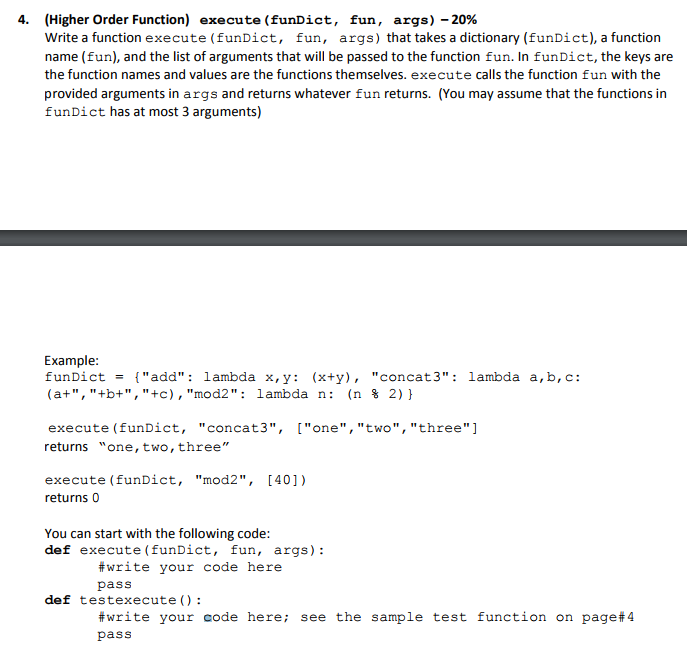
(Higher Order Function) Write a function execute (funDict, fun, args) that takes a dictionary (funDict), a function name (fun), and the list of arguments that will be passed to the function fun. In funDict, the keys are the function names and values are the functions themselves. execute calls the function fun with the provided arguments in args and returns whatever fun returns. (You may assume that the functions in funDict has at most 3 arguments) 4. execute (funDict, fun , args)-20% Example: EunDict-"add": lambda x,y: (xty, "concat3": lambda (a+","+b+","+c), "mod2 ": lambda n: (n % 2) } a,b,c ["one", "two", "three"] execute (funDict, "concat3", returns ''one, two, three " execute (funDict, "mod2", [40]) returns 0 You can start with the following code: def execute (funDict, fun, args): #write your code here pass def testexecute): #write your code here: see the sample test function on page #4 pass (Higher Order Function) Write a function execute (funDict, fun, args) that takes a dictionary (funDict), a function name (fun), and the list of arguments that will be passed to the function fun. In funDict, the keys are the function names and values are the functions themselves. execute calls the function fun with the provided arguments in args and returns whatever fun returns. (You may assume that the functions in funDict has at most 3 arguments) 4. execute (funDict, fun , args)-20% Example: EunDict-"add": lambda x,y: (xty, "concat3": lambda (a+","+b+","+c), "mod2 ": lambda n: (n % 2) } a,b,c ["one", "two", "three"] execute (funDict, "concat3", returns ''one, two, three " execute (funDict, "mod2", [40]) returns 0 You can start with the following code: def execute (funDict, fun, args): #write your code here pass def testexecute): #write your code here: see the sample test function on page #4 pass
Step by Step Solution
There are 3 Steps involved in it

Get step-by-step solutions from verified subject matter experts
 Study Help