







Question: NOTE: include a copy of your equations and equations/code with your plots 1. (50 points) A non-afterburning turbojet is being designed for operation at
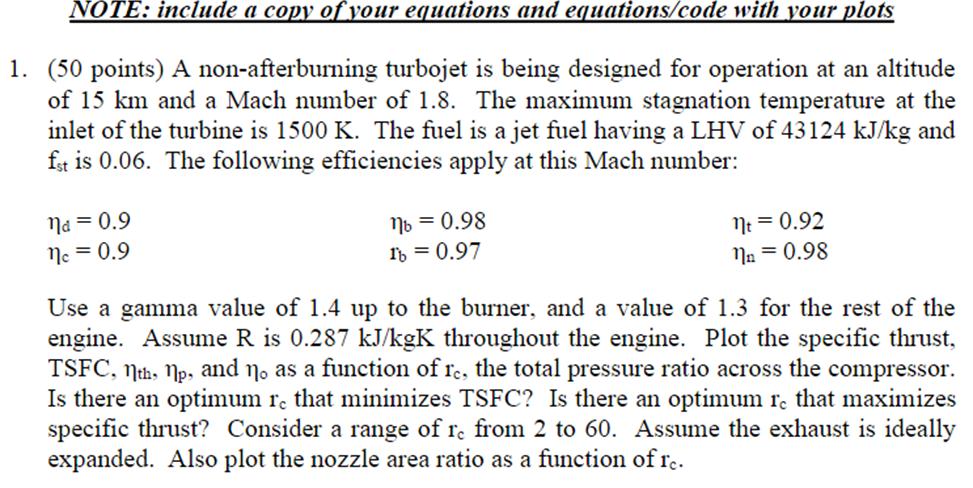
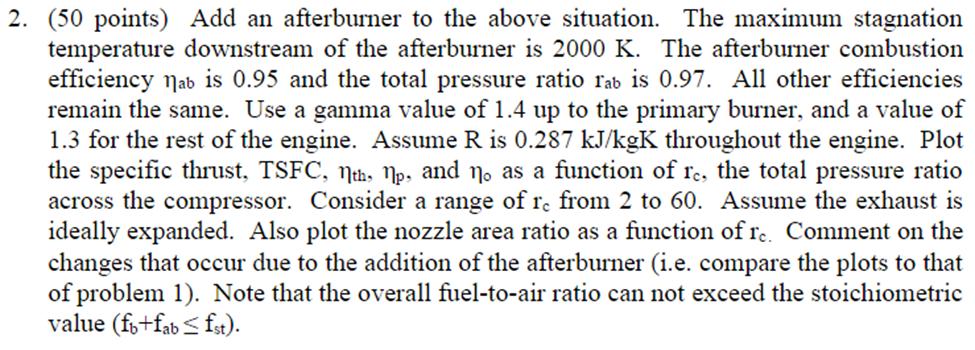
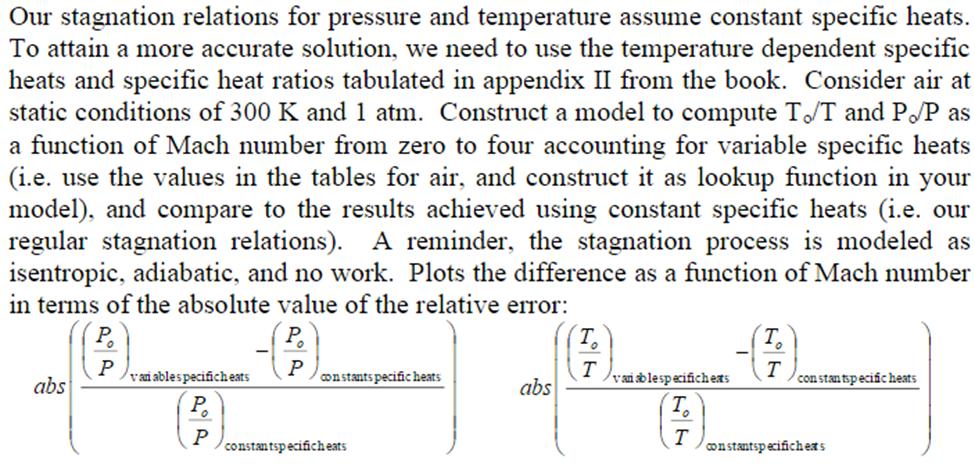
NOTE: include a copy of your equations and equations/code with your plots 1. (50 points) A non-afterburning turbojet is being designed for operation at an altitude of 15 km and a Mach number of 1.8. The maximum stagnation temperature at the inlet of the turbine is 1500 K. The fuel is a jet fuel having a LHV of 43124 kJ/kg and fst is 0.06. The following efficiencies apply at this Mach number: na = 0.9 nc = 0.9 1b = 0.98 1b = 0.97 nt = 0.92 1 = 0.98 Use a gamma value of 1.4 up to the burner, and a value of 1.3 for the rest of the engine. Assume R is 0.287 kJ/kgK throughout the engine. Plot the specific thrust, TSFC, nth, np, and no as a function of re, the total pressure ratio across the compressor. Is there an optimum re that minimizes TSFC? Is there an optimum re that maximizes specific thrust? Consider a range of re from 2 to 60. Assume the exhaust is ideally expanded. Also plot the nozzle area ratio as a function of re. 2. (50 points) Add an afterburner to the above situation. The maximum stagnation temperature downstream of the afterburner is 2000 K. The afterburner combustion efficiency mab is 0.95 and the total pressure ratio rab is 0.97. All other efficiencies remain the same. Use a gamma value of 1.4 up to the primary burner, and a value of 1.3 for the rest of the engine. Assume R is 0.287 kJ/kgK throughout the engine. Plot the specific thrust, TSFC, nth, np, and no as a function of re, the total pressure ratio across the compressor. Consider a range of re from 2 to 60. Assume the exhaust is ideally expanded. Also plot the nozzle area ratio as a function of re. Comment on the changes that occur due to the addition of the afterburner (i.e. compare the plots to that of problem 1). Note that the overall fuel-to-air ratio can not exceed the stoichiometric value (fb+fab fst). Our stagnation relations for pressure and temperature assume constant specific heats. To attain a more accurate solution, we need to use the temperature dependent specific heats and specific heat ratios tabulated in appendix II from the book. Consider air at static conditions of 300 K and 1 atm. Construct a model to compute T/T and P/P as a function of Mach number from zero to four accounting for variable specific heats (i.e. use the values in the tables for air, and construct it as lookup function in your model), and compare to the results achieved using constant specific heats (i.e. our regular stagnation relations). A reminder, the stagnation process is modeled as isentropic, adiabatic, and no work. Plots the difference as a function of Mach number in terms of the absolute value of the relative error: abs P van ablespecificheats P P P constantspecific heats constantspecificheats abs T vansblespecificheats T constantspecific heats constantspecifichents
Step by Step Solution
3.31 Rating (148 Votes )
There are 3 Steps involved in it
Salution A non afterburing turbojet is being designed is the nonafferbaty for 2 calculate ... View full answer

Get step-by-step solutions from verified subject matter experts
 Study Help