







Question: Note: Please don't use ChatGPT as it is already used in the question for reference 2. A mining engineer has been asked to assess if
Note: Please don't use ChatGPT as it is already used in the question for reference
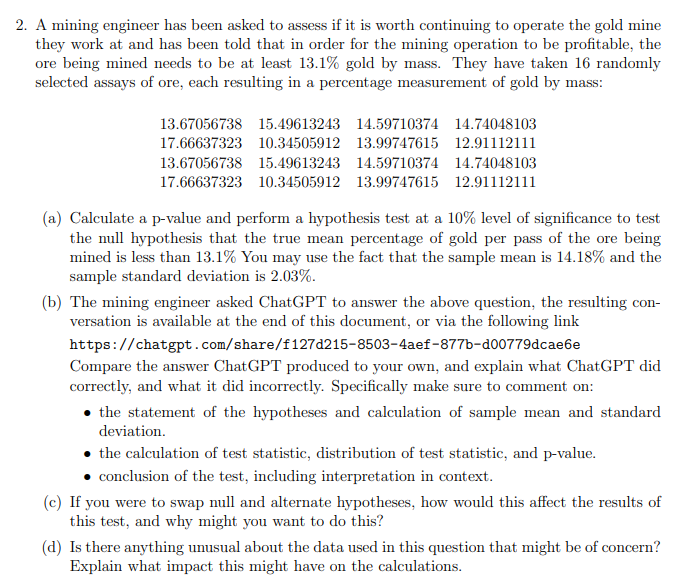
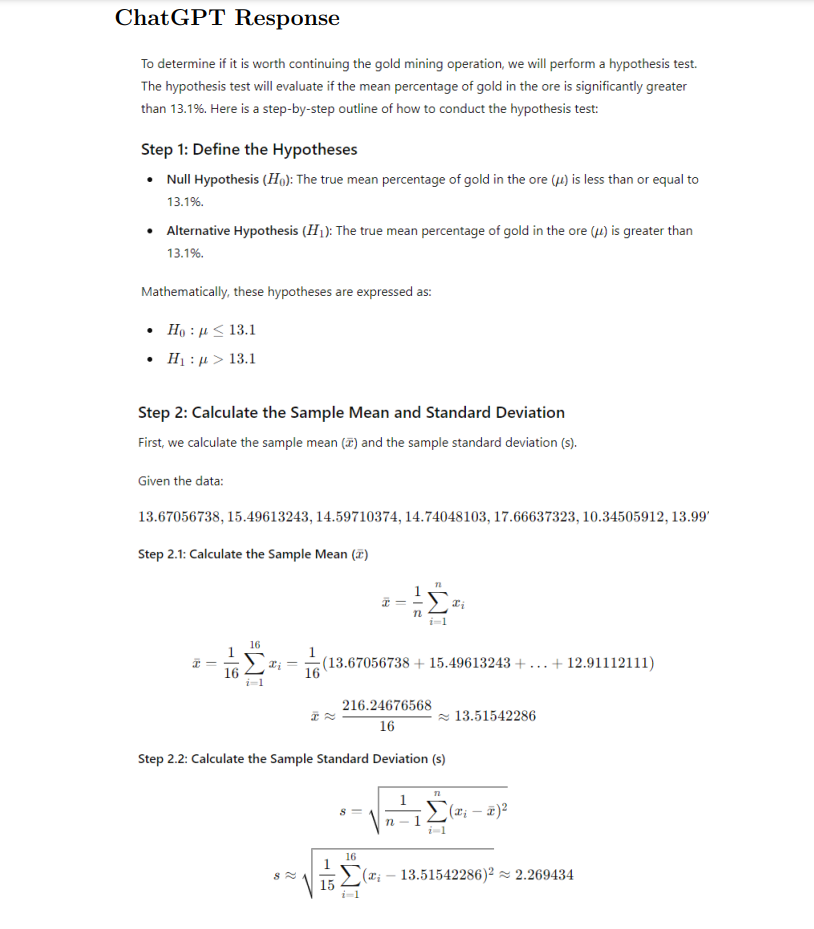
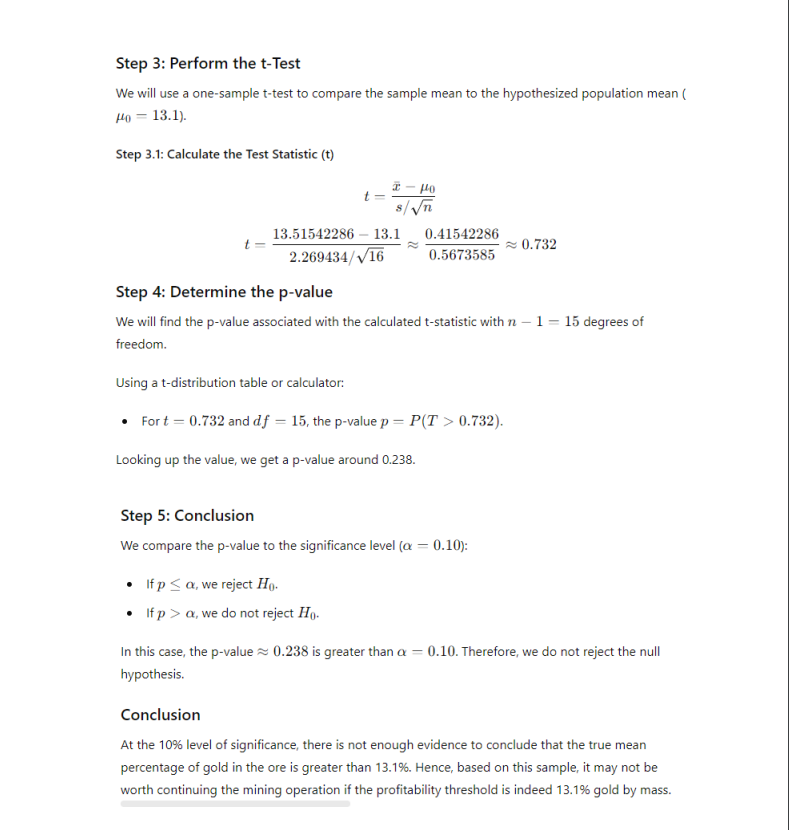
2. A mining engineer has been asked to assess if it is worth continuing to operate the gold mine they work at and has been told that in order for the mining operation to be profitable, the ore being mined needs to be at least 13.1% gold by mass. They have taken 16 randomly selected assavs of ore. each resulting in a percentage measurement of gold by mass: (a) () (d) 13.67066738 15.49613243 14.59710374 14.74048103 1766637323 10.34505912 13.99747615 12.91112111 13.67006738 15.49613243 14.59710374 14.74048103 1766637323 10.34505912 13.99747615 12.91112111 Calculate a p-value and perform a hypothesis test at a 10% level of significance to test the null hypothesis that the true mean percentage of gold per pass of the ore being mined is less than 13.1% You may use the fact that the sample mean is 14.18% and the sample standard deviation is 2.03%. The mining engineer asked ChatGPT to answer the above question, the resulting con- versation is available at the end of this document, or via the following link https://chatgpt.com/share/f127d215-8503-4aef-877b-d00779dcaebe Compare the answer ChatGPT produced to your own, and explain what ChatGPT did correctly, and what it did incorrectly. Specifically make sure to comment on: s the statement of the hypotheses and calculation of sample mean and standard deviation. s the calculation of test statistic, distribution of test statistic, and p-value. s conclusion of the test, including interpretation in context. It you were to swap null and alternate hypotheses, how would this affect the results of this test, and why might you want to do this? Is there anything unusual about the data used in this question that might be of concern? Explain what impact this might have on the calculations. ChatGPT Response To determine if it is worth continuing the gold mining operation, we will perform a hypothesis test. The hypothesis test will evaluate if the mean percentage of gold in the ore is significantly greater than 13.19%. Here is a step-by-step outline of how to conduct the hypothesis test: Step 1: Define the Hypotheses Null Hypothesis (Ho): The true mean percentage of gold in the ore () is less than or equal to 13.1%. Alternative Hypothesis (171): The true mean percentage of gold in the ore (/) is greater than 13.1%. Mathematically, these hypotheses are expressed as: . Ho : p 13.1 Step 2: Calculate the Sample Mean and Standard Deviation First, we calculate the sample mean () and the sample standard deviation (s). Given the data: 13.67056738, 15.49613243, 14.59710374, 14.74048103, 17.66637323, 10.34505912, 13.99' Step 2.1: Calculate the Sample Mean (I) i = 162 (13.67056738 + 15.49613243 + . .. + 12.91112111) 216.24676568 13.51542286 16 Step 2.2: Calculate the Sample Standard Deviation (s) (x; - 13.51542286)2 ~ 2.269434Step 3: Perform the t-Test We will use a one-sample t-test to compare the sample mean to the hypothesized population mean ( o 13.1). Step 3.1: Calculate the Test Statistic (t) _ T~ s/y i 13.51542286 13.1 - 0.41542286 2.969434/4/16 0.5673585 = (.732 Step 4: Determine the p-value We will find the p-value associated with the calculated t-statistic with n 1 15 degrees of freedom. Using a t-distribution table or calculator: Fort =0.732 and df = 15, the p-value p = P(T = 0.732). Looking up the value, we get a p-value around 0.238. Step 5: Conclusion We compare the p-value to the significance level (o 0.10): s Ifp o, we do not reject ). In this case, the p-value = (.238 is greater than ac (0.10. Therefare, we do not reject the null hypothesis. Conclusion At the 10% level of significance, there is not enough evidence to conclude that the true mean percentage of gold in the ore is greater than 13.1%. Hence, based on this sample, it may not be worth continuing the mining operation if the profitability threshold is indeed 13.1% gold by mass
Step by Step Solution
There are 3 Steps involved in it

Get step-by-step solutions from verified subject matter experts
 Study Help