







Question: Note: Please show all intermediate steps leading to the answer. For each of the twelve statements in the end below, determine whether it is universally
Note: Please show all intermediate steps leading to the answer.
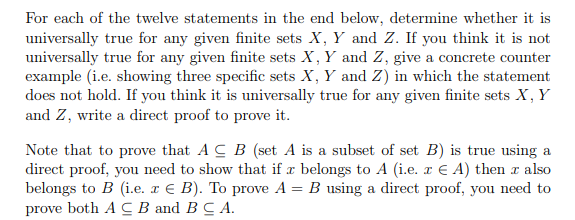
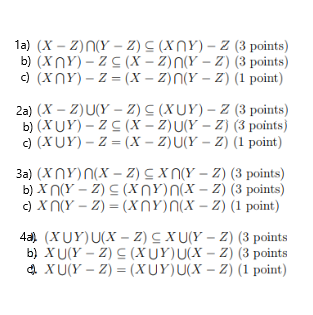
For each of the twelve statements in the end below, determine whether it is universally true for any given finite sets X, Y and Z. If you think it is not universally true for any given finite sets X, Y and Z. give a concrete counter does not hold. If you think it is universally true for any given finite sets X, Y and Z, write a direct proof to prove it. Note that to prove that AC B (set A is a subset of set B) is true using a direct proof, you need to show that ifr belongs to A (ie. I A) then I also belongs to B (ie. I B). To prove A = B using a direct proof, you need to prove both A C B and BCA. 1a) (X-Z)n(Y-Z) (Xn Y)-Z (3 points) b) (XnY)-Z(X-2)n(Y-Z) (3 points) d (xnY)-Z- (X -z)n(Y - z) (1 point 2a) (X - Z)U(Y - Z) S (XUY)- Z (3 points) b) (xU)-ZS(-Z)U(Y- Z) (3 points) c) (X U Y)-Z = (X-Z)U(Y-Z) (1 point) b) XN(Y-Z) c (xn Yn(X-Z) (3 points) c) XN(Y-Z) = (Xn Y)n(X-Z) (1 point) 4a (XUY)U(X- z)SXUY- Z) (3 points b) XU(Y-Z) S (XUYU(- Z) (3 points d XU(Y-Z) = (XU Y) U(X-Z) (1 point)
Step by Step Solution
There are 3 Steps involved in it

Get step-by-step solutions from verified subject matter experts
 Study Help