Question: Note: Presentation must include the chapter and problem number, problem, and step-by-step solving of all the main abd sub-items. Problems an equal number of subassemblies

Note: Presentation must include the chapter and problem number, problem, and step-by-step solving of all the main abd sub-items.
Note: Presentation must include the chapter and
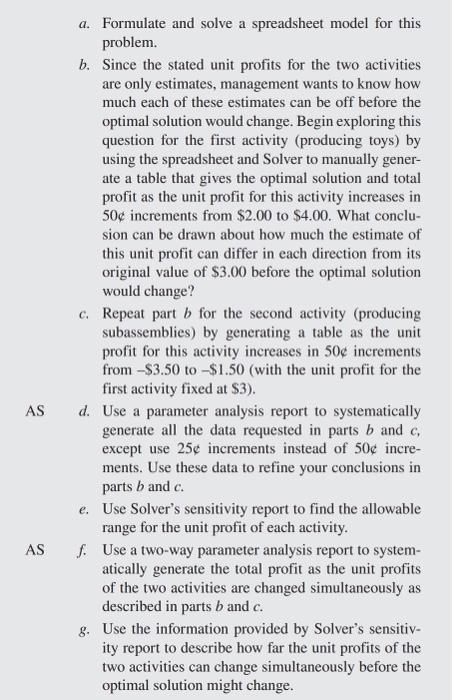
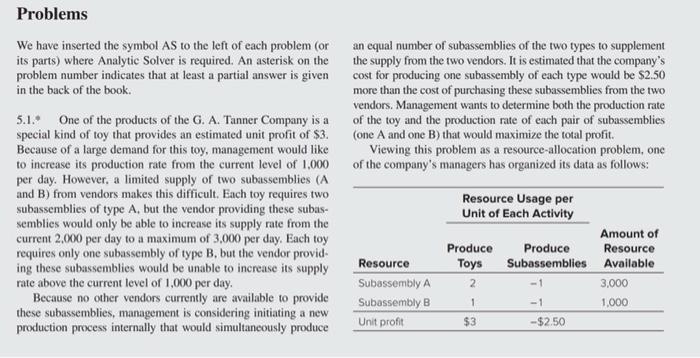
Problems an equal number of subassemblies of the two types to supplement the supply from the two vendors. It is estimated that the company's cost for producing one subassembly of each type would be $2.50 more than the cost of purchasing these subassemblies from the two vendors. Management wants to determine both the production rate of the toy and the production rate of each pair of subassemblies (one A and one B) that would maximize the total profit. Viewing this problem as a resource allocation problem, one of the company's managers has organized its data as follows: We have inserted the symbol AS to the left of each problem (or its parts) where Analytic Solver is required. An asterisk on the problem number indicates that at least a partial answer is given in the back of the book. 5.1. One of the products of the G. A. Tanner Company is a special kind of toy that provides an estimated unit profit of $3. Because of a large demand for this toy, management would like to increase its production rate from the current level of 1.000 per day. However, a limited supply of two subassemblies (A and B) from vendors makes this difficult. Each toy requires two subassemblies of type A, but the vendor providing these subas- semblies would only be able to increase its supply rate from the current 2.000 per day to a maximum of 3,000 per day. Each toy requires only one subassembly of type B, but the vendor provid- ing these subassemblies would be unable to increase its supply rate above the current level of 1,000 per day. Because no other vendors currently are available to provide these subassemblies, management is considering initiating a new production process internally that would simultaneously produce Resource Subassembly A Subassembly B Unit profit Resource Usage per Unit of Each Activity Amount of Produce Produce Resource Toys Subassemblies Available 2 3.000 1 1,000 $3 -$2.50 -1 a. Formulate and solve a spreadsheet model for this problem. b. Since the stated unit profits for the two activities are only estimates, management wants to know how much each of these estimates can be off before the optimal solution would change. Begin exploring this question for the first activity (producing toys) by using the spreadsheet and Solver to manually gener- ate a table that gives the optimal solution and total profit as the unit profit for this activity increases in 50 increments from $2.00 to $4.00. What conclu- sion can be drawn about how much the estimate of this unit profit can differ in each direction from its original value of $3.00 before the optimal solution would change? c. Repeat part b for the second activity (producing subassemblies) by generating a table as the unit profit for this activity increases in 50 increments from $3.50 to $1.50 (with the unit profit for the first activity fixed at $3). d. Use a parameter analysis report to systematically generate all the data requested in parts b and c, except use 25 increments instead of 50 incre- ments. Use these data to refine your conclusions in parts b and c. e. Use Solver's sensitivity report to find the allowable range for the unit profit of each activity. f. Use a two-way parameter analysis report to system- atically generate the total profit as the unit profits of the two activities are changed simultaneously as described in parts b and c. g. Use the information provided by Solver's sensitiv- ity report to describe how far the unit profits of the two activities can change simultaneously before the optimal solution might change. AS AS

Step by Step Solution

There are 3 Steps involved in it

1 Expert Approved Answer
Step: 1 Unlock blur-text-image

Question Has Been Solved by an Expert!

Get step-by-step solutions from verified subject matter experts

Step: 2 Unlock
Step: 3 Unlock

Students Have Also Explored These Related General Management Questions!