







Question: NOTE: Provide thorough derivations or explanations, and computer generated, fully annotated graphs for full credit ( continuing from Problem 3 of HW # 1 )
NOTE: Provide thorough derivations or explanations, and
computer generated, fully annotated graphs for full credit
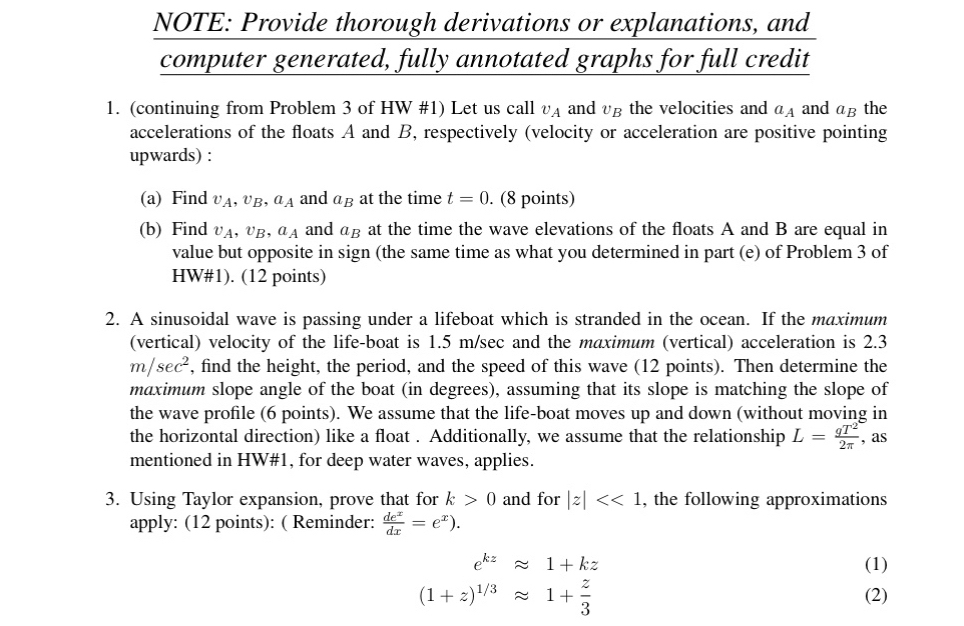
continuing from Problem of HW # Let us call and the velocities and and the
accelerations of the floats A and respectively velocity or acceleration are positive pointing
upwards :
a Find and at the time points
b Find and at the time the wave elevations of the floats A and B are equal in
value but opposite in sign the same time as what you determined in part e of Problem of
HW# points
A sinusoidal wave is passing under a lifeboat which is stranded in the ocean. If the maximum
vertical velocity of the lifeboat is and the maximum vertical acceleration is
find the height, the period, and the speed of this wave points Then determine the
maximum slope angle of the boat in degrees assuming that its slope is matching the slope of
the wave profile points We assume that the lifeboat moves up and down without moving in
the horizontal direction like a float. Additionally, we assume that the relationship as
mentioned in HW# for deep water waves, applies.
Using Taylor expansion, prove that for and for the following approximations
apply: points: Reminder:
~~
~~
Step by Step Solution
There are 3 Steps involved in it
1 Expert Approved Answer
Step: 1 Unlock

Question Has Been Solved by an Expert!
Get step-by-step solutions from verified subject matter experts
Step: 2 Unlock
Step: 3 Unlock
 Study Help